Portuñol , or portuñol ( Spanish: Portuñol , port. Portunhol , also known as Spanish fronterizo , port. Fronteiriço , literally “frontier” or misturado literal. “Mixed”) is a mixed spoken language on the borders of the ranges of closely related Spanish and Portuguese ( Latin America , especially northern Uruguay , Brazil , and also in Europe - in Portugal ).
| Portunol (portunol) | |
|---|---|
| Country | Uruguay , Brazil , Portugal |
| Total number of speakers | several millions |
| Classification | |
| Category | Mixed languages |
| Contact language based on Spanish and Portuguese | |
| Writing | Latin |
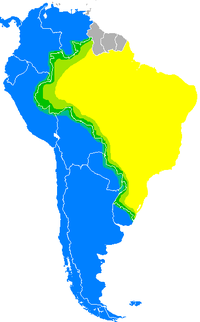
Yellow: Portuguese-speaking territories.
Green: portunol .

Content
General Information
Portuñol is a lingua franca , or a simplified mixture of two languages, which allows people who speak Spanish or Portuguese and do not speak another language to communicate with each other [1] .
If a carrier of one of the languages tries to speak another language, then often there are “interferences” from the native language, which causes the phenomenon of “ code switching ” [2] .
Since Portuguese and Spanish are close Romance languages , such dialogues can be conducted relatively freely. These languages have almost identical syntactic structures and a similar vocabulary, which means that when mixing one macro grammar arises [2] . For example, the phrase en el hueco de la noite longa e langue illustrates the switching of codes between the Spanish article la and the Portuguese noun noite [2] .
Language contact between Spanish and Portuguese is the result of prolonged contact between two languages in border regions and in multilingual trading conditions [2] . Such regions include border areas between Portugal and Spain in the Iberian Peninsula , as well as in areas between Portuguese-speaking Brazil and Spanish-speaking neighboring countries, such as Uruguay and Paraguay [3] . Since portunuol arises spontaneously as a result of the random mixing of Spanish and Portuguese, it is very diverse; [4] There is no single dialect or standard of portunol. However, as a rule, the presence of Spanish in Portohole is stronger [1] .
In recent years, portunuol began to appear not only in everyday speech, but also in other areas. He became a literary tool, especially in Uruguay and Brazil. Maria Jesus Fernandez Garcia describes it as a “linguistic break from a real language.” However, she says that literature only occasionally provides a true understanding of portuoliol, and that the authors often choose only some of the characteristic features of portuñola [4] . One of the most important literary works written in portugua is the Mar paraguayo of the Brazilian author Wilson Bueno. The following excerpt shows the mix of Spanish and Portuguese in this novel.
Usage Examples
| Portuguese | Portunol | Spanish |
|---|---|---|
| Hoje me vejo diante de seu olhar de morto, este homeméné ca me faz dançar castanholas na cama, me mei faz sofrer, me meiouxo, me mei dei de sangue, o sangue que de arteu minha vida amarga. Desde seus ombros, meu destino igual àquele feito de um punhal na chave direita do coração. 1 Agora neste momento, eu não sei o que falar com sua cara dura, roxos 2 os olhos soterrados, estes que eram meus olhos. | Hoy me vejo adelante de su olhar de muerto, este hombre que me hace dançar castanholas en la cama, qua me hace sofrir, me meyo, que me hr construído de dolor y sangre, la sangre que vertiô mi vida amarga. Desde sus ombros, mi destino igual quel hecho de uno punhal en la clave derecha del corazón. 1 Ahora en neste momento, yo no sê que hablar com su cara dura, rojos 2 los olhos soterrados, estos que eram mis ojos. [five] | Hay me veo de la ménée de sura mirada de muerto, este hombre me mexo, me mei sucerio, me mece, mehra construo de dolor y sangre, a la sangre que merio mi vida amarga. Desde sus hombros, mi destino igual aquél hecho de un puñal en la clave derecha del corazón. 1 Ahora en este momento, yo no sé qué hablar con su cara dura, rojos 2 los ojos soterrados, estos que eran mis ojos. |
Notes:
| ||
The appearance causes two different attitudes towards its existence: on the one hand, this is seen as the result of the laziness of people who do not want to learn another language; on the other hand, it is considered as a logical product of globalization [2] .
According to Francisco A. Marcos Marín, it is difficult to foresee the future of portunol, because it is difficult to identify which trends are permanent and which are not [1] .
See also
- Comparative analysis of Spanish and Portuguese
- Lunfardo
- Kokolich
- Papiamento
- Surzhik
Notes
- ↑ 1 2 3 Marcos Marín, Francisco. "De lenguas y fronteras: el espanglish y el portuñol." Nueva revista de política, cultura y arte 74 (2001): 70-79.
- ↑ 1 2 3 4 5 Lipski, John M. Too close for comfort? the genesis of portuhol / portunhol (English) // Selected Proceedings of the 8th Hispanic Linguistics Symposium: journal / Face, Timothy L; Klee, Carol A. .. - Somerville, MA: Cascadilla Proceedings Project, 2006. - P. 1—22 .
- ↑ Lewis, M. Paul, Gary F. Simons, and Charles D. Fennig (eds.), 2013. Ethnologue: Languages of the World, Seventeenth edition. Dallas, Texas: SIL International. Online version: http://www.ethnologue.com .
- ↑ 1 2 Fernández García, Mª Jesús. “Portuñol y literatura.” Revista de estudios extremeños 62.II (2006): 555-577.
- ↑ Bueno, Wilson. 1992. Mar paraguayo. São Paulo: Editora Iluminuras, pg. 15