
Laser pointer - a portable quantum-optical generator of coherent and monochromatic electromagnetic waves of the visible range in the form of a narrow beam. In most cases, it is made on the basis of a red laser diode , which emits in the range of 635–670 nm, and a collimator , a biconvex lens for organizing a narrow beam. A similar device has rarer blue and purple pointers, and so far (2016) even more rare green ones. Until the early to mid-2010s, green laser pointers had a complex structure and consisted of a solid-state laser pumped by an infrared laser diode and a subsequent nonlinear element to double the frequency.
The most common are red laser pointers with a power of up to 1-20 mW, pointers up to 100-200 mW are somewhat less common. The most powerful serial produced pointers: green up to 1W and blue - up to 5 watts, green up to 2 watts.
- Laser pointer

RGB laser pointer
 Play media file
RGB pointer demonstration
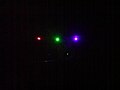
Laser dots

Laser ray


Content
- 1 Types of laser pointers
- 1.1 Red Laser Pointers
- 1.2 Orange Laser Pointers (593.5 nm)
- 1.3 Green laser pointers (510-530nm)
- 1.4 Green laser pointers using DPSS (532nm)
- 1.5 Blue laser pointers (473 nm)
- 1.6 Blue Laser Pointers (445 nm)
- 1.7 Purple Laser Pointers (405nm)
- 2 Using Laser Pointers
- 3 Security
- 4 See also
- 5 notes
- 6 Literature
- 7 References
Types of Laser Pointers
Early laser pointer models used helium-neon (HeNe) gas lasers and emitted in the 633 nm range. They had a capacity of not more than 1 mW and were very bulky and expensive. Now laser pointers, as a rule, use less expensive red diodes with a wavelength of 650-670 nm. Pointers use a little more expensive orange-red diodes with λ = 635 nm, which make them brighter for the eyes, since the human eye sees light with λ = 635 nm better than light with λ = 670 nm. Laser pointers of other colors are also produced; for example, a green pointer with λ = 532 nm is a good alternative to red with λ = 635 nm, since the human eye is approximately several times more sensitive to green light than red. Recently, yellow-orange pointers with λ = 593.5 nm and blue laser pointers with λ = 473 nm have appeared on sale.
Red Laser Pointers
The most common type of laser pointer. These pointers use laser diodes with a collimator. Power ranges from about one milliwatt to a watt. Low-power pointers in the trinket form factor are powered by small “tablet” batteries and as of April 2012 cost about $ 1–5. Powerful red pointers (wavelength 650-660 nm) with a capacity of several hundred milliwatts to a watt, capable of igniting materials that are highly absorbing radiation, cost about $ 50-500.
More rare red laser pointers use a diode -pumped solid-state laser (DPSS) and operate at a wavelength of 671 nm. They differ from the pointers on the laser diode by the round cross-section of the beam (in a conventional laser pointer, the beam is flattened due to the astigmatism of the cavity of the laser diode).
Orange Laser Pointers (593.5 nm)
Orange laser pointers use a diode-pumped solid-state laser that emits two lines simultaneously: 1064 nm and 1342 nm. This radiation enters a nonlinear crystal, which absorbs the photons of these two lines and emits 593.5 nm photons (the total energy of 1064 and 1342 nm of photons is equal to the photon energy of 593.5 nm). The efficiency of such orange lasers is about 1%.
Green Laser Pointers (510-530nm)
Green laser diodes ( Direct Green Laser Diodes based on InGaN), which appeared around 2010 [1] [2] [3], were initially very expensive for making pointers, but the situation is changing. By early 2017, many manufacturers prefer to manufacture laser diode pointers [ specify ] . The design of the pointer becomes much simpler, stabilization of the beam parameters, if important, is also simplified. A green laser can have a wavelength in the range of 510-530nm, which is near the maximum sensitivity of the twilight vision of the human eye. Therefore, in the dark, it seems brighter. There are no fundamental differences from a pointer with a red laser diode.
Green Laser Pointers Using DPSS (532nm)
Green laser pointers began selling in 2000. The most common type of solid-state diode-pumped (DPSS) lasers. Until recently, green laser diodes were not produced, so a complex optical scheme is used, which significantly complicates and increases the cost of products.
Often, cheap green DPSS laser pointers have an insufficiently high-quality system for filtering infrared laser radiation (it can be ten times more powerful than the declared power in green) and pose a health hazard [4] [5] .
First, a neodymium-doped yttrium doped yttrium orthovanadate crystal (Nd: YVO 4 ) is pumped by a powerful (usually 200-1000mW [6] ) infrared laser diode with λ = 808 nm, where the radiation is converted to 1064 nm. Then, passing through a crystal of potassium titanyl phosphate (KTiOPO 4 , abbreviated KTP), the radiation frequency doubles (1064 nm → 532 nm) and a visible green light is obtained. The generation and output of green radiation is provided by mirrors, one of which fully reflects radiation with a wavelength of 1064 and 532 nm and completely transmits 808 nm pump radiation, and the other fully reflects 1064 nm radiation, but completely transmits 532 nm. The pump radiation is also partially reflected.
In most modern green laser pointers, yttrium and KTP vanadate crystals together with resonator mirrors are combined into a so-called “microchip” - gluing of two crystals with mirrors sprayed on the edge. To generate laser radiation, it is sufficient to focus the radiation of the laser pump diode inside the Nd: YVO 4 crystal.
The efficiency of the circuit strongly depends on the pump power and can reach no more than 20%. In addition to green light, such a laser emits significant power in IR at wavelengths of 808 and 1064 nm, therefore, it is necessary to install an infrared filter (IR-filter [7] ) in such pointers to remove the remnants of infrared radiation and avoid damage to vision. In inexpensive versions of green pointers, such a filter may not be installed, in which case even a pointer with a power of 1-5 mW is a serious danger to eyesight, since the infrared radiation power can reach tens of milliwatts. The 1064 nm radiation is focused almost as well as the green one and is dangerous when it comes into the eye even at a great distance, while the 808 nm pump radiation is highly defocused and not concentrated along the beam, representing a danger at a distance of several meters.
It is worth noting the high power consumption of green lasers - the current consumption reaches hundreds of milliamps. Since the generation and doubling efficiency increases rapidly with increasing pump power, an increase in the output power from 5 to 100 mW requires an increase in the current consumption of only about two times.
The small size of the green laser pointer does not allow them to install a system for stabilizing the temperature of the laser diode and active media. The temperature has a particularly strong effect on the wavelength emitted by the laser diode, which leads to its departure from the maximum of the neodymium absorption line and a drop in the output power. This leads to the fact that such pointers are unstable when temperature changes. Partially this drawback is eliminated by stabilizing the radiation power at the laser output. To do this, a beam splitter is installed at the output (the role of which is played by an IR filter, from which part of the radiation is reflected) and a photodiode, and negative feedback is introduced. The disadvantage of this solution is the possibility of failure of the laser diode with a significant temperature deviation, at which the stabilization system, compensating for the drop in output power, is forced to significantly increase the current through it.
Blue Laser Pointers (473 nm)
These laser pointers appeared in 2006 and have a principle of operation similar to green laser pointers. 473 nm light is usually obtained by doubling the frequency of 946 nm laser radiation. To obtain 946 nm, a crystal of aluminum-yttrium garnet with the addition of neodymium ( Nd: YAG ) is used.
Blue Laser Pointers (445 nm)
In these laser pointers, light is emitted by a powerful blue laser diode of 1-5 watts. Most of these pointers belong to the 4th class of laser hazard and pose a very serious danger to the eyes and skin, both directly and in the form of radiation scattered by the surface.
Blue pointers were widely spread in connection with the serial production of high-power laser diodes, mainly for compact LED-projectors, for example, Casio Slim [8] .
Purple Laser Pointers (405nm)
The light in the violet pointers is generated by a laser diode emitting a beam with a wavelength of 405 nm. These lasers are used in Blu-ray Disc players . The wavelength of 405 nm is on the border of the range perceived by human vision and therefore the laser radiation of such pointers seems dim. However, the light of the pointer causes the fluorescence of some objects to which it is directed, the brightness of which for the eye is higher than the brightness of the laser itself. Even the smallest of them are extremely dangerous to the skin and eyes.
Purple laser pointers appeared immediately after the advent of Blu-ray drives, in connection with the start of mass production of laser diodes at 405 nm.
Using Laser Pointers
- Laser pointers are commonly used in educational institutions and business presentations instead of conventional pointers. There are built-in remote control projectors or computer remote control for presentations. Red laser pointers can be used indoors and in the evening in open spaces. Green laser pointers can be used under the same conditions, but they, unlike red ones, are clearly visible on the street during the day and at long distances. The only drawback of laser pointers when pointing to a target is the jerking of a point, since the human hand cannot remain stationary for a long time due to tremor .
- The light spot formed by the laser pointer attracts cats , dogs and other pets, causing a strong desire to catch it, which is often used by people in games with these pets. However, green laser pointers can scare the animal due to the significantly higher beam brightness. It should also not be forgotten that a laser pointer beam directed into the eyes of a person or animal can damage the retina .
- Green laser pointers can be used for amateur astronomy. On a moonless night, a green laser pointer beam can be used to indicate stars and constellations. Also, a laser pointer can be used to align telescopes and to study the shape of the surfaces of telescope mirrors (both by the shadow method and interferometric).
- A precisely-mounted laser pointer can be used as a laser pointer to aim a firearm or air gun.
- Laser pointers use hams in their designs, as an element of communication within sight.
- A red pointer with a collimator removed is used in amateur holography . This is one of the few applications of the laser in everyday life where it uses the most valuable property of the laser, which fundamentally distinguishes it from the LED - radiation coherence. Not all laser pointers have sufficient coherence, so it may be necessary to select the appropriate instance and select the current of the laser diode. Coherence can be estimated at home, for example, by observing interference using a plane-parallel glass plate 1-2 cm thick.
- In laboratory practice, a laser pointer (especially green) is a very useful tool that has many uses - in particular, it can be used to detect in a liquid, gas or any transparent substance (for example, optical glass) a small amount of mechanical impurities or suspensions invisible to unarmed to the eye. Green, and in particular, blue or violet pointers in combination with a suitable light filter that does not allow its radiation, can visually detect weak fluorescence, for example, associated with surface contamination with organic substances.
- A laser pointer, as a source of narrowly directed coherent light, can be used at school physics lessons to demonstrate visual experiments in optics: reflection and refraction of light, diffraction and interference, fluorescence (with a green or blue pointer), optical fibers, and the like.
Security
Laser radiation is hazardous in contact with eyes.
Conventional laser pointers have a power of 1-5 mW and belong to hazard class 2 - 3A and can be dangerous if you direct the beam into the human eye for a sufficiently long time or through optical instruments. Laser pointers with a power of 50-300 mW belong to class 3B and are capable of causing severe damage to the retina of the eye even with a short-term hit by a direct laser beam, as well as specularly or diffusely reflected. Even low-power green DPSS pointers use much more powerful IR lasers inside and often do not provide sufficient IR filtering. Such radiation is invisible and because of this is more dangerous for the vision of humans and animals [9] .
At best, laser pointers only have an annoying effect. But the consequences will be dangerous if the beam hits someone’s eye or is directed at the driver or pilot and can distract them or even blind them . In a number of countries this may entail criminal liability. So, in 2015, a resident of the USA was sentenced to imprisonment for 21 months for briefly blinding a pilot of a police helicopter with a laser pointer [10] . In 2017, a 22-year-old German resident was sentenced to one and a half years in prison for similar actions in Germany [11] .
More and more numerous "laser incidents" in Russia, Canada, the United States and the United Kingdom require the restriction or prohibition of laser pointers. Already now in New South Wales, a fine is imposed for possession of a laser pointer, and for a "laser attack" - a term of imprisonment of up to 14 years.
The use of laser pointers is prohibited by safety regulations at FIFA football stadiums [12] . One example of the application of this ban was a fine of 50,000 Swiss francs imposed on the Algerian Football Federation for the fans sending a laser pointer to goalkeeper of the Russian team Igor Akinfeev and other violations in the Algeria - Russia match at the 2014 World Cup [13] .
See also
- Laser designator
Notes
- ↑ True Green Laser Diodes at 524 nm with 50 mW Continuous Wave Output Power on c-Plane GaN , Adrian Avramescu (Osram), et al 2010 Appl. Phys. Express 3 061003
- ↑ 510–515 nm InGaN-Based Green Laser Diodes on c-Plane GaN Substrate - IOPscience
- ↑ 531 nm Green Lasing of InGaN Based Laser Diodes on Semi-Polar {2021} Free-Standing GaN Substrates - IOPscience
- ↑ The Danger Of Green Laser Pointers
- ↑ NIST Technical Note 1668 https://arxiv.org/abs/1008.1452
- ↑ Casix - Crystal, precision optics products, lenses and coatings (link not available) . Date of treatment January 30, 2013. Archived February 2, 2013.
- ↑ Usually it is a bluish glass plate measuring 3 × 3 × 1 mm.
- ↑ http://www.laserpointersafety.com/rules-general/lawsuggestions/lawsuggestions.html "it was not affordable by most persons. But Casio Green Slim projectors sell for around USD $ 800. Thus, the harvested diodes cost 800/24 or just $ 34 each "
- ↑ A Green Laser Pointer Hazard | Nist
- ↑ Farivar, Cyrus A three-second laser strike cost Barry Bowser everything . Ars Technica (December 20, 2016). Date of treatment May 12, 2017.
- ↑ http://rg-rb.de/index.php?option=com_rg&task=item&id=24050&Itemid=0
- ↑ FIFA Stadium Safety and Security Regulations - page 96, paragraph “g”
- ↑ Evans, Simon . Algeria zapped with FIFA fine over lasers , Reuters (July 1, 2014). Date of treatment July 2, 2014.
Literature
- Obukhov S. Laser pointer // Quantum: Journal. - 2000. - No. 3 . - S. 18-22 .
Links
- Laser Pointer Safety website Includes Safety Data
- A pocket laser beats a dangerous beam at 193 kilometers // Membrana, Leonid Popov, February 15, 2006