Unpaired silkworm , or unpaired [1] ( lat. Lymantria dispar ) - a butterfly from the family of Pox .
| Unmatched silkworm |
 |
| Scientific classification |
|---|
| No rank : | Bilateral symmetrical |
| Subtype : | Tracheo-breathing |
| Infraclass : | Winged insects |
| Treasure : | Fully Transformed Insects |
| Squadron : | Amphiesmenoptera |
| Infrastructure : | Butterflies |
| Treasure : | Double-breasted |
|
| International scientific name |
|---|
Lymantria dispar Linnaeus , 1758 |
| Synonyms |
|---|
- Phalaena dispar Linnaeus, 1758
|
|
Content
The distribution of gypsy moths in the United States by year
Unmatched silkworms are distributed throughout Europe , in Asia Minor , in Turkestan , in the Caucasus , throughout Siberia , in Japan and North America . This species is characterized by outbreaks of mass breeding, followed by eating of deciduous forests and gardens over large areas. Caterpillars consume foliage on almost all hardwoods, of which they especially like oak ( Quercus ) and linden ( Tilia ), but ash ( Fraxinus ) and alder ( Alnus ) do not touch, as well as a pear ( Pyrus ); with a lack of deciduous trees, they sometimes attack conifers and, destroying their seedlings in nurseries, bring noticeable harm. The Asian race of unpaired silkworms is classified in Russia as quarantine objects .
Previously, the story of the distribution of unpaired silkworms in North America was popular due to the carelessness of an amateur entomologist. It was believed that silkworm eggs were introduced to the United States in the late 1860s by amateur astronomer and amateur entomologist Etienne Leopold Truvelo for experiments on crossing this species with a silkworm ( Bombyx mori ). The experiments were carried out on a personal plot of Truvelot, but the larvae quickly spread to nearby forests. Truvelo turned to his colleagues to resolve the problem, but at that time no measures were taken. Only in 1889 in the United States unpaired silkworm was recognized as a pest. [2] It is currently believed that the number of escaped insects would not be enough to form an outbreak of the pest.
Unpaired silkworm - a polyphage, damages up to 300 species of plants, almost all deciduous species, some conifers, many types of shrubs. The preferred species are oak , birch , poplar , linden , willow , plum , apple tree . This is a typical forest pest. During the period of mass breeding, it strongly eats trees in large areas [3] .
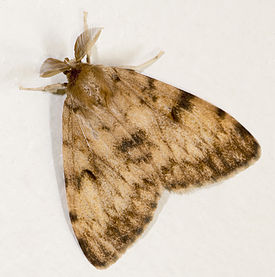
Male and female very sharply differ, both in form and color - hence the name. Female up to 9 cm wide; the front wings are yellowish or grayish-white, with dark brown transverse, serrated and wavy stripes, with a black crescent, or in the form of an angle, a spot at the middle and round small near the base; along the rim, between the veins, a series of rounded black spots, the abdomen is thick, with a brownish-gray fluff at the end; antennae and paws are black. Male up to 4 cm wide; antennae pinnate, brown; dark gray, with the same, but wider stripes and spots on the front wings, like a female. The egg is first yellow, then yellowish or pinkish-gray in color, smooth, round, slightly flattened on top, with a diameter of 1-1.2 mm. [3] Caterpillar up to 7 1/2 cm long, 16-legged, hairy, with three thin, sometimes hardly noticeable, longitudinal stripes on the back and with pair of warts, of which the front 5 pairs are blue and the rear 6 pairs are red; on each wart a bunch of hairs; on the 8th and 10th rings there are two orange, less noticeable glands; the head is dark gray, with two longitudinal, kidney-shaped, black spots. Pupa matte black or dark brown, with sparse tufts of short reddish hairs and with two pits behind the antennae.
Butterflies appear around mid or late summer; fly and mate in the evenings, not high above the ground.
Natural Enemies
Of insects, a beetle hunts for silkworm caterpillars - odorous beetle ( Calosoma sycophanta ). Of the hymenoptera on the caterpillars, the rider Ichneumon sarcitorius parasitizes . [four]
Ground beetle is golden . Introduced to North America [5] thanks to the work of the Washington Entomological Society. In North America, beetles settled in the southeastern United States and in the province of Quebec ( Canada ) [6] .
Females lay eggs in the recesses of the bark of trunks and stumps, in heaps of several hundred pieces. From above, females cover them with yellowish-gray hairs. Heaps of eggs sometimes cover with solid fluffy rings the base of tree trunks, but also come across on stones, buildings, etc. Eggs hibernate without losing their viability even after a 10-day stay under water.
Caterpillars hatch in early spring: they are covered by disproportionately long and numerous hairs. From June to mid-July, depending on the temperature regime, pupation occurs. Pupae not high from the ground in crevices of the bark, on the lower branches, sometimes between undernourished leaves pulled together by cobwebs. The pupal stage lasts 10-15 days.
- Unpaired silkworm // Brockhaus and Efron Encyclopedic Dictionary : in 86 volumes (82 volumes and 4 additional). - SPb. , 1890-1907.
- ↑ Striganova B.R. , Zakharov A.A. The Bilingual Dictionary of Animal Names: Insects (Latin-Russian-English-German-French) / . - M .: RUSSO, 2000 .-- S. 247. - 1060 copies. - ISBN 5-88721-162-8 .
- ↑ Gypsy Moth In North America Leopold Trouvelot, Perpetrator of our Problem
- ↑ 1 2 Unpaired silkworm, description. (unopened) (inaccessible link) . Date of treatment July 2, 2011. Archived March 4, 2016.
- ↑ BioLib Profil taxonu druh bekyně velkohlavá Lymantria dispar (Linnaeus, 1758) (Czech)
- ↑ Nelson, R. E. & Reynolds, R. A. Carabus auratus L. and Clivina fossor L. (Coleoptera: Carabidae): New Records of Two Introduced Taxa in the Northwest and Northeast USA . - Journal of the New York Entomological Society, 1987. - Vol. 95 (1) . - P. 10-13 . - ISSN 0028-7199 .
- ↑ Species Carabus auratus (English) . BugGuide.net. Date of treatment April 24, 2011. Archived on April 16, 2012.
