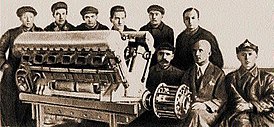
AM-34 ( M-34 ) is a Soviet water-cooled piston aircraft engine developed under the guidance of A. A. Mikulin .
| AM-34 M-34 | |
|---|---|
 | |
| Manufacturer | plant number 24 , Moscow |
| Years of production | 1932 - 1939 |
| Specifications | |
| Volume | 45.842 liters |
| Power | 552 kW (750 hp) at 1760 rpm |
| Compression ratio | 6.0 |
| Bore | 160 mm |
| Piston stroke | 190 mm |
| Number of cylinders | 12 |
| Fuel system | carburetor |
| Fuel type | leaded gasoline 2B-70, 3B-78 (93), 4B-74, B-95 (depending on mod. motor) |
| Cooling system | water |
| Dimensions | |
| Length | 2115 mm |
| Width | 860 mm |
| Height | 1170 mm |
| Dry weight | 608 kg |
Creation History
It was developed since 1928 in NAMI , where A. A. Mikulin was the chief designer for aircraft engines. In 1930, the project was transferred to the newly created Institute of Aircraft Engine Building (later TsIAM ), where Mikulin also transferred. Design completed in March 1931 . The first prototype engine, manufactured by factory number 26 in Rybinsk , went to the test on September 21, 1931 (with imported carburetors and magnetos ). In July 1932 he underwent flight tests on the R-5 aircraft. In October - November 1932, repeated state bench tests of the engine of the first series with domestic carburetors 92KD-3 (in the series were designated K-34) during which a number of defects were eliminated that were eliminated in subsequent series [1] . In October 1933 he underwent state flight tests on a TB-3 aircraft.
On August 9, 1936, to mark the merits of A. A. Mikulin, the engine was renamed AM-34 (in practice, both designations continued to be used).
In 1930, Mikulin began to implement the idea that had matured with him back in 1928: the creation of a motor superior in power to the M-17 . At the initial stage, he met with serious opposition from the leadership of US. Despite this, in May 1930, Mikulin managed to achieve approval of his proposed motor layout. Mikulin was well aware that no one would give the plant new technological equipment. Therefore, for the rapid introduction of the new motor into the series, its main dimensions, cylinder diameter and piston stroke were kept the same as those of the obsolete M-17. This decision predetermined the choice of Rybinsk Plant No. 26 as the place of organization for all further work. Development of working drawings was completed by July 1930. In October, tests of the experimental unit began, and by August 1931, a run-in and preliminary test of the “full-blown” motor were carried out. From August 2 to November 7, the engine, designated M-34, successfully passed 100-hour state tests and in early 1932 was transferred to serial production at Moscow Plant No. 24 . In parallel, the creation and establishment of the Central Institute of Aviation Motors (TsIAM) took place, where Mikulin was appointed chief designer.
M-34 possessed outstanding technical data for its time and exceeded the best foreign models. Its rated power was 750 liters. with., and take-off - 850 liters. from. with a dry weight of 535 kg. The design of the M-34 had a number of innovations. One of them was the power circuit of the block, the so-called “compressed shirt and loose sleeve” circuit, which ensured extremely high rigidity of the system and made it possible to significantly boost the motor in the future. The power circuit of the M-34 block turned out to be more rational and viable than the "with a compressed sleeve" power scheme, which was widely advertised at that time by the British company Rolls-Royce. It should be noted that 10-12 years after the creation of the M-34 motor, the British company Rolls-Royce and the American company Packard, when forcing their motors, were forced to switch to the power circuit of a piston engine of the M-34 type. During the development of the cylinder block, it was possible to create a complex, but rather technologically advanced and reliable unit. Unlike the M-17, instead of one exhaust valve per cylinder, two smaller sizes were used (to avoid warping). The shape of the combustion chamber was chosen to be special, preventing the occurrence of detonation . This allowed the engine to be fed with second-class Baku gasoline. For other engines, when operating on the same gasoline, with a compression ratio of 6.0 - 6.2, detonation started. It should be noted that, having connected themselves with the dimension of the M-17 motor, the designers agreed with all the disadvantages of this solution: the difficulties of organizing the work process and the design of some nodes.
The relatively large diameter of the cylinder and the stroke of the M-34 piston have been "callused by many experts." In the early thirties, theorists and practitioners of motor engineering believed that the optimum diameter of the cylinder is 140-150 mm. Note that already during the Second World War, many foreign companies were forced to rebuild production for large cylinder diameters when forcing their motors. So, to increase the power of engines, Rolls Royce switched from a cylinder diameter of 137.16 mm (Merlin XX motor) to a diameter of 152.4 mm (Griffon motor), and Daimler-Benz increased its cylinder diameter from 150 to 162 mm. Naturally, the transition to a different cylinder diameter for these companies necessitated the restructuring of the entire production and a certain delay in the release of new engines. Mikulin's perspicacity bore fruit: the M-34 engine was boosted without changing its basic dimensions.
Simultaneously with the preparation of the M-34 motor for introduction into the series, the development of a gearbox, a supercharger, a variable pitch propeller began in order to improve its technical characteristics. In 1931, the design of the M-34R gearbox variant was completed, while the M-34N motor with a two-speed supercharger, which provided a height of 5000 m, was simultaneously designed. The M-34RN motor, equipped with a gearbox and supercharger, passed state tests in 1934.
The director of the Soviet pavilion at the 2nd International Aviation Exhibition, held in Copenhagen in 1934, noted in his report that the visitors were most interested in the M-34RN motor, which was not inferior in terms of decoration and technical data to foreign ones. Specialists who visited the exhibition examined the motor with great attention, as well as individual parts and assemblies mounted on a special shield. The presence of this exhibit at the exhibition caused a wide response in the Danish and English press, where the M-34RN was celebrated as a grand achievement of the Soviet aircraft industry. A similar success was accompanied by the display of the M-34RN at the international aviation exhibition in Milan in 1935. In his report, the head of SUAI (Main Directorate of Aviation Industry of the People’s Commissariat of Industry ) Korolev pointed out that the engine made a favorable impression on foreign specialists, but many did not believe that he could develop the declared power.
The M-34 engine was also praised by the country's leadership. So, the deputy People's Commissar of Heavy Industry P. I. Baranov, in a letter that he sent in early April 1933 to the Secretary of the Council of Labor and Defense , wrote:
“At present, the M-34 motor is a reliable motor and, according to its data, is among the foreign non-high-speed motors. Reliability of the motor is proven on a large number of 100-hour tests. At the operational tests being carried out at the RKKA Air Force Research Institute, the engine worked for 270 hours without disassembling (with partial reassembly after 230 hours of operation with the replacement of 2 valves, a valve guide and two piston rings) under conditions of operation on an airplane and becomes up to 300 hours. Both these tests, and the tests of the engine No. 2040 at full throttle for 80 hours, give reason to believe that in the near future it will be possible to increase the motor power and guarantee a service life between bulkheads of up to 200 hours. Motors still have certain shortcomings (the artisanal way of filling the heads of the connecting rods with babbitt, the defects of oil pumps), on the elimination of which the plant is working. When equipped with a gearbox, supercharger, variable-pitch screw, the motor manufactured at TsIAM is becoming a class of first-class motors. Preliminary work on boosting the motor showed that the motor can develop a maximum power of 1000 liters. from. The engine was tested on a R-5 airplane and is tested on a TB-3 in flight with satisfactory results. "
. In a report at a meeting of designers of aircraft and engines, which took place at the end of 1934, the head of TsIAM, K. I. Belyaevsky, reported that by this time six modifications of the M-34 motor had already been developed:
“Domestic heavy aviation is provided with engines of the M-34 family ... [Today] the M-34 engine has a capacity of 750 liters. from. at an altitude of about 4500 m. The next modification has, with the same weight data, 850 liters. with., and the modification, which will be released in 1935, - 950 liters. from. Experiments show the ability to raise this power to 1000 liters. from."
The appearance of the M-34 family of engines allowed Soviet aircraft designers to launch work on the creation of promising bombers, torpedo bombers, reconnaissance aircraft, attack aircraft, single-engine and twin-engine fighters, and stratospheric aircraft. The M-34 engine in various modifications was installed on a number of serial aircraft, such as TB-3 , R-Z , MDR-2 . The same engines were equipped with the world's largest aircraft, Maxim Gorky .
Of particular note is the use of the M-34 on RD aircraft. In 1934, on an RD-1 airplane, a crew of pilots M. M. Gromov and A. I. Filin, navigator I. T. Spirin made a flight to a range of 12 411 km along a closed route. The aircraft was in the air for 75 hours, which was comparable to the resource of the engine. In 1936, a crew of V.P. Chkalov, G.F. Baidukov, and A.V. Belyakov, on an airplane RD (ANT-25) with an M-34 engine, made a non-stop flight along the route: Shchelkovo - Kamchatka - Udd island with a length of 9374 km, and in 1937 they also flew along the route Schelkovo - North Pole - Portland (USA) with a length of 8509 km. In the same year, a crew of M. M. Gromov, A. B. Yumashev and S. A. Danilin made a flight on the route Schelkovo - North Pole - San Jacinto (USA) with a length of 10 148 km. At the same time, a new world record was set for the flight range in a straight line without landing. Flights to America were carried out on completely undeveloped routes, in very difficult weather conditions. So, Gromov’s crew collided with three cyclones during the flight.
“American” flights have become a real triumph of Soviet aviation, its pilots and navigators, the aviation industry and, in particular, domestic engine building. At the same time, it was the triumph of Pavel Osipovich Sukhoi , the designer of the aircraft, and the huge success of Mikulin, the designer of the motor. In January 1935, by order of the people's commissar of heavy industry, Sergo Ordzhonikidze, for his success in creating the M-34, Alexander Mikulin was awarded a car.
Working at TsIAM, Mikulin was actively engaged in improving this engine. So, specifically for reconnaissance aircraft, a design of the engine with an upside down cylinder arrangement was worked out, but in the future the work was curtailed for the reason that this option did not provide a significant improvement in the forward-downward view, and then no one won in aerodynamics for future high-speed aircraft I thought. Work was underway to create a variant of the M-34 with steam cooling.
The M-34 engine with direct fuel injection into the cylinders passed flight tests. Already at that time, experiments were conducted to convert the M-34 to hydrogen-gasoline fuel. Based on the M-34, a variant of the diesel engine was being worked out. Another project involved the use of the M-34 as part of a steam-powered installation developed at the KhAI by the subsequently known designer of space technology Lozino-Lozinsky . The work was carried out in close contact with Mikulin. An interesting application was found by the M-34 in the work on creating a high-altitude aircraft, which were carried out by specialists of VVIA them. N.E. Zhukovsky . In addition, the M-34 motor was successfully tested at the balancing machine at the academy, the fuel of which was previously fed with oxygen. In TsIAM, it was specifically for the M-34 motors that variable pitch propellers were first worked out.
Having achieved success in creating a motor for heavy aircraft, Mikulin decided to develop a new, more advanced engine for fighter aircraft. Note that in parallel with the M-34 back in 1931, Mikulin began the development of an in-line six-cylinder engine M-52, which is essentially a "half" of the M-34. The rated power of the M-52 was 350 liters. with., and take-off - reached 400 liters. from. The M-52 engine was supposed to be launched in a series, but for some reason, still unclear, the reasons for this did not happen. The new version of the “fighter” motor was supposed to be a development of the M-52.
At the above-mentioned meeting of aircraft and engine designers, Mikulin outlined his approach to creating a motor for fighter jets. He proposed the development of a 12-cylinder engine with a capacity of 500 liters. with. having relatively small dimensions (900x450 mm) and weight (360 kg, weight return of 0.7 kg / l. from.). Cylinders were located in one plane. Due to this arrangement of cylinders (as on the M-52 engine) and a 200 mm shift of the gear shaft, the motor fit perfectly into the fuselage contours of the fighter, and when it was installed in the wing, the cylinders could be positioned horizontally, completely hiding the motor in the thickness of the bearing plane. The cooling was provided for mixed: conventional air and glycol with a minimum radiator area, which, according to Mikulin, simplified the solution to the problem of motor height. The use of a variable pitch screw was envisaged. In a speech, Mikulin said: “... the airplanes must say - is 500 l enough? p. ”And they said, but not at all what Mikulin expected to hear. In particular, the highly respected aircraft designer N. N. Polikarpov did not agree with the concept of the Mikulinsky “fighter” engine. His arguments boiled down to the following: “The armament of aircraft is constantly progressing, more machine guns, ammunition and cannons are being installed. Therefore, the total weight of the fighters cannot be greatly reduced, even when staging a lightweight engine. Therefore, the use of a lightweight motor can not so dramatically affect the speed as it is thought. It seems to me that it would be reckless to reduce weight by reducing power, as suggested by Comrade Mikulin. I would like to dwell on the power that we have on the "Spanish" - 750 liters. from. This is the ultimate minimum power up to a height of 4000 m for fighters. In 1937, it will be approximately determined by the value of about 1000 forces and will be obtained. I had to agree with the opinion of the leading specialist. Note that the popular concept of the “light” fighter, adopted in Italy and France, did not stand the test of battle, which was popular in the late thirties. So this time, Mikulin was probably lucky - reputable experts kept him from creating an unpromising engine.
Another thing is the situation with the quite successful M-34. Director of Plant No. 24 did not show concern for the further development of the motor. There was a danger of lagging behind in the development of powerful aircraft engines. In order to increase the authority and influence of Mikulin on the fate of his brainchild, in early August 1936, Sergo Ordzhonikidze, by order of the People’s Commissariat of Industry, assigned all the motors of the M-34 type the name of the designer Alexander Mikulin. In the future, it was prescribed to name the motor AM-34. On August 9, 1936, a meeting of the Defense Committee was held that supported this decision: “... approve the order of Comrade Ordzhonikidze to assign the M-34 engine to plant No. 24 named after A. Mikulin (AM-34) ... To approve Comrade Mikulin as the chief designer of plant No. 24 ... Comrade Mikulin immediately take office as chief designer ... ". A little later, in accordance with the order of the Main Directorate of the Aviation Industry No. 198 dated August 11, 1936, in connection with new tasks to the factory No. 24 and pursuant to a government decision, Mikulin took over as chief designer of the factory, where he developed a forced version of the engine AM-34FRN. Its capacity was to be 950 liters. from. at an estimated height of 5000 m. Having become the chief designer, Mikulin got at his disposal a more advanced production base (he complained about the weakness of TsIAM's production capacities at a meeting on the TsIAM's work plan for 1935).
In parallel with AM-34FRN, the option No. AM-34FRNU with an elongated shaft was designed at Plant No. 24. Work on the AM-34FRN was very difficult, its creation was delayed. Mikulin, apparently, underestimated the difficulties and almost "turned his neck." On January 31, 1938, a resolution of the Defense Committee on the removal of Mikulin from the post of head of the Design Bureau of Plant No. 24 and on the appointment of K. V. Novikov to this position was held. Mikulin with a decrease was appointed responsible designer of the design group for the motor AM-34FRN. From the heavier repressions of the designer, the success of the ANT-25 aircraft with the AM-34RN engine, exhibited at the Paris exhibition, fenced off the success.
No matter how difficult the development of the AM-34FRN was, in 1938 he nevertheless entered the arsenal of the Air Force , becoming for some time the most powerful serial engine in the world. This engine was equipped with the experimental and first serial heavy bombers TB-7. The motor had a rated power of 1050 liters. from. at an estimated height of 3050 m (30% more than that of the AM-34RN motor) and take-off power of 1200 liters. from. (46% more than AM-34RN). The specific gravity of the motor decreased significantly: instead of 1.07 kg / l. from. in AM-34RN it became equal to 0.7 kg / l. from. These engines were produced in a relatively small series, since the TB-7 aircraft were built at a low pace. The number of upgraded TB-3 bombers, where the AM-34FRN also found use, was small.
At the same time, the motor design had to be substantially changed. Due to the increase in power and speed, many parts were reinforced, the lubrication system was redone, and the design of the connecting rods was revised. The motor was equipped with a single-speed supercharger FN-35. At the entrance to it, a guiding apparatus with Polikovsky rotary blades was used, which significantly improved the altitude characteristics and increased by 90-100 liters. from. effective power near the earth and at heights below the calculated. The AM-34FRN motor was produced in two versions, differing in the number and type of carburetors: AM-34FRNA had four, and AM-34FRNV had six carburetors. An interesting new idea, applied in the interests of increasing the height of the AM-34, was the so-called “central pressurization unit” ACN-2, proposed by S. A. Treskin. The carburetors of the Mikulinsky engines were supplied with compressed air by a compressor working with the M-100 or M-103 engine. Mikulin carried out works on the integration of AM-34FRNV motors with ACC units in close cooperation with Treskin. Flight tests conducted in April 1938 revealed good flight data of the AM-34FRN motor with ACN-2. The units were fairly well completed, but the phasing out of TB-7 operations led to the completion of experiments with ACN-2. The AM-34FRN motor, somewhat modified at the suggestion of S.V. Ilyushin in order to reduce its midship , was installed on the I-21 Ilyushin experimental fighter. To cool the engine on this aircraft, a steam evaporation system was used.
Design Features
The M-34 engine was created to replace the M-17 (BMW-VI) and was interchangeable with it in the seats, but it was significantly different in design - it was block and with a central articulation of the connecting rods (on the AM-34FRN they returned to the lateral articulation of the connecting rods). On the M-34, for the first time, a block with a free sleeve pulled together with studs was used .
Production
Serial production of the M-34 at the Moscow plant number 24 began in 1932 . By the end of the year, the Air Force received 64 engines of the 2nd series, recognized as fit for trial operation; in 1933 - already 790 engines. Production of aircraft modifications M-34 continued until 1940 inclusive, boat (GAM-34) - until the end of 1942. In total, 10 538 engines of the AM-34 family were produced.
Modifications
Aviation
- M-34 - the original serial version, without gear and supercharger. The first series had foreign-made Zenit 90P carburetors, the next ones were domestic K-34s. Dry weight 608 kg, power 750/800 l. from. Produced until the end of 1939.
- M-34F - boosted by revs up to 750/830 l. from. (no design changes, only due to adjustment). Released in small series in June 1933.
- M-34R - gear option. The prototype was released in November 1932, state tests in March-May 1933; mass produced from the end of 1933 until the end of 1939. Dry weight 677 kg, power 750/800 l. from. On repeated tests in May 1934, the M-34R engine ran at a test bench for 500 hours.
- M-34RD (M-34RSp) - a special series of M-34R for record aircraft RD ( ANT-25 ). In 1934, 20 sets of parts were manufactured, 15 engines were assembled, 10 of them were delivered. They differed from the standard by tighter tolerances on the parts, as well as by structural changes: new suction pipes, oil and water pumps, camshafts , the crankshaft shank design was changed, a second gas pump was installed . Forced at speeds up to 830 liters. from. Later, another 50 such engines for the "representative" TB-3 were produced.
- M-34N - gearless with a supercharger . State tests of two prototypes - in November 1933, mass production from September 1934. The first in the USSR two-speed centrifugal driven supercharger (PTs) designed by A. A. Mikulin was installed on the prototypes, however, the engine went into the series with a simpler and more reliable single-speed PTs A N. Danilevsky. The supercharger is made by a separate removable assembly, could be installed on other modifications. Advanced carburetor K-34B. Power 750/820 l. from.
- M-34RN - gearbox with monitoring station. Dry weight 737.5 kg, power 750/820 l. from. The supercharger is the same as on the M-34N. Factory tests began on May 1, 1934, state tests in September 1934 ended unsuccessfully - the pistons burned out. Released in small series.
- M-34NA, M-34RA - advanced versions of modifications H and P, with an increased resource.
- M-34RNA - gearbox with monitoring station and all the improvements of the previous two types. Weight 748 kg, power 750/820 l. from. Tested on TB-3 in May 1935 , from the end of the year it was produced in series.
- M-34NB - further development of the type of HA, with a stiffer crankcase, lightweight crankshaft with a modified toe, modified by the monitoring station. Weight 638 kg, 750/820 l. from.
- M-34RNB - gearbox variant NB. The gearbox is lighter than the PHA, the engine weight is reduced to 725 kg. In the series from October 1935 until the end of 1939.
- M-34RB - altered from the NLR in 1938-1939 by removing the monitoring station.
- M-34FRN (M-34RFN, M-34RNF) is a significantly revised engine modification. The crankshaft, gearbox, crankcase are strengthened, the lubrication system is changed, the monitoring station is improved, the gas distribution mechanism is changed. Lateral articulation of connecting rods introduced; the piston stroke in cylinders with a hook-on connecting rod has increased to 196.7 mm, the total engine displacement is up to 46.662 liters. 4 carburetors are installed after the monitoring station (on previous versions - one carburetor to the monitoring station). Dry weight 735 kg, capacity under the project 1050/1200 liters. with., actually 900/1200 liters. from. Passed state tests in January 1938, but unsuccessfully; brought up to 1938 . In 1938, a small series was released.
- M-34FRNA - large-scale version of the M-34FRN, with 4 carburetors.
- M-34FRNB (M-34RFNB) - a large-scale version with 6 carburetors.
- AM-34FRNV - further development of the Federal Reserve Bank; existed in various versions (3 types of gearbox, 2 types of monitoring station). It had a modified crankcase, bronze liners of the main supports instead of babbitt , an elongated toe of the gearbox, a reinforced crankshaft and other improvements; 4 carburetors K-4. Power 1050/1200 l. from. It was first tested in December 1937 , but collapsed during testing; after improvements in April 1938, it was re-set and successfully worked 100 hours. It was mass-produced in 1939-1940. The latest large-scale version of the M-34.
A further modification of the AM-34 family is the AM-35 engine.
Speedboats
- GM-34 (from August 9, 1936 GAM-34 ) - an engine for torpedo boats. It is equipped with a reverse gear, a freewheel , the cooling system (outboard water is used) and the exhaust system have been changed. Two prototypes have been tested on a torpedo boat since November 1932. In August 1934, state tests were completed, and from the same year the engine was mass-produced. Weight 864 (with reverse clutch and collectors 1000) kg, power 750/800 l. from.
- GAM-34F is an improved version using AM-34FRNV units. He worked on a gasoline-alcohol mixture. The compression ratio is 7.3, the power is 800/1000 liters. from. Weight 1080 kg.
- GAM-34FN - a variant of the previous with the FN-25 monitoring station and one K-4 carburetor; compression ratio 6.0, power 1200 l. sec., weight 1110 kg. In a series since August 1939.
- GM-34BP - an option for river armored boats , power 800 l. from.
- GM-34BS (GAM-34BS) - an improved version of the previous one, which worked on a gasoline-alcohol mixture. Power is 850 l. sec., weight 1045 kg.
Experienced options
- ACN-1 - central pressurization unit based on M-34. Designed by S. A. Treskin in 1935, tested on TB-3.
- M-34SO - mixed cooling option (sleeves with air, heads with ethylene glycol). It was tested in March 1936. Power 1050 liters. from.
- M-34FRN with evaporative cooling - designed specifically for the pilot fighter I-21 S.V. Ilyushin . It had a step-up gearbox and a non-standard lower case, in which a sealed through channel for the center section spar tube was made. In 1936, a small series was released.
- M-34NV - with direct fuel injection (the injection system was developed by S. A. Kosberg and N. P. Serdyukov at TsIAM in 1934). It was tested at the stand in 1935, on R-Z and TB-3 aircraft - in 1937. Power 985 l. from.
- M-34RNV - a variant of the previous one with a reduction gear.
- M-34RNV-TK - the same RNV, but with turbochargers TK-1. Power 700/850 l. s., weight 810 kg (project). Created at the end of 1938 .
- M-34FRNV with direct fuel injection - was tested in May-June 1938. Weight 810 kg, power 1050/1200 l. from.
- M-34N2B is an M-34NB variant with two turbochargers TK-1, PTsN from the serial M-34RN, new forged pistons and four K-4 carburetors. Dry weight without generator 689 kg, actual power 789/1033 liters. from. (according to the documentation 760/950 l. from.). Tested on a RSh plane (modification P-Z) in July-September 1938; tests not completed due to repeated breakdown of the turbine blades.
- M-34NF - an option with blocks from FRNV, additional oil and gas pumps, a monitoring station and two TK-1. K-4 carburetors were installed after the monitoring station. Power 787/985 l. from. Tested on R-Z and TB-3 in 1938-1939.
- M-34FRNV-TK - with two TK-1s, power 950/1200 l. from. Tested in September 1939
- M-34N with a PTK steam turbine supercharger - passed bench and flight tests in 1940
- GAM-34BT - a tank engine based on a boat; It was distinguished by a cooling system, a forced blower fan, a new gearbox, an electric starter instead of a pneumatic start. Power is 850 l. from.
- M-52 is a single-row 6-cylinder engine using the M-34 cylinder block. Power 350/450 l. from. It was developed at the IAM since 1931, and was tested in November 1932.
Unrealized projects
- M-34FRNU - boosted to 900 liters. from. M-34RN with an extended shaft;
- M-34P - option M-34RN for installing a motor gun;
- Spark M-34 with single-screw operation (designed for the K-7 aircraft);
- Spark M-34, of which one worked on a screw, and the other rotated a powerful supercharger (the project was developed in March 1934 at the Air Force Academy , intended for a stratospheric aircraft);
- M-33 - the project of a 6-cylinder single-row engine, unified with the M-34 (earlier than the M-52);
- M-55 - "inverted" (Λ-shaped) version of the M-34. Designed in 1932; work terminated due to lack of clear benefits.
Application
- The engines of the M-34 family were used on production aircraft TB-3 , KR-6 , R-Z , MBR-2 , DB-A , ANT-25 /36 (RD, DB-1), ANT-27 (MDR-4, MTB-1), the first copies of TB-7 , as well as experimental: LR and TSh-3 S. A. Kocherigina , TB-4 (ANT-16), ANT-20 "Maxim Gorky", MI-3 (ANT-21 ), MK-1 (ANT-22), T-1 ( ANT-41 ) A.N. Tupolev , K-7 and K-13 K. A. Kalinina , I-21 (TsKB-32) S.V. Ilyushin , Steel MAI .
- GM-34 (GAM-34) boat engines of various modifications were used on torpedo boats G-5 , D-3 , river armored boats of projects 1124 and 1125 , and experimental torpedo boats G-6 , G-8 and SM-4 .
- The GAM-34BT tank engine was installed on the test tanks SMK , T-100 and self - propelled guns SU-100-Y .
Notes
- ↑ Subsequently, the entire 1st series was rejected and used for training purposes.
Literature
- Aircraft engine M-34 (Russian) // Wings: magazine. - St. Petersburg: Zeichhaus, 2008. - No. 01 . - S. 34-36 . - ISBN 978-5-9771-0092-2 .
- Kotelnikov V. R. Piston engines A. A. Mikulin // Domestic aircraft piston engines 1910-2009. - M .: Russian Foundation for the Promotion of Education and Science, 2010. - S. 191-192, 197-211. - 504 s. - 2000 copies. - ISBN 978-5-91244-017-5 . .
- Котельников В. Р. М-34 — легендарный мотор Микулина (рус.) // Авиация и космонавтика . — М. , 2010. — № 3 . — С. 20—31 .
Links
- Л. Берне, В. Перов. Александр Микулин: человек-легенда . — «Двигатель» № 11-12, 2000 г.
- АМ-34 на сайте « Уголок неба »
- АМ-34ФРН на сайте «Уголок неба»