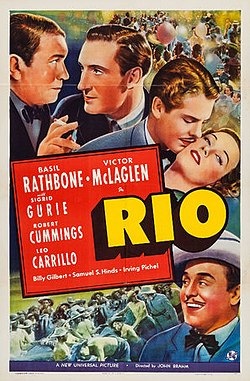
"Rio" ( born Rio ) is an American crime film directed by John Brahma , which was released in 1939 .
| Rio | |
|---|---|
| Rio | |
 | |
| Genre | Crime romance Adventure movie |
| Producer | John Bram |
| Author script | Eben Candel, Edwin Justice Mayer, Frank Partos, Stephen Morehouse Avery Jean Negulesco (story) |
| In the main cast | Basil Rathbone Victor Maclaglen Sigrid Guri Robert Cummings |
| Operator | Hal mor |
| Composer | Frank Skinner |
| Film company | Universal pictures |
| Duration | 77 min |
| A country |  USA USA |
| Tongue | English |
| Year | 1939 |
| IMDb | ID 0031863 |
The film is about the French financier Paul Reinard ( Basil Rathbone ), who is sentenced to 10 years in a penal colony in South America for bank fraud. His wife Irene ( Sigrid Guri ) follows him to Rio de Janeiro , where he soon falls in love with American engineer Bill Gregory ( Robert Cummings ). After the escape, Paul sees that his wife loves Bill and wants to kill him, but the servant of Paul, in an attempt to prevent the shot, accidentally kills his master.
Although the film was not widely successful, it received positive reviews from critics, who particularly praised the directorial work of John Brahm, anticipating the emergence of the film noir genre, and Basil Rathbone’s game, which will soon become famous as the performer of the role of Sherlock Holmes in the 1939-1946 film series.
Content
Story
French financier Paul Reinard ( Basil Rathbone ) is desperately trying to get a loan in London to save his company from collapse. After failing in the negotiations, Paul returns home by plane, where his faithful servant Dirk ( Victor McLaglen ) tries to convince the boss not to fly to Paris, where he faces a prison. Nevertheless, the self-confident Paul does not pay attention to Dirk’s words, as he is convinced that he will be able to deal with all the problems. In Paris, when meeting with his creditors, Paul threatens them with ruin and a major scandal if they refuse him a new loan, after which he goes with his beloved wife Irene ( Sigrid Guri ) to a fashionable restaurant to celebrate the first anniversary of their wedding. Right in the restaurant where Irene once worked as a singer, with a huge number of people gathering, the police arrest Paul and soon he is sentenced to ten years for financial fraud. By the verdict of the court, Paul goes to serve his sentence in one of the correctional colonies, which is located in a tropical forest near Rio de Janeiro . Before leaving, Paul asks Irene to forget about him and start a new life, especially since he left her enough jewelry to support herself. However, loyal to her husband, Irene regularly writes letters to Paul, and soon, together with Dirk, he moves to Rio to be closer to Paul and take care of him. She goes to work as a singer in a Roberto restaurant ( Leo Carrillo ), and Dirk gets a job as a bartender. At the club, Irene meets witty American engineer Bill Gregory ( Robert Cummings ), who lost heart and washed down after the bridge that he had just built fell through the fault of corrupt suppliers. Meanwhile, in prison, Paul is worried that letters have stopped coming from Irene. Despite the fact that just yet another escape ended in the death of a prisoner, Paul decides to escape with the help of Dirk. At the carnival in the restaurant, Roberto Irene, to the displeasure of Dirk, dances with Bill all evening. Towards the end of the evening, Bill, who fell in love with Irene, kisses her, however, she says that she should not have allowed this, and they cannot be together. Soon, a pump breaks on Roberto’s agricultural plantation, leaving the village and workers without water. Drunk Bill volunteers to fix everything, but sobering up the next morning, trying to abandon this work. Nevertheless, after seeing the line from the peasants for drinking water, Bill changes his mind, undertaking not only to repair the pump, but also to build a dam . A newly released prisoner arrives at Roberto’s tavern, who retells to Dirk the escape plan developed by Paul, according to which Dirk must send Paul some things to the colony. In the village at the festivities marking the launch of the dam, the authorities and peasants honor Bill, who thanks to this work stopped drinking and regained his moral and physical strength. He again declares his love for Irene, who confesses that she also fell in love with him, but must be faithful to her husband. She says that she loved Paul and admired him, although she was afraid of him. Now she had fallen out of love with him, but she could not leave him, as he had her husband and so many things connected them. Meanwhile, Paul makes an escape, taking with him another prisoner Mashi ( Irving Bacon ), without whose help he would not be able to get through the jungle . When they finally get out into the open, Paul kills his partner with a knife with the words “you helped me a lot”, after which he hangs his prisoner badge in his hand and then finds him on the river Dirka, who is waiting for him with the boat. Soon, newspapers reported that the body of Paul Reinard, who was trying to escape from the colony, was found in the jungle. Upon learning of Paul’s death, Irene felt like a free woman and was planning a life together with Bill. Having entered his dressing room after speaking, Irene suddenly sees Paul there, which makes her shocked. Irene says that she was faithful to him, but fell in love with another, but Paul insists that they are still husband and wife and will leave together tomorrow. At this moment, having felt that something was amiss, Bill bursts into the dressing room, and then Dirk, who reports that the restaurant is surrounded by the police and that Paul must immediately run. Paul demands that Irene run away with him, however she refuses and remains with Bill. Realizing that he had lost his wife forever, Paul says that after these words she feels dead. He pulls out a gun to shoot Bill, but Dirk grabs his hand in an attempt to stop Paul. In the subsequent struggle, a shot is heard, which becomes fatal for Paul. Dirk picks up his body and carries it out onto the street, where he is caught in the fire surrounding the police building.
Cast
- Basil Rathbone - Paul Reinard
- Victor Maclaglen - Dirk
- Sigrid Guri - Irene Reinar
- Robert Cummings - Bill Gregory
- Leo Carrillo - Roberto
- Billy Gilbert - Manuelo
- Maurice Moskovich - an old prisoner
- Samuel S. Hinds - Lamartine
- Irving Pichel - Rocco
- Irving Bacon - Mashi
- Ferike Boros - Maria
Movie Story
As the film historian Arthur Lyons noted, the Romanian immigrant Jean Negulesco , who wrote the original story of this film, will soon become one of the most famous Hollywood directors, thanks to the production of four category A noirs , among them the Mask of Dimitrios (1944) and Roadhouse “(1948), as well as such expensive dramas and comedies as“ Titanic “(1953) and“ How to Marry a Millionaire “(1953)” [1] .
The German director John Bram arrived in Hollywood in 1937, where he attracted attention by staging the harsh crime drama “ Let Us Live ” (1937), and in the early 1940s turned to the noir horror genre, staging such wonderful films as “ The Resident ” "(1944) and" Hanover Square "(1945) [2] .
As movie historian Hal Erickson, the English actor Basil Rathbone , who is best known for his role as Sherlock Holmes in a series of films from 1939-1946, noted in 1938 he had already played together with an actress of Norwegian origin Sigrit Guri in the film “ The Adventures of Marco Polo ” [3] . According to Hollywood Reporter , the French actress Daniel Darje was originally planned for the main female role [4] .
Criticism of a film
After the film was released, the New York Times film critic Frank S. Nugent praised him, noting that although it was a category B film , thanks to director John Brahm it was made “as if it were A”. According to Nugent, both “Rio” and “ Let Us Live ” last year, “if they are not a complete triumph of the director’s mind over routine story material, at least represent his victory in several important battles. Moreover, this film is an attempt by the director to get away from the existing schemes and try to do something new. Already for this we must approve and support him ” [5] . As the critic further notes, instead of telling this “outwardly simple old melodrama” in the usual way, namely “creating screen characters, exploiting the horrors of the penal colony and slowly enjoying the melodrama of the scene between the husband, wife and lover,” Bram supported by the scriptwriter and acting composition “led the matter in a different way, building characters, avoiding the obvious as much as possible and digging into the psychological aspects of suspense and drama” [5] . According to Nugent, the director, though “did not achieve full success, which was expected, but he managed to make some extremely powerful scenes.” In addition, he “was able to create a gallery of interesting characters with the help of Rathbone , Guri , Cummings and Maclagen , who play roles that are not at all like those they usually play” [5] . The critic believes that “one could get by with lesser singing of Guri, as well as reduce the unreasonably prolonged festival episode”, however, these minor flaws easily overlap with the “originality that Bram brings to such a category devoid of originality as a category B film ” [5] .
Modern critics also evaluate the film as a whole positively, pointing out the connection of the film with the noir genre of the 1940s. According to Arthur Lyons, this one, “one of the few early noir Universal , although somewhat boring, but overall achieves success thanks to the good direction and convincingly manic game of Rathbone” [1] . Film historian Vincent Brooke draws attention to the “expressionist staging of the mise-en-scene and the light contrast of the climactic scene in the rays of blinking neon, which indicates Brahm’s penchant for noir aesthetics, which was further developed in the 1940s” [6] . Hal Erickson notes that with “a film lasting only 75 minutes, it contains a plot for ten films.” The critic especially emphasizes Rathbone’s game, which “although it plays a completely disgusting character, in the finale turns out to be the cutest person in the film, and as such, he is the only real reason why you should endure all the melodramatic turns of the picture” [3] .
Notes
- ↑ 1 2 Lyons, 2000 , p. 133.
- ↑ Hal Erickson. John Brahm. Biography AllMovie. Date of treatment February 19, 2018.
- ↑ 1 2 Hal Erickson. Rio (1939). Synopsis AllMovie. Date of treatment February 5, 2018.
- ↑ Rio (1939). History . American Film Institute. Date of treatment February 19, 2018.
- ↑ 1 2 3 4 Frank S. Nugent. John Brahm's Direction Distinguishes 'Rio' at the Globe . The New York Times (October 27, 1939). Date of treatment February 19, 2018.
- ↑ Brook, 2009 , p. 187.
Literature
- Arthur Lyons. Death on the Cheap: The Lost B Movies of Film Noir . - Boston, MA: Da Capo Press, 2000 .-- ISBN 978-0-3068-0996-5 .
- Vincent Brook. Driven to Darkness: Jewish Emigre Directors and the Rise of Film Noir . - New Brunswick, New Jersey, and London: Rutgers University Press, 2009. - ISBN 978–0–8135–4630–8.