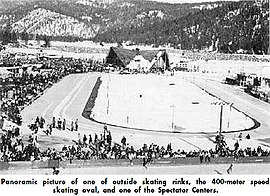
Squaw Valley Olympic Skating Rink is a speed skating stadium built in 1959 in the California city of Squaw Valley ( USA ) for the 1960 Winter Olympics . He became the first skating rink with artificial ice to host Olympic competitions.
| Squaw Valley Olympic Ice Ring | ||
|---|---|---|
 | ||
| original name | English Squaw Valley Olympic Skating Rink | |
| Location |  USA , Squaw Valley USA , Squaw Valley | |
| Built | 1959 | |
| Open | 1960 | |
| Ruined | 1963 | |
| Capacity | 8500 | |
| Track length | 400 m | |
| Material | artificial ice | |


Content
History
The Squaw Valley ice rink is located near the Blyth Arena at an altitude of 1890 meters above sea level - it is 200 meters higher than the record Medeo ice rink in Alma-Ata in combination with artificial ice provided extremely convenient conditions for setting world records. It was one of the highest mountain skating rinks ever used in international competitions.
In 1960, during the Winter Olympic Games, it held competitions in speed skating .
However, after the Olympics, the track was demolished and turned into a parking lot. The freezer system to create ice was transferred to the State Fair Park ice rink in 1966.
World Records
During the opening ceremony of the arena in late February / March 1959, the ice rink demonstrated its speed characteristics. Finn Juhani Yarvinen set a fantastic world record at 1,500 m - 2.06.3, having thrown 2.3 seconds from the achievement of the Soviet skaters Yevgeny Grishin and Yuri Mikhailov, set three years earlier at the Olympic Games in Cortina d'Ampezzo . The new record lasted seven years.
At test competitions a few days before the Olympics, the representative of the USSR Viktor Kosichkin set a record for 3000 m - 4.29.2. More than 10 seconds from the current world record. The expectations of the first Olympic starts among skaters broadcast on television were high.
For the first time in Olympic history, women also competed at the rink (with the exception of 1932, when it was a demo view). The Soviet speed skater Lydia Skoblikova won two golds, setting a world record at 1,500 m - 2.25.2.
Competitions among men at 1,500 and 5,000 m were accompanied by wind and the results were relatively normal. At the end of the Olympics, on the last day the conditions were good again.
The 10,000-meter race on February 27, 1960 went down in history as one of the largest speed skating competitions. Five people exceeded the eight-year-old world record held by the Norwegian Yalmar Andersen - 16.32.6 set by him in Hamar . Norwegian Knut Johannesen exchanged 16 minutes, improving the world record by 46 seconds - 15.46.6. He defeated his main rival Viktor Kosichkin, ahead of him by only 2.6 seconds.
At a distance of 500 m during the Olympics, Grishin, having made a mistake in the last corner, won with a result of 40.2, thereby repeating the world record. In the test race at the same distance a few days after the Olympics, Grshin showed a result of 39.5 s, becoming the first time anyone changed 40 seconds. However, this time was not counted as a new world record.
Notes
Links
- Olympics Skating Squaw Valley-Olympic Valley speedskatingnews.info
- VIII Olympic Winter Games 1960, Squaw Valley, California: Final Report
- Speed Skating at the 1960 Squaw Valley Winter Games sports-reference.com