Henry XI Legnitsky ( Polish Henryk XI legnicki , German Heinrich XI von Liegnitz ; February 23, 1539 , Legnica - March 3, 1588 , Krakow ) - Prince Legnitsky ( 1551 - 1556 , 1559 - 1576 , 1580 - 1581 ).
| Henry XI Legnitsky | |||||||
|---|---|---|---|---|---|---|---|
| polish Henryk XI legnicki him. Heinrich xi von liegnitz | |||||||
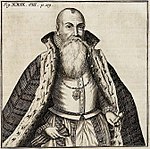 Prince Henry XI Legnitsky | |||||||
 | |||||||
| Predecessor | Frederick III Legnitsky | ||||||
| Successor | Frederick III Legnitsky | ||||||
| |||||||
| Predecessor | Frederick III Legnitsky | ||||||
| Successor | Frederick IV Legnitsky | ||||||
| |||||||
| Predecessor | Frederick IV Legnitsky | ||||||
| Successor | Frederick IV Legnitsky | ||||||
| Birth | February 23, 1539 Legnica , Principality of Legnica | ||||||
| Death | March 3, 1588 (49 years old) Krakow , Commonwealth | ||||||
| Kind | Silesian Piasts | ||||||
| Father | Frederick III Legnitsky | ||||||
| Mother | Ekaterina Mecklenburg-Schwerinskaya | ||||||
| Spouse | Sofia Brandenburg-Ansbach | ||||||
| Children | four daughters and two sons | ||||||
Content
- 1 Youth
- 2 Prince Legnitsky
- 3 Journey to the Holy Roman Empire
- 4 Return to Legnica
- 5 Stay in Poland
- 6 Death
- 7 Marriage and offspring
- 8 Literature
- 9 References
Youth
Representative of the Legnica line of the Silesian Piasts . Born February 23, 1539 in Legnica Castle, the eldest son of Prince Frederick III Legnitsky (1520-1570) and Catherine of Mecklenburg-Schwerinsky (1518-1581), daughter of Henry V, Duke of Mecklenburg-Schwerinsky . In his youth, Henry witnessed how his father was removed from power in 1551 by decision of the German emperor Charles V of Habsburg . The emperor’s decision was dictated by the disloyal behavior of Prince Frederick III Legnitsky , who joined the anti-Habsburg coalition of Protestant princes of the empire, and supported the king of France, Henry II , a longtime enemy of the Habsburgs . 12-year-old Henry XI, the eldest son of Frederick III , was declared the new Legnica prince. The regents of Legnica principality were appointed imperial governor of Silesia and Bishop of Wroclaw Balthazar von Promnitz and Prince George II of Brzeg (the younger brother of Frederick III). At the court of his uncle, Henry XI spent several years studying science. After the abdication of Emperor Charles V of Habsburg from power in 1556, Frederick III was reinstated in the rank of Prince Legnitsky, having made a promise of obedience and loyalty to the new Emperor Ferdinand I of Habsburg .
Prince Legnitsky
On October 27, 1559, by the decision of the German Emperor Ferdinand I of Habsburg, Frederick III Legnitsky was again removed from power in his principality. His eldest son, Henry XI, was again elevated to the Legnica princely throne. His father Frederick III was put under house arrest , in which he spent eleven years until his death on December 15, 1570 .
Henry XI inherited from his father a principality whose finances were in a terrible state. During the reign of Prince Frederick III, the Principality of Legnica had debts of 80 thousand thalers . Henry XI, instead of gradually repaying his father's debts, surpassed his father in wastefulness, leaving at the end of his reign debts reaching 700 thousand thalers.
Prince Legnitsky tried to get funds to pay off his increasing debts. In 1567, Henry XI proposed in exchange for 120 thousand thalers to abandon the so-called Glogow privilege, which gave the right to occupy the estate of a dead vassal who did not have children. However, this idea was not accepted. On December 24, 1571, at the congress of the camps of the Legnica Principality, Henry XI tried to convince his vassals to pay off their princely debts by pledging their own lands and property. The camps of the principality refused to support the plans of the prince. Then Henry XI captured the representatives of the camps and held them captive until they signed an agreement to pay a tax of almost 66 thousand thalers . After gaining freedom, representatives of the principalities of the principality sent an appeal to the German emperor Maximilian II a complaint against his prince. The emperor appointed a special commission to investigate this case.
Journey to the Holy Roman Empire
In March 1575, Prince Henry XI Legnitsky, wanting to calm the situation in the principality and take a break from the hardships of government, went on a journey through the empire. During his absence, the Principality of Legnica was governed by his younger brother Frederick IV , who already in December 1571 became co-ruler of his older brother Henry XI, but remained under his care all the time. During the three-year expedition, Henry XI Legnitsky visited, in particular: Prague (where he took part in the coronation of Rudolf II of Habsburg on September 22, 1575 ), Worms , Regensburg , Augsburg , Heidelberg , Mainz , Speyer , Ingolstadt, again Prague , Cieszyn , Nuremberg , Strasbourg , Frankfurt , Cologne and Leipzig . During this time, Henry XI Legnitsky stayed at the courts of numerous German princes.
While in the Rhine Palatinate , Henry XI Legnitsky entered the service of Prince Louis I Conde , who recruited Huguenot troops to fight the new Catholic king of France (and the former king of Poland), Henry III of Valois . With the money received from Conde, Prince Legnitsky collected about 9,000 mercenaries . The prince led the 4,000th Protestant detachment went to Lorraine , but soon had to give up service at Prince Conde. The Emperor of the Holy Roman Empire, Maximilian II of Habsburg , overlord of the Principality of Legnica, learning about the participation of Prince Henry of Legnitz in the battles in France, ordered him to refuse service. However, Prince Legnitsky refused to obey the imperial decree and continued to serve Prince Conda , who paid him constant salaries. In May 1576, after the conclusion of peace in Beaulieu , which completed the Fifth Religious War , the service of Prince Henry XI to the French Prince ended. Not already receiving military compensation, he soon lost all his livelihoods. Prince Legnitsky has done a lot of debt. Henry XI lived for so long on the loans received until all potential lenders realized that they could not count on the repayment of the money borrowed to him. In the spring of 1577, the prince decided to return to his principality. In total, the three-year trip of Prince Henry XI through the Holy Roman Empire cost 32 thousand thalers .
Return to Legnica
While Prince Henry XI Legnitsky fought on the side of the Huguenots in France, his younger brother Frederick IV decided to take this moment to free himself from the care of his older brother. He turned to his overlord, Holy Roman Emperor Maximilian II, with a request to partition his father's principality. Commissioners on the basis of the imperial decree of March 13, 1576 the following month, April 17, 1576 , recognized Frederick IV as Prince Legnitsky. Frederick IV undertook to provide the family of the elder brother of Henry XI, who remained in Silesia, with all the necessities, including cash and food. At the same time, on September 29, 1577, a deadline was set for the division of the Legnica Principality between the two brothers. However, this did not happen, because Emperor Maximilian II of Habsburg died on October 12, 1576 , the new Emperor Rudolph II tried to re-examine the case.
Frederick IV , who sought to pay off the debts of his older brother and father, he had a reputation as a calculating and economical ruler. This style of government did not like the nobility of the principality, accustomed to the wastefulness of previous princes. On November 9, 1577, Henry XI, returning from his trip to Germany, was enthusiastically greeted by his subjects. Before Henry XI, the opportunity opened up to regain power in Legnica , especially since the year before the disapproving emperor Maximilian II had passed away to him. The new emperor was his eldest son, Rudolph II of Habsburg , at the coronation of which, as King of the Czech Republic, Henry XI was present in 1575 .
Nevertheless, unable to wait for a solution to the protracted dispute about his father’s inheritance, Henry XI took over the castle in Grodziec , from where he began to attack the surrounding villages, merchants and his brother’s possessions. Despite attempts to mediate, this situation lasted several months, until Frederick IV finally won the battle and became the sole ruler of Legnica . Prince Henry XI passed the castle of Grodziec and on November 16, 1578 went on a new trip to Germany, visiting Halle , Berlin and Rostock .
At this time, his wife, Sofia Hohenzollern, urgently sought permission at the court of Emperor Rudolph II of Habsburg to return her husband. On October 5, 1580, Emperor Rudolph II revoked the decree of April 17, 1576 and allowed Prince Henry XI Legnitsky to his capital. However, he was forced to share power in the principality with his younger brother Frederick IV . Henry XI chose Legnica as his residence, and Frederick was forced to leave the capital in Chojnów . On October 28, 1580, the ceremonial entry of Henry XI to Legnica took place.
Prince Henry XI Legnitsky to continue his disrespectful behavior in relation to his overlord . A few months after his restoration to the princely throne in Legnica, Henry XI refused to take the oath of allegiance to the emperor , and also did not participate in the Silesian Sejm. This led to a punitive armed expedition to Legnica, which was headed by the imperial governor of Silesia and the Wroclaw bishop Martin Gerstmann on June 7, 1581 . The campaign participants were not able to take the city by surprise, because Henry XI had collected weapons and provisions from other cities in Legnica in advance. After the negotiations, Prince Henry XI Legnitsky agreed to take the oath of oath before Charles II , Prince Zembitsky , and also appear before the emperor in Prague in July 1581 .
Prince Legnitsky arrived in Prague on July 9, 1581 . However, he had to wait several months for an audience with Emperor Rudolph II . The punishment against him was severe: Henry XI was arrested and deprived of power over Legnica , which was again transferred to Frederick IV , who (like the first time) was obliged to take care of the family of his older brother Henry XI, paying her an amount of 30 thalers per week. Prince Henry XI spent the first year of captivity in Prague Castle , then three years in Wroclaw , and in the spring of 1585 he was transported to Swidnica . From there on September 30, 1585 , bribing the guards, the prince fled. In pursuit of him, the forces of the new Bishop of Wroclaw, Andreas Yerin and Prince George II of Brzeg, were sent. But they could not catch him. After a four-day trek through the forests, Henry XI fled to Poland , where he remained until the end of his life.
Stay in Poland
Henry XI had very good contacts with Poland. His grandfather, Prince Frederick II Legnitsky , first married Elzbiet Jagiellonka and then Sofia Brandenburg-Ansbach (daughter of Sofia Jagiellon ), and his brother Frederick II, prince George I of Brzegzi , married Anna Pomeranska , daughter of Anna Jagiellonki and another granddaughter King Casimir IV . Sigismund II Augustus patronized Prince Frederick III Legnitsky , the father of Henry XI. In 1569, at the invitation of Sigismund Jagiellon, Prince Legnitsky participated in the Sejm in Lublin , at which the Union of Lublin was concluded . On the way to the Sejm, the prince stayed with a number of Polish magnates, among whom he made friends. At a meeting with Sigismund II Augustus in Lublin, Heinrich Legnitsky presented two lions and precious stones to the Polish king. A trip to Poland brought Prince Legnitsky undoubted magnificence, but also cost 24,000 thalers and caused discontent of the imperial court.
In January 1575, Henry XI participated in Poznan at the funeral of the Bishop of Poznan, Adam of Konarski , with whose younger brother, Jan, he had friendly relations. In the summer of that year, he arrived in Krakow , trying to enlist the support of his candidacy for the Polish royal throne.
After the escape of Henry XI to Poland, Emperor Rudolph II of Habsburg and Prince George II of Brzeg were unsuccessfully trying to convince the Polish king Stephen Batory to extradite the fugitive. After visiting the estate of Marshal of the great crown, Andrzej Opalinsky, Henry XI went on a journey through the country of his ancestors, visiting Kruswitsa , Lovic and Warsaw . Then he went to Grodno , where he stayed for three weeks at the court of Stefan Batory . After completing his trip, Henry XI went to Koenigsberg , where he visited his relative, Duke Albrecht Friedrich of Prussia .
During the royal elections in 1586, Henryk Legnitsky supported the candidacy of the Swedish prince Sigismund Vazy . He even traveled to Stockholm as the personal envoy of the Queen of Poland, Anna Jagiellonki , to guarantee her support for Sigismund Wase . Soon, Henry managed to establish friendly relations with the elected king of the Commonwealth, who promised him to take all diplomatic efforts to achieve his restoration to the princely throne in Legnica. On December 9, 1587, Henry XI participated in the coronation of Sigismund III Vasa as king of Poland.
Death
Henry XI suddenly died on March 3, 1588 in Krakow . He was probably poisoned by order of the Habsburgs . The funeral of the prince, who until the end of his life remained a Lutheran, caused many problems. Sigismund III Vasa turned to his daughter and younger brother with a request to take the body and bury him in Legnica . However, these plans were violated by the objection of Emperor Rudolph II , who refused to give permission to bury the rebel prince on the territory of his possessions. Temporarily, the tomb of the prince was placed with the Franciscans in Krakow , who in exchange for accepting the body of the Protestant demanded payment and assurances that the body of Prince Legnitsky would soon be taken from them. Due to the refusal of the prince's family to take the body of the deceased, a few months later the coffin was put right on the street. In the end, thanks to the efforts of his family and many Silesians, on November 9, 1588, the tomb with the body of the prince was placed in the chapel of the Church of the Visitation of the Blessed Virgin Mary in Krakow .
Marriage and offspring
On November 11, 1560, in the Legnica castle, Henry XI married Sophia Hohenzollern (March 23, 1535 - February 22, 1587), the daughter of Margrave George Brandenburg-Ansbach and Prince Krnovsky (1484-1543) and Emilia of Saxony (1516-1591). Their relationship was not perfect. Between spouses there were often disputes and quarrels (often in front of the whole court), most often due to the prince's tendency to communicate with other women. Sofia Hohenzollern died on February 12, 1587 . In the marriage, the couple had four daughters and two sons:
- Katarina Sofia (August 7, 1561 - May 10, 1608), wife from February 24, 1587 of Friedrich, Palatine of Zweibrucken-Foenstraussky (1557-1597)
- Anna Maria (January 3, 1563 - February 28, 1620)
- Emilia (December 26, 1563 - November 9, 1618)
- son (born and died until January 16, 1565)
- Georg Friedrich (September 11, 1565 - November 14, 1565)
- Sabina Barbara (January 8, 1571 - December 14, 1571).
Literature
- Allgemeine Deutsche Biographie (ADB). - Lpz. : Duncker & Humblot, 1875-1912. (German)
- Egon Erwin Kisch: Drei Prozesse eines trinkfesten Herzogs. In: Egon Erwin Kisch: Prager Pitaval (= Gesammelte Werke in Einzelausgaben. Bd. 2, 2). 4. Auflage. Aufbau-Verlag, Berlin ua 1986, ISBN 3-351-00613-6 , S. 86-97.
- Rudolf Žáček: Dějiny Slezska v datech. Nakladatelství Libri, Praha 2004, ISBN 80-7277-172-8 , S. 142, 145-147.