Alcor [6] (g Ursa Major [7] , 80 UMa) - a star in the constellation Ursa Major , located near (about 12 arc minutes) a much brighter Mizar (the second star from the end of the handle of a large “bucket” ). The ability to see Alcor is a traditional way of checking vision [8] . The name in Arabic means forgotten or insignificant. The apparent magnitude is about +4, the spectral class is A5 V, the distance is about 78 light years . For the 2000 era, right ascension is 13 h 25 m 13.53 s , declination + 54 ° 59 ′ 16.65 ″.
| Alcor | |||
|---|---|---|---|
| Star | |||
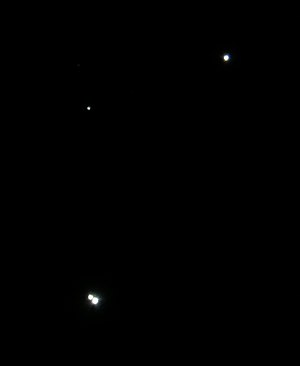 Mizar A and B (bottom left), Alcor (top right) and Ludwig Star (top left) | |||
| Observational data ( Age J2000.0 ) | |||
| Right ascension | 13 h 25 m 13.53783 s [1] | ||
| Declination | + 54 ° 59 ′ 16,6548 ″ [1] | ||
| Distance | 81.2 ± 1.2 St. years (24.9 ± 0.4 pc ) | ||
| Visible magnitude ( V ) | +3.99 [2] | ||
| Constellation | Big Dipper | ||
| Astrometry | |||
| Radial velocity ( R v ) | |||
| Own movement (μ) | RA: Dec: | ||
| Parallax (π) | 39.91 ± 0.13 mas | ||
| Absolute magnitude (V) | +2.00 [2] | ||
| Specifications | |||
| Spectral class | A5 v | ||
| Variability | |||
| physical characteristics | |||
| Temperature | |||
| |||
| Database Information | |||
| SIMBAD | |||
General Information
The question of whether Alcor and Mizar are part of a common star system or whether their proximity in heaven is accidental has caused controversy. Only in 2009, astronomers of the University of Rochester established a connection between Alcor and the stars of Mizar, this position is currently generally accepted [7] . In the same year, a weak (+8.8) satellite was discovered at Alcor, which was 1 arc second away [2] . Thus, the system consists of six components [9] : the binary stars Mizar A and Mizar B, and the binary star Alcor lying at a distance of about 0.3 light years from them.
Title
The name of the star comes from the Persian Khwar, Khawwar [10] , "weak", with the addition of Arabic al- [11] .
Two stars, Mizar and Alkor, enter into pair asterism , denoted by the Arabic expression "horse and rider", but these epithets are not a translation of the Arabic names of the stars. The Arabic name for Alcor is al-Suhā , “undetected”; the name is given by al-Sufi and comes from the fact that the star was not mentioned in the Ptolemy catalog ) [12] (al-Sufi himself also did not include Alcor in his catalog).
Vision Testing
Trying to see Alcor is a good test for visual acuity . Although the limit of angular resolution of the eye is close to 1 minute of the arc , and thus 12 minutes - almost half of the apparent diameter of the moon - separating Alcor and Mizar, theoretically do not require perfect vision (visual acuity of 0.1 or 20/200 should be enough), in practice, the task is greatly complicated by the small brightness of the stars and the large difference in brightness between Mizar and Alcor [8] . J. Bohigian’s experiments showed that this “Arab vision test” is actually not much different from Snellen’s line 20/20 (normal vision, visual acuity 1.0), at least for young people (the only one tested a 65-year-old volunteer was unable to resolve a couple of stars even after correcting his vision to 1.0) [8] .
Arabic literature says that only those with the most keen eyesight can see Mizar’s companion. The 14th-century Arab lexicographer Firuzabadi called it “Our riddle,” while the 13th-century Persian astronomical writer Zakaria al-Qazvini said that “people tested their vision with this star.”
Notes
- ↑ 1 2 van Leeuwen, F. Validation of the new Hipparcos reduction // Astronomy and Astrophysics . - EDP Sciences 2007 .-- November ( vol. 474 , no. 2 ). - P. 653-664 . - DOI : 10.1051 / 0004-6361: 20078357 . - . - arXiv : 0708.1752 .
- ↑ 1 2 3 Eric E .; Mamajek; Kenworthy, Matthew A .; Hinz, Philip M .; Meyer, Michael R. Discovery of a Faint Companion to Alcor Using MMT / AO 5 μm Imaging (Eng.) // The Astronomical Journal : journal. - IOP Publishing 2010. - Vol. 139 , no. 3 . - P. 919-925 . - DOI : 10.1088 / 0004-6256 / 139/3/919 . - . - arXiv : 0911.5028 .
- ↑ 1 2 Gontcharov G. A. Pulkovo Compilation of Radial Velocities for 35 495 Hipparcos stars in a common system // Ast. Lett. / R. Sunyaev - Nauka , 2006 .-- Vol. 32, Iss. 11. - P. 759–771. - ISSN 1063-7737 ; 1562-6873 ; 0320-0108 ; 0360-0327 - doi: 10.1134 / S1063773706110065
- ↑ 1 2 3 4 5 6 Gaia Data Release 2 - 2018.
- ↑ 1 2 J. Zorec, F. Royer Rotational velocities of A-type stars // Astron. Astrophys. - EDP Sciences , 2012. - Vol. 537.- P. A120. - ISSN 0004-6361 ; 0365-0138 ; 1432-0746 ; 1286-4846 - doi: 10.1051 / 0004-6361 / 201117691 - arXiv: 1201.2052
- ↑ Astronomical calendar. The permanent part. 7th ed., Revised. Ed. V.K. Abalakin. - M .: Nauka, 1981
- ↑ 1 2 BDT, 2005 .
- ↑ 1 2 3 Bohigian, George M. An Ancient Eye Test — Using the Stars // Survey of ophthalmology 53.5 (2008): 536-539.
- ↑ First Known Binary Star is Discovered to be a
Triplet, Quadruplet, Quintuplet, SextupletSystem - ↑ Davis, GR, Jr .. The pronunciations, derivations, and meanings of a selected list of star names // Popular Astronomy, Vol. 52 (1944). S. 28. (English)
- ↑ Phil Simpson. Long Tails of Two Bears // Guidebook to the Constellations. Springer, 2012.S. 5-36. (eng.)
- ↑ Emilie Savage-Smith, Andrea PA Belloli. Islamicate celestial globes, their history, construction, and use . Smithsonian Institution Press, 1985.P. 96 .
Literature
- Alcor // A - Questioning. - M .: Great Russian Encyclopedia, 2005. - P. 558. - ( Great Russian Encyclopedia : [in 35 vols.] / Ch. Ed. Yu. S. Osipov ; 2004—2017, vol. 1). - ISBN 5-85270-329-X .
- Berezkin, Yuri Evgenievich. Alcor, bowler and dog: intercontinental parallels and epochal changes in the picture of the starry sky // "Bricks": cultural anthropology and folklore today. Collection in honor of the 65th anniversary of S. Yu. Neklyudov. M .: RGGU, 2008.S. 11-23.