PAS-22 , also known as AsiaSat 3 and HGS-1 , is a former geosynchronous communications satellite that was rescued from an unsuitable geo-transition orbit using the Moon's gravitational force. The satellite became the first commercial and first non-state spacecraft to reach the vicinity of the moon [1] .
| AsiaSat 3 → HGS-1 → PAS-22 | |
|---|---|
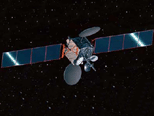 | |
| Manufacturer |  Hughes Hughes |
| Operator |  AsiaSat (1997-1998) HGS (1998-1999) PanAmSat (1999-2002) AsiaSat (1997-1998) HGS (1998-1999) PanAmSat (1999-2002) |
| Tasks | communication satellite |
| Span | Of the moon May 13, 1998, 19:00 UTC - 6,248 km Of the moon June 6, 1998, 16:30 UTC - 34,300 km |
| Satellite | Of the earth |
| Launch pad |  Baikonur , 81/23 Baikonur , 81/23 |
| Launch vehicle | Proton-K / DM3 |
| Launch | December 24, 1997, 23:19 UTC |
| Flight duration | 21 years, 7 months, 24 days |
| NSSDC ID | 1997-086A |
| SCN | 25126 |
| Specifications | |
| Platform | HS-601HP |
| Weight | 3400 kg (at startup) |
| The term of active existence | 15 years (plan), 4 years (achieved) |
| Elements of the orbit | |
| Orbit type | Geocentric orbit |
| Standing point | 105.5 ° East (plan) 158 ° West (1998) 62 ° to the west (1999-2002) |
| Target equipment | |
| Transponders | 16 × Ku band 28 × C-band |
| Coverage area | Asia |
History
At the time of the construction of Asiasat-3, Asia Satellite Telecommunications operated two telecommunication satellites: Asiasat-1 and Asiasat-2 . The first Asiasat was made on the basis of the space platform HS-376 (manufacturer Hughes Space and Communications International), and the second based on AS-7000 (manufacturer Astro Space , a division of General Electric ). During the operation of Asiasat-2, there were problems associated with the decrease in the efficiency of Ku-band transponders, which led to a conflict with insurance companies and threatened with litigation. Amid difficulties in operating Asiasat-2, Asia Satellite Telecommunications decided to manufacture Asiasat-3 on the basis of the HS-601 space platform manufactured by Hughes Space and Communications International. The choice fell on the modification of the HS-601HP [2] .
Design
In February 1996, Asia Satellite Telecommunications entered into an agreement with Hughes Space and Communications International to build a satellite based on the HS-601HP space platform [2] . The size of the spacecraft with the folded solar panels was 3.1 × 3.4 × 4.0 m. With the batteries open, the width was 26.2 m. The mass of the empty spacecraft was 1674 kg, the mass of a fully charged vehicle was 3480, and after reaching the standing point the mass was to be 2534 kg [3] .
The spacecraft carried on board 28 C-band transponders , each of which was powered by a 55-watt traveling-wave tube amplifier. 16 Ku-band transponders each had a power of 138 W and were also powered by traveling-wave tube amplifiers. Two solar panels based on gallium arsenide had to produce up to 9900 watts. 29 elements of a nickel-hydrogen storage battery provided the satellite during operation in the earth’s shadow [4] .
The antenna complex was configured to provide a coverage area similar to Asiasat-2 in the C-band, and duplicate Asiasat-1 coverage in the C-band in the Ku-band. In addition, a Ku-band redirectable transponder was provided that could move around as needed. The coverage area of the retargeted transponder was sufficient to cover, for example, Australia. After the launch of Asiasat-3, the operator company planned to transfer Asiasat-1 users to it, who were going to move it to a point of standing above 122 ° C. e. The total value of the contracts for the production and launch of Asiasat-3 amounted to 220 million dollars [2] .
Launch into orbit
Asiasat-3 was supposed to be launched on December 23, 1997 at 02:19 UHF, but on this day at a height of 10-12 kilometers a wind of 30-40 m / s was recorded, which is significantly higher than that allowed for the Proton launch vehicle ( 18 m / s) and the start was delayed [to 1] [5] .
On December 24, 1997 at 23:19 GMT (December 25 at 02:19 UHV), the Asiasat-3 satellite was launched into space using the Proton-K launch vehicle. The launch was carried out from the 23rd site of the Baikonur cosmodrome by the forces of combat calculations of the space forces of the Strategic Missile Forces. After 580 seconds, the linkage “ DM3 + Asiasat-3 overclocking block ” was launched into the reference orbit. The first launch of the booster block was successful, and the bundle entered the first transitional orbit. Six hours after the start at 08:39 UHF, the second acceleration unit turned on, but instead of the regular 130 seconds, he worked one. The engine turned off and the emergency payload compartment occurred. As a result, the spacecraft entered an off-design orbit [5] :
| Target options | Actual options | |
|---|---|---|
| orbital inclination | 13.15 ° ± 0.15 ° | 51.37 ° |
| perigee | 9650 ± 400 km | 203 km |
| apogee | 36000 ± 150 km | 36,008 km |
| circulation period | 13:47:45 ± 550 s | 636 min |
The emergency satellite received the international designation 1997-086A and the number according to the NORAD satellite catalog is 25126 [5] . In connection with Asiasat-3, an unusual legal incident arose related to the nationality of the satellite. The headquarters of the customer of the satellite Asia Satellite Telecommunications was located in Hong Kong , which since July 1, 1997 became part of the PRC . In anticipation of this event, in May 1996, Asia Satellite Telecommunications was re-registered in Bermuda , which is under British jurisdiction. Thus, from a legal point of view, Asiasat-3 was British. NASA in its reports to the Orbital Information Group unequivocally assigned the spacecraft to the jurisdiction of the PRC [6] .
The first (unofficial) versions of the reasons that led to the crash of the upper stage were associated with a possible burnout of the gas generator of the DM3 propulsion system. To determine the causes of the accident, a special commission was formed [5] .
This was the eighth commercial launch of the Proton-K launch vehicle in the interests of a foreign customer and the eighth launch of this type of launch vehicle in 1997. The Proton was manufactured at the Khrunichev State Research and Production Space Center , the DM3 upper stage at RSC Energia , which was adapted for the HS-601 space platform. To mount the satellite to the upper stage, the adapter SAAB Ericsson-1666 was used [5] .
At a press conference on December 25, Asiasat CEO Peter Jackson said the company “only intends to adjust the satellite’s orbit to prevent it from falling in populated areas.” This reaction to the emergency was explained by the fact that there was not enough fuel on board to bring the spacecraft into the target orbit. The observer of the Cosmonautics News magazine M. Tarasenko assessed the situation with the words: ““ pulling out the Asiasat-3 spacecraft from its current orbit is completely hopeless ” [5] .
To prevent an uncontrolled fall to Earth, the Asiasat-3 orbit was corrected using an onboard propulsion system and the perigee was raised to 350 km [7] .
Accident Investigation
On December 27, 1997, an Interdepartmental Commission was created, the chairman of which was appointed first deputy director of the Central Research Institute of Engineering, N.A. Anfimov . The commission was created by a joint order of the Director General of the RCA Yu. N. Koptev and the Commander-in-Chief of the Strategic Missile Forces V. N. Yakovlev ; started work on December 30 and was to submit its opinion for approval to the RCA and Strategic Rocket Forces by January 30, 1998 [8] .
After the telemetry analysis, four official versions of the accident were formed [8] :
- failure of the propulsion system of POPs;
- insufficient power of the booster pump of the turbo-pumping unit of the engine;
- engine gas valve failure;
- ingress of an increased amount of gaseous oxygen to the input of the impeller of the oxidizer pump.
The investigation showed that when separating the upper stage from the third stage of the Proton-K launch vehicle, no anomalies were observed. The on-board systems of the upper stage until the accident worked normally and commands were issued in accordance with the flight sequence diagram. The fuel supply and engine start systems in zero gravity worked normally [8] .
The situation on board began to change after giving a command to turn on the engine for the second time: the temperature of the gas duct wall after the turbine (parameter T-74) began to rise sharply and after about 0.2 s reached approximately 700 ° C (the normal value was 400-430 ° C). After 0.2-0.25 seconds, all parameters of the propulsion system became abnormal. At the same time, abnormal deviations in pitch , yaw and rotation were recorded, which indicated the appearance of a significant lateral force. The same lateral force deflected the combustion chamber of the main engine. Telemetry showed that after the appearance of lateral force, the pressure in the fuel tank began to decrease, which was clearly associated with damage to the tank. These data led to the conclusion that there was a burnout of the gas duct after the turbine of the turbopump assembly of the main engine of the booster block. A jet stream spurting from a burnout site created an unintended lateral force. The same jet burned the fuel tank [8] .
The Commission found that 4 months before the accident, for the same reason, an acceleration block accident occurred during ground tests conducted by RSC Energia, but this information was not made public. The observer of the Russian journal "Cosmonautics News" V. Voronin noted that a very similar situation occurred during the accident on December 25, 1996, which occurred during the launch of the Mars-96 interplanetary station [8] .
Tests conducted at RSC Energia confirmed the circumstances of the accident. As a result, a version was adopted about the ingress of gaseous oxygen through the increased gaps into the oxidizer pump [8] :
| The reason for the failure of the RB engine to switch to the mode at the second start was the failure of the oxidizer pump head after ~ 0.2 seconds from the second start command. Disruption of the pressure of the oxidizer pump occurred due to the increased amount of gaseous oxygen entering the impeller of the oxidizer pump from the cooling cavity of the thrust bearing through increased gaps in the floating rings due to the development of an antifriction coating. |
The representative of RSC Energia, V. M. Filin, stated that eight booster blocks could have a similar defect, two of which were at Baikonur in varying degrees of readiness for launch. In accordance with the recommendations of the Interdepartmental Commission, all the booster blocks were inspected and replaced with defective bearings. At the request of the Luxembourg company SES , additional tests of the upper stage were carried out, which was to be launched by the Astra-2A satellite [8] .
The idea of saving a satellite
After paying insurance, Asiasat-3 became the property of Hughes Global Services Inc. and received the name HGS-1 [7] .
According to one version, the first idea to use the gravitational maneuver near the moon was put forward by Edward Belbrano ( English Edward Belbruno ). On January 12, when he heard of the accident, he called Hughes and received satellite orbit data. After that, he contacted Rex Ridenoure ( Eng. Rex Ridenoure ), with whom he previously worked in JPL, where they took part in the implementation of the mission of the Japanese lunar AWS Hiten . On January 16, after consulting with Curtis Potterveld, Hughes was offered the option of rescuing the HGS-1 with a flyby of the moon. The Belbrano variant assumed the duration of the operation was 3-5 months and the exit far beyond the orbit of the moon. Hughes was not happy with such an elongated orbit - the company and the satellite itself did not have the means for long-distance communications. But the idea of the gravitational maneuver was liked by the company [1] .
Chris Cutroneo, the leader of the astrodynamic group, noted that Belbrano’s appeal did not play an important role in the development of the satellite’s orbit, but served as an incentive to find a solution to the problem. In his opinion, the idea of rescuing Asiasat-3 with the help of a gravitational maneuver around the moon completely belonged to Jerry Salvatore, the chief technologist of Hughes Space and Communications, and was invented by him independently [9] . Hughes Global Services vice president and satellite rescue program manager Mark Skidmore argued that the idea was born out of a random conversation between Jerry Salvatore and Ronald Swenson in a car park. [10] Cesar Ocampo , who used the Satellite Tool Kit software package from Analytical Graphics, Inc., provided important assistance in orbit calculations. [11] . Subsequently, the orbit developed by Jerry Salvatore and Cesar Ocampo was patented [2] . To determine the exact parameters of the orbit of the emergency satellite, they invited Tom Martin ( Eng. Tom Martin ) [11] .
Hughes management decided to limit the dissemination of information about preparing for the rescue of the satellite and completely break off relations with Edward Belbrano and his colleagues, and after the successful completion of the rescue operation, Hughes representatives never officially mentioned the participation of third-party specialists. Subsequently, this step was condemned and led to litigation. “This cover-up constitutes a serious injustice on the part of a well-known historical events corporation and detrimental to ethical behavior in the aerospace community,” said Cesar Ocampo in a 2006 article [12] .
Implementation
| External Images | |
|---|---|
| AsiaSat-3 Rescue Team Celebrates 15th Anniversary of Mission | |
| from left to right: Ken Manson, Laura Fields, Mark Skidmore, Fred Linkhorst, Jerry Salvatore, Doug Leber, Elias Polendo and Steve Enright | |
Hughes Global Services began the operation of moving the HGS-1 into geostationary orbit without drawing attention to its actions. From April 10 to 12, two test inclusions of the propulsion system were carried out, which did not affect the orbit parameters [13] . The first information that the device began to maneuver became known from the two-line elements of the orbit of spacecraft, which are submitted by the US Space Command and distributed by the Orbital Information Group of the Center named after Goddard . On April 12, 1998, the first maneuver was carried out, which led to an increase in apogee to 63,460 km. The second maneuver was carried out on April 14 at approximately 18:15 UTC , after which the apogee increased to 74 120 km, and the period of circulation increased to 1512 minutes. On April 16, at about 8:40 p.m. UTS, the third onboard engine was turned on, which led to an increase in apogee to 87,800 km, and the circulation period to 1882 minutes. On April 18, at about 03:50 UTC, another maneuver was carried out, raising its climax to 108,500 km and increasing the circulation period to 2,490 minutes. After that, the engine was turned on on April 23, 26 and 30, which put the device into orbit with an apogee of 320,000 km, the period was about 7.8 days. It was difficult to obtain more accurate information on the latest maneuvers, since two-line elements are designed to work in the standard SDP4 motion model, which is designed for orbits with an eccentricity of more than 0.9 [7] .
To ensure stabilization of the spacecraft during maneuvers and in orbit, two parabolic antennas were deployed, and the spacecraft itself was twisted around its longitudinal axis. At the same time, solar panels did not turn around [7] . Onboard electrical systems were powered from two external sections of solar panels located on the side faces of the satellite. The area of accessible sections is 5.5 m2, which ideally (with three-axis stabilization) could produce 2.2 kW of energy [13] .
An important problem during the maneuvers was the problem of determining the amount of fuel on board the satellite. Hughes Global Services President Robert V. Swanson defined the situation as follows: “Since we have never done anything like this before, we don’t know exactly how much fuel we will spend. Of course, we proceed from the best estimates based on 35 years of experience in the production and operation of spacecraft, as well as computer simulation, but there are no guarantees ” [7] .
On May 7, at about 9:00 UTC, a maneuver program was transferred aboard the vehicle, according to which on May 8, at about 00:42 UTC, a two-minute engine was turned on. It was this maneuver that sent the spacecraft to the moon. The inclusion was carried out outside the radio visibility zone, and information on the result of the maneuver was received only after half an hour [13] .
May 13 at 18:52 UTC HGS-1 entered the radio shadow of the moon, from which it left at 19:20. The minimum distance to the lunar surface was reached at 19:55 UTC and amounted to 6248 km. The moon itself was above a point on the surface of the Earth with coordinates 17.99 ° S and 87.41 ° east The distance between the centers of the Earth and the Moon at that moment was 389,627.9 km. As a result of the gravitational maneuver around the moon, the orbital inclination of the spacecraft changed from 52.1 ° to 18.2 °. At the same time, perigee grew from 400 to 36,000 km. On May 17 at 03:00 UTC, while passing the perigee, the spacecraft made another maneuver and switched to the 15-day waiting orbit. On May 18, Ronald Svenson stated: “Although the first moonlit was completely successful and all the tasks we set were completed, we nevertheless always said that we would try to get the best orbit possible. The second flight of the Moon will allow you to get a significantly better orbit and thereby increase the attractiveness of the device for potential users. We do not plan any additional flights of the Moon, since they will nullify the achieved improvements ” [13] .
On June 2, at 02:40 UTC, the engine was switched on again, which, after 30 minutes of operation, transferred the HGS-1 to the trajectory of the second approach to the Moon with the apogee of 488,000 km. On June 6 at 16:30 UTC, the satellite passed at a distance of 34,300 km from the lunar surface. At that moment, the moon was above 9.43 ° S and 72.95 ° E, and the distance between the centers of the Moon and the Earth was 397 042.4 km. This passage around the moon changed the inclination of the orbit of the spacecraft from 18.2 ° to 10.2 °. On June 14 at 16:15 UTC, the engine turned on for 46 minutes, after which the inclination of the orbital plane changed to 8.85 °. After an additional two-minute maneuver made at 17:50 UTC, an orbit of 35,900 by 82,300 km was formed. This was followed by several maneuvers to transfer the satellite into a near-stationary orbit. On June 16 at 14:29 UTC, the propulsion system was turned on for 28 minutes, which formed an orbit of 35,870 per 45,000 km, with an orbital inclination of 8.75 ° and a orbital period of 28 hours. On June 17, at 18:29 UTC, a maneuver was performed, which put the device into orbit with an apogee of 35 634 and a perigee of 35 865 km, an orbital inclination of 8.72 ° and a orbital period of 1434.3 minutes. With two short maneuvers on June 19, the orbit was stabilized, and from that moment on, HGS-1 was in geosynchronous orbit crossing the equator over the Pacific Ocean in the longitude range 157 ° 32 '- 56 ° 33' W (orbit height - 35 684 by 35 899 , orbital period 1436.4 minutes), orbital inclination was 8.70 °. The trajectory of the spacecraft looked like an eight with a middle near the equator and extreme points at a latitude of 8.7 ° in the northern and southern hemispheres [13] .
This orbit had its drawbacks: to receive or transmit a signal, it was necessary to have an antenna that tracks the position of the spacecraft in the sky. This was not possible for users with home antennas, but it was possible for users on marine vessels where antennas have special drives [13] .
To control the movement of the device, radio engineering, optical and radar tools were used, which were scattered across different continents. The device was controlled using the PanAmSat ground control station in Fillmore (California) [13] . The total cost of saving the satellite amounted to about 1 million US dollars [1] .
The management team [transfer of the satellite to full-time orbit using the lunar maneuver] has performed outstanding work. Everything went as predicted. This confirms the applicability of this technique for future flights. | |
| [14] |
The lunar recovery mission team did an outstanding job. Everything has gone just as predicted. It really validates the viability of this technique for future missions. |
In June 1998, the company Hughes Space and Communications International sent a letter to the Institute of Applied Mathematics. M.V. Keldysh RAS in the name of Vyacheslav Vasilievich Ivashkin, expressing gratitude for the previously developed theory of the transition to the geostationary orbit using the lunar gravitational field. It was these studies that formed the basis of mathematical models that made it possible to carry out such an unprecedented operation to save the satellite [13] .
Aviation Week & Space Technology magazine nominated HGS-1 rescuers for the 1998 Excellence in Space Award [15] . During the 50th International Congress of Astronautics , held on October 4–8, 1999 in Amsterdam, Jerry Salvatore and Cesar Ocampo made a presentation on saving the satellite [16] .
Further Operation
When the satellite took a stable orbit, he received a command to release solar panels, folded during takeoff and maneuvering. Only one of the two solar panels could open. The development engineers explained this by the fact that, due to the non-standard orbit, the satellite was exposed to extreme temperature extremes, which damaged the mechanism of opening the solar battery. In April 1999, the HGS-1 was acquired by PanAmSat , renamed PAS-22, and moved to a standing point of 60 ° East. [3] In July 2002, it was disconnected and moved to the burial orbit. [17]
AsiaSat 3S
On March 9, 1998, Asia Satellite Telecommunications announced that the Asiasat-3S satellite would be manufactured and launched into orbit in return for Asiasat-3. The new communications satellite is a complete counterpart to Asiasat-3: manufacturer Hughes Space and Communications International Inc., the space platform HS-601. To launch, the Proton-K-DM3 link was selected again. Commenting on the choice of launch vehicle, Executive Director Peter Jackson said: “Although the final results of the investigation were not made public, the initial instructions are such that the reasons have been identified and Proton will resume launches soon ... We are confident that Proton experts will take all necessary steps. measures to ensure the successful launch of Asiasat 3S ” [18] . Asiasat-3S was successfully launched into orbit on March 21, 1999 from the Baikonur cosmodrome with the Proton-K launch vehicle in conjunction with the DM3 upper stage [19] .
Comments
- ↑ This was the first transfer of the Proton-K launch due to weather conditions since the launch of the launch vehicle
- ↑ Salvatore, Jeremiah O., and Ocampo Cesar A. (Assignee: Hughes Electronics Corporation) US Patent 6,116,545, “Free return lunar flyby transfer method for geosynchronous satellites”, Filed April 9, 1998;
Salvatore, Jeremiah O. and Ocampo, Cesar A. (Assignee: Hughes Electronics Corporation) US Patent 6,149,103, “Free return lunar flyby transfer method for geosynchronous satellites having multiple perilune stages”, filed May 15, 1998;
Notes
- ↑ 1 2 3 Asiasat: Idea of using Moon for satellite salvage suggested to Hughes by two former JPLers . Astronet Date of treatment July 14, 2019. Archived on August 7, 2011.
- ↑ 1 2 3 M. Tarasenko. Communication system "Asiasat" // Cosmonautics news : journal. - 1997. - T. 7 , No. 26 (167) . - S. 50-53 .
- ↑ 1 2 AsiaSat 3 (German) . Cosmos-indirekt.de. Date accessed July 14, 2019. Archived July 29, 2019.
- ↑ Gunter Krebs. AsiaSat 3, 3S / HGS 1 / PAS 22 (English) . Gunter's Space Page. Date of treatment July 14, 2019. Archived July 16, 2019.
- ↑ 1 2 3 4 5 6 I. Lisov, M. Tarasenko. Russia-PRC: “Asiasat-3” put into non-calculated orbit // Cosmonautics News : Journal. - 1997. - T. 7 , No. 26 (167) . - S. 45-48 .
- ↑ M. Tarasenko. Asia Satellite Telecommunications Company // Cosmonautics News : Journal. - 1997. - T. 7 , No. 26 (167) . - S. 50 .
- ↑ 1 2 3 4 5 V. Agapov. Asiasat 3 flies to the Moon or Once again about the benefits of gravity maneuvers // Cosmonautics News : Journal. - 1998. - T. 8 , No. 10 (177) . - S. 23-24 .
- ↑ 1 2 3 4 5 6 7 V. Voronin. Block DM rehabilitated // Cosmonautics News : Journal. - 1998. - T. 8 , No. 10 (177) . - S. 34-35 .
- ↑ Chris Cutroneo. HGS-1 Mission - Setting the Facts Straight . Our Space Heritage 1960-2000 (10 March 2018). Date of treatment July 14, 2019.
- ↑ Mark Skidmore. An alternative view of the HGS-1 salvage mission . The Space Review (July 8, 2013). Date accessed July 14, 2019. Archived March 9, 2019.
- ↑ 1 2 Jerry Salvatore. The Chief Technologist's view of the HGS-1 mission . The Space Review (May 15, 2013). Date accessed July 14, 2019. Archived August 22, 2018.
- ↑ New Book Reveals How Engineers Saved Hughes Satellite On Christmas Day 1997 . Spacedaily (January 11, 2006). Date of treatment July 14, 2019. Archived on August 20, 2017.
- ↑ 1 2 3 4 5 6 7 8 V. Agapov. HGS-1: a long road to geostationary orbit // Cosmonautics News : Journal. - 1998. - T. 8 , No. 14 (181) . - S. 18-20 .
- ↑ HGS-1 arrives in Earth orbit, ready for customers . Hughes Global Services, INC., Hughes Space and Communications company. Date of treatment July 14, 2019. Archived on August 7, 2011.
- ↑ Rex Ridenoure. Beyond GEO, commercially: 15 years ... and counting . The Space Review (March 13, 2013). Date accessed July 14, 2019. Archived October 14, 2018.
- ↑ J. Salvatore, C. Ocampo. Mission Design and Orbit Operations for the First Lunar Flyby Rescue Mission . Our Space Heritage 1960-2000 (2 July 2018). Date of treatment July 14, 2019.
- ↑ Asiasat 3 . The Satellite Encyclopedia. Date of treatment July 14, 2019. Archived July 27, 2019.
- ↑ M. Tarasenko. Hughes and Khrunichev were instructed to replace the lost Asiasat 3 // Cosmonautics News : Journal. - 1998. - T. 8 , No. 7 (174) . - S. 21 .
- ↑ SatBeams - Satellite Details - Asiasat 3S (English) . Satbeams. Date of treatment July 14, 2019. Archived July 24, 2009.
Literature
- HGS-1: First commercial lunar mission . - Hughes Global Services. - 10 s.
- J. Salvatore, C. Ocampo. Mission Design and Orbit Operations for the First Lunar Flyby Rescue Mission . Our Space Heritage 1960-2000 (2 July 2018). Date of treatment July 14, 2019.
- M. Tarasenko. Hughes will make an understudy for the AsiaSat 3S satellite // Cosmonautics News : Journal. - 1999. - T. 9 , No. 1 (192) . - S. 63 .
- M. Tarasenko. AsiaSat 3S - the second time in the bull's eye // Cosmonautics News : Journal. - 1999. - T. 9 , No. 5 (196) . - S. 22-23 .
- C. Ocampo. Trajectory Analysis for the Lunar Flyby Rescue of AsiaSat ‐ 3 / HGS ‐ 1 (Eng.) // Annals of the New York academy of sciences: journal. - 2006 .-- March 29 ( vol. 1065 ). - P. 232–253 .
- Ivashkin V.V., Tupitsyn N.N. On the use of the gravitational field of the Moon to launch a spacecraft into the stationary orbit of an Earth satellite. - M .: Institute of Applied Mathematics, Academy of Sciences of the USSR, 1970. - 31 p.
Links
- Jerry Salvatore. AsiaSat Rescue: The Real Story, Part 1 . Our Space Heritage 1960-2000 (8 July 2013). Date of treatment July 14, 2019. Archived July 27, 2019.
- Jerry Salvatore. The 20th Anniversary of the First Commercial Lunar Flyby Rescue Mission . Our Space Heritage 1960-2000 (31 May 2018). Date of treatment July 14, 2019.
- Mark Skidmore. AsiaSat-3 Rescue: The Real Story Part 2 (English) . Our Space Heritage 1960-2000 (8 July 2013). Date of treatment July 14, 2019. Archived on September 3, 2017.