Diluvicursor is a genus of medium-sized dinosaurs from the infraorder Ornithopod from Australia 's lower alb . The genus includes the only species Diluvicursor pickeringi . Two specimens are known: a vertebra and a partial postcranial skeleton , discovered in 2005 in the suite and described in 2018 [1] .
| † Diluvicursor |
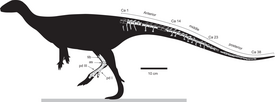
A diagram illustrating known parts of the skeleton |
| Scientific classification |
|---|
| No rank : | Bilateral symmetrical |
| Infraclass : | Archosauromorphs |
| No rank : | Archosauriformes |
| Infrastructure : | † Ornithopods |
|
| International scientific name |
|---|
Diluvicursor Herne et al. 2018 |
| Single view |
|---|
† Diluvicursor pickeringi Herne et al. 2018 |
Geochronology113-112 Ma | million years | Period | Era | Aeon |
|---|
| 2,588 | Even | | | Ka | F
but
n
e
R
about
s
about
th | | 23.03 | Neogene | | 66.0 | Paleogen | | 145.5 | a piece of chalk | M
e
s
about
s
about
th | | 199.6 | Yura | | 251 | Triassic | | 299 | Permian | P
but
l
e
about
s
about
th | | 359.2 | Carbon | | 416 | Devonian | | 443.7 | Silur | | 488.3 | Ordovician | | 542 | Cambrian | | 4570 | Precambrian |
◄ Nowadays◄ Cretaceous-Paleogene extinction◄ Triassic extinction◄ Mass Permian Extinction◄ Devonian extinction◄ Ordovician-Silurian extinction◄ Cambrian explosion |
|---|
|
Type specimen with preserved tail and hind limb fragments
The fossilized remains of Diluvicursor were found in 2005 in the Australian state of Victoria , in the Eumerall Suite, which dates from the lower Albian tier (approximately 113-112 million years ago). Here, on the shores of Cape Otway, not far from the widely excavated Dinosaur Bay, the remains of several other poultry species were found, along with the remains of other species. The new location is called " Eric the Red West Sandstone " ( Eng. Eric the Red West Sandstone ). The find in a scientific publication was reported in 2009 by Thomas Rich and his colleagues [2] .
The holotype NMV P221080 consists of an almost complete articulated tail that does not have only the first, second and twelfth vertebrae, and fragments of the lower right limb. The fossils are preserved on a stone slab. Apparently, the body of the dinosaur was washed away by a fast, full-flowing stream and subsequently trapped in plant debris near a tree stump. The fossils belonged to an immature individual. Sample NMV P229456, a partial caudal vertebra of a larger individual, found nearby in the same field, was also assigned to a taxon [1] .
The name and description of the new taxon was registered in January 2018 via the Internet on the ZooBank website - the official portal of the International Commission on Zoological Nomenclature . The generic name of the taxon comes from lat. diluvi ~ , which means “flood” or “flood”, and lat. cursor - "runner". The species name pickeringi is given in honor of David A. Pickering, who made a notable contribution to Australian paleontology and who died during the preparation of the study [1] .
Reconstruction of
Diluvicursor in a natural habitat
The sample is considered to belong to a teenage individual whose size was 1.2 meters in length. To recreate the lost parts of the skeleton, the proportions of gypsilophodone were conditionally taken. The article noted that the conservation of tail residues in a bent form made it impossible to determine its exact size. Based on an isolated caudal vertebra, an approximate estimate of the length of an adult at 2.3 meters was given [1] .
