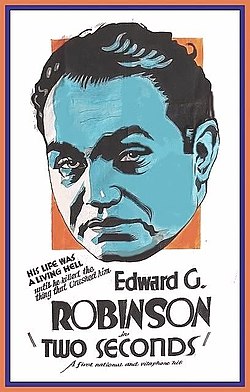
Two Seconds is an American crime drama directed by Mervyn Leroy , which was released in 1932 .
| Two seconds | |
|---|---|
| Two seconds | |
 | |
| Genre | Crime romance Drama |
| Producer | Mervyn Leroy |
| Producer | |
| Author script | Harvey Tew Elliott Leicester (play) |
| In the main cast | Edward G. Robinson Vivienne Osbourne Preston Foster |
| Operator | Sol Polito |
| Composer | |
| Film company | First national pictures Warner Bros (distribution) |
| Duration | 68 min |
| A country |  USA USA |
| Tongue | English |
| Year | 1932 |
| IMDb | ID 0023629 |
The film is based on the successful Broadway play of the same name, written by Elliott Leicester. The film tells about a construction worker ( Edward G. Robinson ) who falls in love with a vicious dancer ( Vivien Osborne ), which leads him first to the accidental murder of a friend ( Preston Foster ), then to the murder of the dancer, and ultimately to electrocution . The name of the picture implies the two seconds that a person in an electric chair still remains alive after turning on the electricity. During this time, it is believed that his whole life sweeps before him.
This was the third joint film directed by Mervyn Leroy and actor Edward G. Robinson after two successful works in the previous year - “ Little Caesar ” and “ Last Five Stars ”. Actor Preston Foster plays in this film the same role that he played in a Broadway production.
In 1932, the National Council of Film Critics of the United States included the picture in the list of 10 best films of the year [1] .
Story
When the sentenced to death John Allen ( Edward G. Robinson ) is taken to an electric chair , the prison warden answers to a question from one of the observers in the hall that the person lives about two seconds after giving the current, and during this time his whole life sweeps before him ... John's story begins at the moment when during Prohibition, he worked as a riveter in the construction of a New York skyscraper and shared an apartment with his best friend and colleague Bad Clark ( Preston Foster ). Bud, who was engaged and about to get married, asked his bride to go on a date with a friend who would be a couple for John. However, the girl did not interest John, and he went to the dance hall opposite, where he met with the paid dancer Shirley Day ( Vivien Osborne ). When one of the clients starts pestering Shirley, she screams to the whole room, and John arrives in time and hits the client in the face, knocking him down. Seeing this scene, the director of the hall, Tony ( J. Carroll Nash ), expels John, and Shirley dismisses him altogether. John invites Shirley to a bar for a milkshake, where she finds out that he decently makes money on a construction site. After John discusses that he would like to date an educated girl, Shirley says that she went to work in the dance hall only because she needs to keep sick parents who live on a farm in Idaho , before finishing one year in senior school classroom. Shirley pretends that she is interested in attending lectures with him, but instead persuades him to go to an underground bar, where a bootlegging gin is served under the guise of “tea”. Having drunk John to an almost insane state, Shirley leads him to a justice of the peace , who quickly arranges their marriage for a bribe. Returning with John to his apartment, Shirley drives Bad into the street. Three weeks later, while working on the 28th floor of a skyscraper, Bad tells John that Shirley is constantly cheating on him. In particular, her parents are not sick farmers in Idaho , but drunkards from Tenth Avenue that she spends too much money on clothes that she supposedly needs to work, and besides that, under the guise of going to the movies, she regularly meets Tony. Angry John swings at Bud with a wrench, from which he loses his balance, falls down and crashes to death. Depressed by grief, John quits his job, but life with the money Shirley receives in the dance hall decomposes him. Shirley, in turn, turns from a cute lady into an evil vixen. She dresses expensively and pays for the apartment, frankly declaring that she receives money from Tony. Shirley tells her husband that she decided to get Tony a job Annie, the unhappy and innocent widow of Bud, whom she met at the funeral. This enrages John. After an unexpectedly big win at the races, John repays debts to his bookmaker ( Guy Kibby ), leaving himself only money to buy weapons and to pay off debt to Tony. John comes to the dance hall, where he sees Shirley in Tony's arms. Contrary to the protests of the latter, Johnny gives him a debt, and then turns to Shirley with the words: “You turned me into a rat. Bad was right, you were born depraved and trying to corrupt other girls by making them like yourself. ” He kills Shirley with a few shots, and Tony screams out of the room. During the trial, the judge tells John that he could have referred to the state of affect as a defense, but John refuses the defense, saying that he had to be “burned” earlier when he was at the bottom, and not when he himself began to make justice. John is sentenced to death.
Cast
- Edward G. Robinson - John Allen
- Vivienne Osbourne - Shirley Day
- Preston Foster - Bad Clark
- J. Carroll Nash - Tony
- Guy Kibby - Bookmaker
- Frederick Burton - Judge
The history of the creation and rental results of the film
The film is based on the original play by playwright Elliott Leicester. The premiere of the play, which had the same name as the film, took place at the Ritz Broadway Theater on October 9, 1931. The only actor who repeated his theatrical role in the film was Preston Foster , who subsequently had a long career in Hollywood as a character actor [2] [3] .
Created at 310 thousand dollars, the film collected at the box office 822 thousand dollars [2] .
Criticism of a film
After the release of the film, columnist Mordant Hall wrote in The New York Times that "the film is dark and terrible, while being made expertly, capturing the viewer's attention." The critic writes that "despite its boring story, the film is admirable because it never stalls." At the same time, as a director, Mervyn Leroy “does everything very inventively and believably, expressively conveying to the viewer the last thoughts of the killer”, while “all the remarks are accurate and natural.” According to Hall, “ Robinson creates an amazingly strong image,” his game “is especially impressive when he shows his character’s nervous state or gives out heated words to the judge.” Hall also praised the play of Foster , Osborne and Nash. [4]
As modern film expert Bret Wood noted, although this film “often falls under the shadow of the outstanding gangster painting“ Little Caesar “(1931), which was also a joint work of Robinson and Leroy, today this newly discovered masterpiece serves as an example of a spectacular, harsh spectacle that defined the face of cinema on the eve of the introduction of the Production Code in the early 1930s. ” Although, according to Wood, “the plot of the picture may not seem particularly original, but it stands out for its presentation style. The unadorned, urbanistic atmosphere of the film is complemented by scenes detailing the simple entertainments of the main characters - this is a dance hall with rented dancers, and meaningless radio programs, and a bookmaker, and an underground bar that offers alcohol during the Prohibition period, calling it “tea.” In other words, the film is “a fascinating time capsule showing the tasteless amusements that appeased the suffering of Americans from the working class in those difficult socio-economic times.” Wood also draws attention to the "dramatic acting that fills the picture with life." Among other actors, Robinson is particularly notable, who “brilliantly played a fall in madness, the peak of which is a stunning monologue in court. In this four-minute scene, Robinson’s character releases his demons in a fight with his confused thoughts of revenge, justice and punishment, and the viewer sees him rolling to complete insanity. "Few actors would dare to such a feat, even less could cope with it." According to Wood, this "climax monologue of the film appears as one of the highest points in Robinson's career" [2] .
Notes
- ↑ Two Seconds (1932). Awards AllMovie. The appeal date is February 3, 2018.
- ↑ 1 2 3 Bret Wood. Two Seconds (1932). Article . Turner Classic Movies. The appeal date is February 3, 2018.
- ↑ Two Seconds . Internet Broadway Database. The appeal date is February 3, 2018.
- ↑ Mordaunt Hall. Edward G. Robinson in a Flash-Back Pictorial Melodrama Telling of the Last Thoughts of a Murderer . The New York Times (19 May 1932). The appeal date is February 3, 2018.
Links
- Two seconds on the IMDb website
- Two seconds on AllMovie website
- Two seconds on the website of the American Film Institute
- Two seconds on Turner Classic Movies