Hermaphroditism ( named after the Greek god Hermaphrodite ( dr. Greek Ἑρμαφρόδιτος )) - the simultaneous or sequential presence of male and female sexual characteristics and reproductive organs in the body .
Distinguish between natural hermaphroditism inherent in various species of animals and plants ( monoeciousness ) and abnormal (pathological) hermaphroditism of normally dioecious animals (see Ginandromorphism , Intersexuality ).
Content
- 1 Natural hermaphroditism
- 1.1 Synchronous hermaphroditism
- 1.2 Sequential hermaphroditism (dichogamy)
- 2 Abnormal (pathological) hermaphroditism
- 2.1 True hermaphroditism
- 2.2 Pseudohermaphroditism
- 3 notes
- 4 See also
Natural hermaphroditism
Hermaphroditism is quite widespread in nature - both in the plant world (in this case, the terms monoecious or multicommodity are usually used), and among animals. Most of the higher plants are hermaphrodites, hermaphroditism in animals is distributed primarily among invertebrates - a number of intestinal , the vast majority of flat , some annular and round worms, mollusks, crustaceans (in particular, the majority of species of barnacle cancers) and insects ( coccids ).
Among vertebral hermaphrodites are many species of fish, and hermaphroditism is most often manifested in fish inhabiting coral reefs.
Under natural hermaphroditism, an individual is capable of producing both male and female gametes , while a situation is possible where both types of gametes (functional hermaphroditism) or only one type of gametes (afunctional hermaphroditism) have the ability to fertilize.
Hermaphroditism is one of the varieties of sexual reproduction: hermaphrodite organisms produce male and female gametes , the fusion of which forms a zygote in the sexual process . Since the main evolutionary advantage of sexual reproduction is the recombination of the genetic material of the parent individuals during cross-fertilization (exogamy), most species have developed various forms of hermaphroditism during evolution that prevent self-fertilization (autogamy), but in many algae, fungi and flowering plants , and in the animal world - Among helminths (parasitic worms), self-fertilization is quite common.
Synchronous hermaphroditism
With synchronous hermaphroditism, an individual is capable of simultaneously producing male and female gametes.
In the plant world, this situation often leads to self-fertilization, which is found in many species of fungi , algae and flowering plants ( self-pollination in self-fertile plants).
In the animal world, self-fertilization with synchronous hermaphroditism occurs in helminths, hydras and mollusks, as well as some fish ( Rivulus marmoratus ), however, in most cases autogamy is prevented by the structure of the genital organs, in which the transfer of one's own sperm into the female genital organs is physically impossible (mollusks, in particular , aplisia , ciliary worms), or the inability to merge their own differentiated gametes into a viable zygote (some ascidia ).
Accordingly, with exogamous synchronous hermaphroditism, two types of copulative behavior are observed:
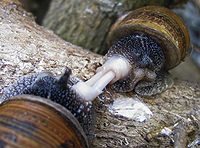
- mutual fertilization, in which both copulating individuals play the role of both males and females (most often among invertebrates, earthworms , grape snails can be taken as an example)
- consecutive fertilization - one of the individuals plays the role of the male, and the other the female; mutual fertilization in this case does not occur (for example, in perch fish of the genera Hypoplectrus and Serranus ).
Sequential hermaphroditism ( dichogamy )
In the case of sequential hermaphroditism ( dichogamy ), the individual sequentially produces male or female gametes, with either sequential activation of the male and female gonads or a change in the phenotype associated with the entire sex. Dichogamy can manifest itself both within the same reproductive cycle and during the life cycle of an individual, while the reproductive cycle can begin either from the male (protandria) or female (protoginia).
In plants, as a rule, the first option is common - with the formation of flowers, anthers and stigmas ripen at the same time. Thus, on the one hand, self-pollination is prevented and, on the other hand, due to the non-simultaneous flowering time of various plants in the population, cross-pollination is ensured.
In the case of animals, the phenotype is most often changed, that is, gender change. A striking example are many species of fish - representatives of the families of Gubanovy ( Labridae ), groupers ( Serranidae ), pomacenter ( Pomacentridae ), parrot fish ( Scaridae ), most of which are inhabitants of coral reefs.
Abnormal (pathological) hermaphroditism
It is observed in all groups of the animal world, including higher vertebrates and humans. Hermaphroditism in humans is a pathology of sexual determination at the genetic or hormonal levels.
Distinguish between true and false hermaphroditism [1] :
True hermaphroditism
It is characterized by the simultaneous presence of male and female genital organs, along with this there are both male and female genital glands. The testes and ovaries with true hermaphroditism can either be combined into one mixed sex gland, or are located separately. Secondary sexual characteristics have elements of both sexes: a low timbre of the voice, a mixed (bisexual) type of figure, and to some extent developed mammary glands. The chromosome set (karyotype) in such people usually corresponds to the female karyotype. In more rare cases, there is a situation where there are both cells containing the female chromosome set and cells containing the male chromosome set (the phenomenon of so-called mosaicism). True hermaphroditism is an extremely rare phenomenon (only about 150 cases are described in world literature) .
Pseudohermaphroditism
It occurs when there is a contradiction between the internal ( chromosomal and gonadal) and external (genital structure) signs of sex (bisexual development), that is, the genital glands are formed correctly according to the male or female type, but the external genitalia have signs of bisexuality.
Notes
- ↑ Deryagin G. B. Criminal sexology. Lecture course for law schools. - M., 2008 .-- S. 62 . ISBN 978-5-93004-274-0 .
See also
- Intersex
- Androgyny
- Ginandromorphism