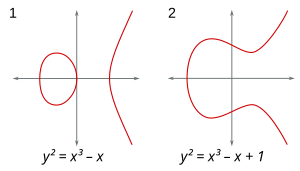
The Harnack curve theorem , named after Axel Harnack , gives the possible number of connected components that an algebraic curve can have in terms of the degree of the curve. For any algebraic curve of degree m on the real projective plane, the number of components c is bounded by the expression

The maximum number of components is one greater than the maximum kind of a curve of order m, achieved in the case of a nonsingularity of the curve. Moreover, any number of components in this range of possible values can be achieved.

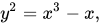
A curve that reaches the maximum number of real components is called an M-curve (from "maximum"). For example, an elliptic curve with two components, such as or the Trott curve , a quartic with four components, are examples of M-curves.
This theorem forms the prerequisites for the sixteenth Hilbert problem .
Modern studies have shown that Harnack curves are curves whose amoeba has an area equal to the polynomial P, which is called the characteristic curve of dimer models, and any Harnack curve is a spectral curve of some dimer model [1] [2] .
Notes
- ↑ Mikhalkin, 2001 .
- ↑ Kenyon, Okounkov, Sheffield, 2006 .
Literature
- Gudkov D.A. Topology of real projective algebraic varieties // Uspekhi Matematicheskikh Nauk. - 1974. - T. 29 , no. 4 . - S. 3–79 .
- Harnack CGA Ueber die Vieltheiligkeit der ebenen algebraischen Curven . - Math. Ann. - 1876. - T. 10. - S. 189–199.
- Wilson G. Hilbert's Sixteenth Problem // Topology. - 1978.- T. 17 . - S. 53–74 .
- Richard Kenyon, Andrei Okounkov, Scott Sheffield. Dimers and Amoebae // Annals of Mathematics . - 2006. - T. 163 , no. 3 . - S. 1019-1056 . - DOI : 10.4007 / annals.2006.163.1019 .
- Grigory Mikhalkin. Amoebas of algebraic varieties . - 2001.
Translation of the English article "Harnack's curve theorem"