Ekaterinhof ( German: Ekaterinhof , that is, “Catherine’s yard”) is a historical landscape park in the south-west of the Admiralteysky district of St. Petersburg , leading its history from the time of Peter the Great when the Spy Palace was built at the mouth of the Ekaterinofka river. In 1933 it was renamed the May 1 park , then in 1948 the park named after the 30th anniversary of the Komsomol [1] . The original name was returned in 1992 [2] .
| Ekaterinhof | |
|---|---|
| him. Ekaterinhof | |
 | |
| basic information | |
| Type of | regular park |
| Square | 33.86 ha |
| Established | 1711 year |
| Status |  An object of cultural heritage of the peoples of the Russian Federation of regional significance. Reg. No. 781520319830005 ( EGROKN ). (Wikigid database) An object of cultural heritage of the peoples of the Russian Federation of regional significance. Reg. No. 781520319830005 ( EGROKN ). (Wikigid database) |
| Location | |
| A country |
|
| City | St. Petersburg |
| A district of the city | Admiralteysky District |
| Underground |  "Narva" "Narva" |


Content
Location
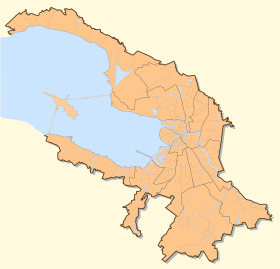
It is located on the Ekaterinofsky Island [5] [6] , bounded by the Ekaterinofka River, the Paper Channel and the Tarakanovka River in the Admiralteysky District, on the border with the Kirovsky District, in the historical district of Narva Outpost near the modern Stachek Square with the Narvskaya metro station. Perekopskaya street leads from the Stachek square to the park. Tram traffic is organized along Lifland Street through the park.
Nearby is the St. Petersburg State Technological University of Plant Polymers (formerly LTI Pulp and Paper Mill). The region is dominated by pre-revolutionary, constructivist and Stalinist buildings.
Neva Estuary Battle
One of the events of the Northern War , which became victorious for the Russian troops, occurred near the mouth of the Neva and became a stage in the consolidation of Russia in the territory of the future St. Petersburg: Russian soldiers led by Peter I and A. D. Menshikov captured two Swedish ships " Gedan ”and“ Astrild ”on May 6, 1703 [7] a few days after the capture of the main Swedish stronghold on the territory of the future Russian capital - the Nyenschanz fortress in the eastern part of the Neva Delta. This gave rise to the following years in May, following the decree of Peter the Great, in Yekaterinburg [8] , which became very popular among Petersburgers long before workers in May at the end of the 19th century became associated with the workers' struggle for their rights and the international solidarity of workers [9] .
Peter's time
The wooden Yekaterinhof Palace appeared in 1711 on the southern bank of the mouth of the Neva River as a suburban residence of Catherine I , the wife of Peter I. Peter gave these lands to his wife a few years after the conquest of the Swedes. Nearby on the neighboring islands were the royal Spy Palace and the estates Annenhof and Elizavethof allotted to their daughters (not preserved).
From the Empress’s palace, which was pulled for firewood, in 1926 the river Ekaterinofka was named, which is the western border of the entire park and its old, western part.
Amusement Park
In the 19th century, the Yekaterinhof Park became a public place for festivities and turned into a favorite vacation spot for Petersburgers. Rimsky-Korsakov Avenue , leading from the city center towards the park, at that time was called Ekaterinofsky. In 1823, at the initiative of the military governor-general of St. Petersburg, Count M. A. Miloradovich, the park was landscaped and thoroughly transformed by the construction of new buildings designed by architect O. Montferrand in the 1830s. [10] Ekaterinof became the place of traditional festivals of Petersburgers. Especially crowded were the festivities on the day of May 1, the city holiday of spring. “This place,” wrote the Russian disabled person newspaper on May 1, 1824, “ formerly so secluded and little decorated with Art, has now turned, as it were with some charm, into beautiful gardens and huts” [11]
In the park, according to the projects of O. Montferrand, pavilions were built that were freely placed in space and decorated in different neostil. Near the shore of Yekateringofka stood two wooden pavilions “in the Gothic style”: a farm with a belvedere tower and the Lion pavilion crowned with a high spire. On the other side of the walking highway, in the landscape of the park, Montferrand built a large pavilion also in the Gothic style, intended for concerts and summer balls. This pavilion was called the “station” (as various suburban and semi-suburban structures intended to entertain the public began to be called in Russia). “In the Gothic style”, with lancet arches, another large building was erected: Katalnaya Gorka. Not far from the station, in Kindergarten, Montferrand located the Moorish Pavilion (Pavilion Moresque), decorated in an exotic "oriental taste." And at some distance, next to a small picturesque lake, Montferrand built the building of the Russian Tavern. The park was surrounded by a picturesque winding river. One of the attractions of the park was the first in Russia innovative chain bridge designed by engineer P. Bazen. The four chains of the bridge rested on pylons made in the form of massive Gothic columns. [12] [13]
According to A. L. Punin, Doctor of Art Criticism, the importance of the park complex built by Montferrand is that it was the first manifestation of a new creative method in the history of Russian architecture, which replaced classicism and paved the way for eclecticism. [14]
K.A. Ton built nearby, on Staro-Petergofsky Prospect, the first temple in the Russian-Byzantine style - the Catherine Church (not preserved).
Yekaterinhof is often mentioned in the works of Russian classical literature, including the novels " Oblomov " and " Idiot " [15] . With the advent of the Putilov plant, Yekaterinhof turns into the factory outskirts of the city.
Soviet time
In Soviet times, the Park, named after the 30th anniversary of the Komsomol , had regional significance.
During the beautification of the front (eastern) part of the park after the war, a monument was erected there to the heroes of Krasnodon (a copy of the monument “Oath” in Krasnodon) [16] : young underground workers from the Young Guard organization who fought during the Great Patriotic War against the German fascist occupiers in the Lugansk ( Voroshilovgrad ) region of Ukraine. On the monument you can find the profile of Stalin - this is one of the three historical sculptural images of the Secretary General preserved in St. Petersburg [17] . In the same part, a cafe, a number of attractions and a boat station, preserved until the 21st century, were arranged.
In the western, older part of the park during the Soviet period, a small stadium and equestrian school appeared, operating in the 21st century. This part of the park is more neglected.
Modernity
In the post-Soviet era, several reconstruction projects were proposed for western Yekaterinhof. In particular, it was planned to recreate the park constructions of the XVIII — XIX centuries — the Moorish and Lion pavilions, as well as the palace of Catherine I in their former places. As of 2010, only the foundation of one of the pavilions was poured with concrete and a memorial tablet was installed about the first Russian naval victory, then damaged by vandals. Lifland Street , which cuts the park into two parts, was renovated.
Attractions
- Architectural and planning solution of the park with a system of ponds.
- Monument to the Heroes of Krasnodon [18]
- In the vicinity are located
- Narva Triumphal Gates .
- Compound of the Valaam Monastery .
- Palace of Culture named after A.M. Gorky
- Narva (metro station)
- Monument to L. A. Govorov
- Church of the Epiphany on Gutuevsky Island [19]
Notes
- ↑ Encyclopedia "St. Petersburg". Ekaterinhof
- ↑ St. Petersburg State Institution "Park" Ekaterinhof ". Historical background
- ↑ Kamenev Valerian Konstantinovich. Ekaterinhof
- ↑ Landscape with a river. Ekaterinof (Inaccessible link) . Date of treatment November 19, 2013. Archived December 4, 2013.
- ↑ Register of names of objects of the urban environment (Appendix to the Resolution of the Government of St. Petersburg dated 02.06.2006 No. 117). Html version at https://web.archive.org/web/20100529071152/http://kupsilla.narod.ru/reestr/reestr.htm
- ↑ Encyclopedia of St. Petersburg
- ↑ This place is marked in the park on the banks of Ekaterinofka with a memorial plaque as the site of the first Russian naval victory.
- ↑ May 1 (holiday)
- ↑ May Day (holiday) # May Day in the Russian Empire
- ↑ Punin A.L. Architecture of St. Petersburg in the middle and second half of the nineteenth century. T. 1. 1830 - 1860s. Early eclecticism. SPb., 2011.S. 41.
- ↑ Andreev A.I., Ekaterinhof Island // Nevsky Archive: History and Local Lore Collection. Vol. II. St. Petersburg, 1995.S. 17.
- ↑ Kormiltseva O.M., Sorokin P.E., Kishuk A.A. Ekaterinof. SPb., 2004.S. 22-40.
- ↑ Punin A. L. Architecture of St. Petersburg in the middle and second half of the 19th century. T. 1. 1830 - 1860s. Early eclecticism. SPb., 2011.S. 41-45.
- ↑ Punin A. L. Architecture of St. Petersburg in the middle and second half of the 19th century. T. 1. 1830 - 1860s. Early eclecticism. SPb., 2011.S. 41.45.
- ↑ After the scene with the money in the fireplace, Nastasya Filippovna leaves with Ekaterina, who was then entertaining, with Rogozhin and his company.
- ↑ Encyclopedia of St. Petersburg
- ↑ Dmitry Vitushkin. Find Stalin! Where in St. Petersburg you can still see the leader of the peoples . Moon.Info (02/07/2018).
- ↑ Encyclopedia of St. Petersburg . Date of treatment March 10, 2013.
- ↑ Church of the Epiphany on Gutuevsky Island
Literature
- Andreev A.I., Ekaterinhof Island // Nevsky Archive: History and Local Lore Collection. Vol. II. SPb., 1995.
- Gorbachevich K. S. , Khablo E. P. Why are they so named? On the origin of the names of streets, squares, islands, rivers and bridges of St. Petersburg. - 4th ed., Revised. - SPb. : Norint , 1996 .-- S. 310-311. - 359 p. - ISBN 5-7711-0002-1 .
- Kormiltseva O.M., Sorokin P.E., Kishuk A.A. Ekaterinof. SPb., 2004.
- Punin A.L. The architecture of St. Petersburg in the middle and second half of the XIX century. T. 1. 1830 - 1860s. Early eclecticism. SPb., 2011.
- Khodanovich V.I. Ekaterinof: From the imperial residence to the working outskirts. - M .: Centerpolygraph, 2013 .-- ISBN 978-5-227-04587-4 .
- Kuznetsov S.O. Guard Park. Historical and artistic research of Yekaterinhof in St. Petersburg // Art. 2017. No. 1-2. S. 94-141.
- Yekaterinof // Encyclopedic Dictionary of Brockhaus and Efron : in 86 volumes (82 volumes and 4 additional). - SPb. , 1890-1907.
Links
- Wikimedia Commons has media files related to Yekaterinhof
- Yekaterinhof Park and Palace on the site “St. Petersburg. Encyclopedia"
- Yekaterinhof Park on the site “Walks in St. Petersburg”