

Zemburek ( zamburek , zambruk , zambaruk from Persian زمبورک ) is a general term for an artillery installation with a small-caliber gun (as a rule, the diameter of the barrel bore ranged from 40-65 mm), placed on camels , and used by parts of the Arabian and Persian camel cavalry , Indian, Mongolian, Chinese and other Asian armies in the XVIII - XIX centuries , right up to the beginning of the XX century.
Zembureks were a special independent kind of light mobile artillery in the armies of these states. These were small cannons like the Falconet , transported by camels. It was believed that the camel gunners, who were called "zemburekchi", were able to annoy the enemy like bees (hence the name (translated from Pashtun - "little bee").
In addition to the guns, each camel carried on itself one or two zemburekchi and 40 charges, the nuclei of which weighed from 300 to 800 g, depending on the caliber; Zamburek fire could be fired on the move. The American researcher of the Afghan army, Colonel F. Colombari, who dedicated a special military-historical study to the Zembureks, claimed that the Gilzai from Kandahar were the first (in 1722 during the conquest of Iran) to guess how to install a zemburek in the saddle on a rotating rod.
On the battlefield, zembureks, as a rule, were located behind field artillery; sometimes, to deceive the enemy, they were hidden behind the ranks of infantry and cavalry. Camels were not afraid of the rumble of shots. The great mobility of the zembureks made it possible to admit the enemy to the distance of a carte shot without any particular risk to the zamburecci and their guns. Volley fire from zambureks inflicted heavy damage to the enemy.
The enormous role they played in the Battle of Panipat , where Ahmad Shah Durrani had about 2 thousand of these guns, is known.
Zembureks were successfully used until the 19th century, until they were finally crowded out as a result of the development of more powerful and accurate gun mount artillery. Later, zembureks played a purely decorative role, participating in military parades, and also served for salute shooting, during the shah's trips and during celebrations and celebrations.
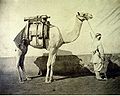
in stowed position
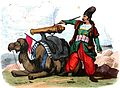
short stop shooting
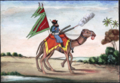
marching fire
Literature
- Ermolov P.N. "On the establishment of regular troops in Persia. On the regular infantry, cavalry and artillery called Zamburaki." RGVIA. F. 446. Op. 1. D. 6.
- Gankovsky Yu. V., Polishchuk A. I., Slinkin M. F., Lukov V. V. "History of the armed forces of Afghanistan 1747-1977." The main edition of oriental literature of the publishing house "Science", Moscow, 1985