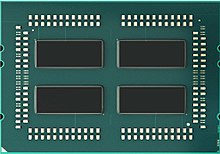
EPYC [1] is a series of AMD microprocessors aimed at use in servers and data centers .
| AMD EPYC | |
|---|---|
| CPU | |
 | |
| Production | from 2017 to the present |
| Manufacturer |
|
| CPU frequency | 2.0-3.2 GHz |
| Production technology | 14-7 nm |
| Instruction sets | x86 , X86-64 , MMX (+), SSE , SSE2 , SSE3 , SSSE3 , SSE4a , SSE4.1 , SSE4.2 , AES , CLMUL, AVX , AVX2 , FMA3 , CVT16 / F16C, ABM, BMI1, BMI2, SHA |
| Microarchitecture | Zen Zen 2 |
| Number of cores | up to 64 cores / 128 threads (up to 128 cores / 256 threads on systems with two sockets) |
| Connector |
|
The first generation of processors is based on Zen microarchitecture using several processor complexes connected by bus [2] ; processors went on sale June 20, 2017.
The trademark unites 12 models of processors of the 7000 series. All processors, with the exception of models with the P index, are capable of working in motherboards with two processor sockets [3] .
The number of cores in AMD EPYC varies from 8 to 32 pieces. Each physical core is capable of handling two logical threads . Thus, the number of logical cores varies from 16 to 64 pieces, depending on the processor model. In dual-processor systems, the number of physical cores can reach 64 pieces, and the number of logical cores - 128 pieces.
The processors support working with DDR4 standard memory , including error correction, with a total volume of up to 2 TB .
In 2019, the second generation of these processors will be released.
The number of cores in AMD EPYC (Rome) varies from 8 to 64 pieces.
The processors support working with DDR4 standard memory , including error correction, with a total volume of up to 4 TB .
Content
Ruler
Server
First Generation (Naples)
| Model | Kernels | Streams | CPU Frequency | Increased CPU Frequency | Level 1 cache | Level 2 cache | Level 3 cache | CPU socket | Connector configuration | RAM | PCI lines | Basic heat dissipation | Variable heat dissipation | release date |
|---|---|---|---|---|---|---|---|---|---|---|---|---|---|---|
| 7251 | eight | sixteen | 2.1 GHz | 2.9 GHz | 768 Kb | 4 Mb | 32 MB | Socket SP3 | Up to two | Eight-channel DDR4 up to 2666 MHz | 128 | 120 watts | June 2017 [4] | |
| 7281 | sixteen | 32 | 2.1 GHz | 2.7 GHz | 1,536 Mb | 8 Mb | 155 watts | 155-170 watts | ||||||
| 7301 | 2.2 GHz | 2.7 GHz | 64 MB | |||||||||||
| 7351 | 2.4 GHz | 2.9 GHz | ||||||||||||
| 7351P | One | |||||||||||||
| 7401 | 24 | 48 | 2.0 GHz | 3.0 GHz | 2,304 Mb | 12 Mb | Up to two | |||||||
| 7401P | One | |||||||||||||
| 7451 | 2.3 GHz | 3.2 GHz | Up to two | 180 watts | ||||||||||
| 7501 | 32 | 64 | 2.0 GHz | 3.0 GHz | 2,304 Mb | 16 Mb | 155 watts | 155-170 watts | ||||||
| 7551 | 3 Mb | 180 watts | ||||||||||||
| 7551P | One | |||||||||||||
| 7601 | 2.2 GHz | 3.2 GHz | Up to two |
Second Generation (Rome)
In November 2018, AMD announced Epyc 2 at its Next Horizon event, the second generation of Epyc processors code-named “Rome” and based on the Zen 2 microarchitecture. These processors have up to 64 cores with 128 threads .7nm Rome will be produced by TSMC Released on August 7, 2019
| Model | Kernels (streams) | Purity | Configuration connector | Cache | PCI lines ( PCI-E 4.0 ) | RAM | TDP | Socket | date exit | Price ( USD) | ||
|---|---|---|---|---|---|---|---|---|---|---|---|---|
| Full-time | Boost | L2 (kB) | L3 (MB) | |||||||||
| EPYC 7232P | 8 (16) | 3.1 | 3.2 | One | 32 | 128 | DDR4-3200 Eight channel | 120 W | SP3 | August 7, 2019 | $ 450 | |
| EPYC 7302P | 16 (32) | 3 | 3.3 | 128 | 155 W | $ 825 | ||||||
| EPYC 7402P | 24 (48) | 2.8 | 3.35 | 180 W | $ 1250 | |||||||
| EPYC 7502P | 32 (64) | 2.5 | $ 2300 | |||||||||
| EPYC 7702P | 64 (128) | 2 | 256 | 200 W | $ 4425 | |||||||
| EPYC 7252 | 8 (16) | 3.1 | 3.2 | Two | 64 | 120 W | $ 475 | |||||
| EPYC 7262 | 3.2 | 3.4 | 128 | 155 W | $ 575 | |||||||
| EPYC 7272 | 12 (24) | 2.9 | 3.2 | 64 | 120 W | $ 625 | ||||||
| EPYC 7282 | 16 (32) | 2.8 | $ 650 | |||||||||
| EPYC 7302 | 3 | 3.3 | 128 | 155 W | $ 978 | |||||||
| EPYC 7352 | 24 (48) | 2.3 | 3.2 | $ 1350 | ||||||||
| EPYC 7402 | 2.8 | 3.35 | 180 W | $ 1783 | ||||||||
| EPYC 7452 | 32 (64) | 2.35 | 155 W | $ 2025 | ||||||||
| EPYC 7502 | 2.5 | 180 W | $ 2600 | |||||||||
| EPYC 7542 | 2.9 | 3.4 | 225 W | $ 3400 | ||||||||
| EPYC 7552 | 48 (96) | 2.2 | 3.3 | 192 | 200 W | $ 4025 | ||||||
| EPYC 7642 | 2.3 | 256 | 225 W | $ 4775 | ||||||||
| EPYC 7702 | 64 (128) | 2 | 3.35 | 200 W | $ 6450 | |||||||
| EPYC 7742 | 2.25 | 3.4 | 225 W | $ 6950 | ||||||||
See also
- Opteron
- Xeon
Notes
- ↑ http://www.amd.com/system/files/2017-06/AMD-EPYC-Data-Sheet.pdf
- ↑ Kingsley-Hughes, Adrian . AMD EPYC: What you need to know | ZDNet (English) , ZDNet . Date of treatment February 7, 2018.
- ↑ AMD Dual-Slot AMD EPYC ™ Solutions | AMD . www.amd.com. Date of treatment February 7, 2018.
- ↑ AMD EPYC ™ Datacenter Processor Launches with Record-Setting Performance, Optimized Platforms, and Global Server Ecosystem Support . www.amd.com. Date of treatment February 7, 2018.
Links
- EPYC ™ | Server Processor for Datacenter | AMD (Russian)
- AMD returns to servers: getting to know AMD EPYC processors // ServerNews, 06/27/2017
- AMD Epyc: first look at new server processors / IXBT.com , July 6, 2017
- We study memory encryption in AMD processors, or how EPYC 7000 protects your cloud , // HWP.ru, July 3, 2019