Prince Ludwik Jan Nepomucen Sulkowski ( Polish: Ludwik Jan Nepomucen Sułkowski ; March 14, 1814 , Bielsko-Biala - February 18, 1879 , Bielsko-Biala ) - Polish aristocrat , 6th ordinate in Bielsko-Biala (1832-1849).
| Ludwik Jan Nepomucen Sulkovsky | |||||||
|---|---|---|---|---|---|---|---|
| polish Ludwik Jan Nepomucen Sułkowski | |||||||
 Prince Ludwik Sulkovsky, 1845 | |||||||
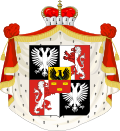 Coat of arms of Sulkovsky "Sulima" | |||||||
| |||||||
| Predecessor | Jan Nepomucen Sulkovsky | ||||||
| Successor | Liquidation of ordination | ||||||
| |||||||
| Predecessor | Jan Nepomucen Sulkovsky | ||||||
| Successor | Joseph Maria Ludwik Sulkovsky | ||||||
| Birth | March 14, 1814 Bielsko-Biala , Austrian Silesia , Austrian Empire  | ||||||
| Death | February 18, 1879 ( 64) Bielsko-Biala , Austrian Silesia , Austro-Hungarian Empire  | ||||||
| Kind | Sulkovsky | ||||||
| Father | Jan Nepomucen Sulkovsky | ||||||
| Mother | Baroness Ludwik von Larisch and Gross-Nimsdorf | ||||||
| Spouse | 1) Baroness Anna Elizabeth Francis von Dietrich (1845-1853) 2) Maria Antonia Gemperle (1853-1870) | ||||||
| Children | from first marriage : Joseph Maria Ludwik from a second marriage : Taida, Ludwik, Alfred, Alexander Edward , Antonina, Stanislav, Paulina, Sigmund, Gabriela, Wanda, Edgar and Victor illegitimate son from connection with Maria Harry : Ludwik Ian Harry | ||||||
Childhood and Youth

Representative of the Polish magnate clan of the Sulkovo coat of arms “ Sulima ”. The eldest son of Prince Jan Nepomucen Sulkowski (1777-1832), the 5th ordinate in Bielsko-Biale (1812-1832), and Baroness Ludwiki von Larisch and Gross-Nimsdorf (1786-1848). The younger brother is Prince Maximilian Sulkovsky (1816-1848).
He spent his childhood in the castle of the Princes Sulkowski in Bielsko-Biala , where he was raised in the Polish spirit. Since 1824 he studied at a local gymnasium. In the same year, his father, Jan Nepomucen Sulkovsky , was imprisoned for his pro-Napoleonic activities, deprived of his ranks and title to property. Since 1826, at his request, Ludwik continued his education in Bochnia among the Polish aristocracy. The Austrian authorities and aunt Julianna Metterich from the Sulkowski clan (1776-1839) decided to bring up the young man in a German spirit. In 1829, through their efforts, he was transferred to a gymnasium in Tesin , where he passed the exams. In the autumn of the same year, he began training at the Vienna Theresianum . This time was the conclusion and death of his father in the Terezin fortress [1] .
If necessary, Ludwik Jan Nepomucen Sulkovsky began military service in the Austrian army . Since 1834 he served as a warrant officer in the 30th Galician Infantry Regiment named after Count Laval Nugent von Westmet, stationed in Lviv . In 1837, Prince Sulkovsky served as second lieutenant in the 4th Ulan Imperial Regiment named after Kaiser Ferdinand (headquarters in Alt Arad in Hungary). A year later, in 1838, he still served with the rank of second lieutenant in the same regiment with headquarters in Horad , where he completed his military service.
In 1835, Ludwik Jan Nepomucen Sulkowski was declared an adult, and the next year received the right to ordination in Bielsko-Biala. He took over the management of his father's inheritance with great debt during the sequestration of property carried out after the conclusion of his father. In addition, on August 5, 1836, a big fire occurred in the city. The first and second floors, the castle tower, as well as the adjacent buildings, including the castle chapel , theater , factory and stable, were destroyed. Prince Ludwik Sulkovsky moved his residence from the castle to the modest Wilhelm Manor (Wilhelmshof) in Upper Olszowka . After entering into the inheritance, he immediately began to reform the property and reconstruct the castle.
Revolutionary and Emigrant
Despite the aristocratic title, in the spring of 1848, Prince Ludwik Jan Nepomucen Sulkovsky took part in the " Spring of the Peoples " on the side of the revolutionaries. The ordinate supported the struggle against monarchist despotism and advocated democratic reforms in the Austrian Empire. The prince was involved in the creation of a national guard on the territory of Bielsko-Biala and became her commandant. In the autumn of that year, Ludwik Sulkovsky led the Bielskie Democratic Society, which advocated the creation of a republic in Austria , the unification of German states and the inclusion of Austrian Silesia in Germany. On October 15, after the start of the third uprising in Vienna ( October 6 ), a popular assembly was convened in Bielsko-Biała , at which a decision was made to send volunteers to the capital. On October 17, a Belleys detachment under the command of Prince Ludwik Sulkovsky (from 125 to 200 guardsmen) at the train station in Ostrava joined other guard detachments sent from Oberberg to Vienna . At night, the train arrived in Napayedla outside Kromeriz , where government troops easily disarmed the poorly armed and trained volunteer guards. Prince Sulkovsky was arrested, but at night was able to escape from custody. He was sentenced in absentia to imprisonment. On December 2, 1848, the government imposed sequestration on the Sulkowski property in Bielsko-Biala . The following 1849, the new Austrian Emperor Franz Joseph I carried out administrative reform of the monarchical system. Old feudal structures were abolished. The Principality in Bielsko-Biala officially ceased to exist; the Bielsko-Biala County was created under the control of the headman. Ordinary Prince Ludwik Jan Nepomucen Sulkovsky became one of the citizens of the city and became subordinate to local authorities.
Prince Ludwik Sulkovsky left for emigration to Switzerland . He settled in Rorschach on the shores of Lake Constance, from where he moved to the United States . October 14, 1852 he arrived on the ship "Radius" in New York . Then he moved to Albany , and then to Harrisville, near Lake Bonaparte, where he settled for a while. In 1855, Prince Sulkovsky moved further south, to New Bremen ( New York State ), which was also called Danville. During his stay in the United States, Prince Sulkovsky was engaged in farming and significantly increased his property, which he returned to the Foundation for the wounded in the Civil War and then to the New Bremen municipality for school purposes before returning to Europe. Thanks to constant contacts with representatives of the old continent, he oversaw family property and reconstruction of the castle in Bielsko-Biala . In 1850, repairs began on the castle of the Princes Sulkowski in Bielsko-Biala .
In 1861, Prince Ludwik Jan Nepomucen Sulkovsky returned to Europe, and in 1864 - to Bielsko-Biala . Until the end of his life, he was engaged in the management of his property and the modernization of the interior of the family castle and its environs. In 1866, during the Prussian-Austrian war , which also affected Bielsko-Biala , Prince Sulkowski was in Paris for several months among Polish immigrants. In 1873, he decorated his castle in honor of the anniversary of the emperor of Austria-Hungary, Franz Joseph I.
In the last years of his life, his health deteriorated. Prince Ludwik Sulkovsky died in a castle in Belsh on February 18, 1879 at the age of 64. His body was buried in the crypt of the castle chapel [2] .
According to the local press, Ludvik Sulkovsky was introverted, calm and hardworking, and did not boast of his fortune. He was a very open and kind person for everyone, regardless of social background. He devoted most of his free time to his favorite family pastime - hunting. Also, Prince Sulkovsky was a philanthropist .
Personal life
Prince Ludwik Sulkovsky was twice married. During his military service in Hungary, his mistress was Maria Harry (daughter of a royal notary from Lugož ), who arrived with him in Bielsko-Biala and settled on the estate of Wilhelm. Here, on May 29, 1841, she gave birth to an illegitimate princely son, Ludvik Ian Harry (died on December 13, 1906 in Sebis , his descendants live in Romania today), whom Prince Sulkovsky, despite plans, never recognized as his legitimate son [3] .
Soon, Mary Harry and her son faded into the background. Prince Ludwik Sulkovsky got engaged in Vienna with Baroness Anna Elizabeth Franziska von Dietrich (1823–1853), daughter of financial tycoon, Baron Joseph von Dietrich (1780–1855). Their wedding took place on October 2, 1845 in the parish church of St. Florian in Matzleinsdorfie near Vienna. On February 2, 1848, the first-born was born in the Sulkovsky family. At baptism, he received the name Joseph Maria Ludwik (1848-1920), the future 7th prince in Bielsko-Biala. Thanks to this marriage union, the Sulkowski, being the only heirs of Dietrich, became the richest owners in the entire Austro-Hungarian Empire (in particular, they owned Faistritz am Veksel , Mürtsuschlag and others), which Ludwik controlled until 1870 , when they received the full rights of his eldest son Joseph Mary [4] .
During his emigration to Switzerland, Prince Ludwik Sulkowski met a minor, Maria Antonia Gemperle (1832–1870), the daughter of Josef Anton Gemperle, a merchant from Rorschach . Together they left for the USA . When Anna Sulkovskaya died in Vienna on February 13, 1853 , the prince decided to marry his Swiss mistress, who was already pregnant. Their wedding took place on June 3, 1853 in the church of the Holy Cross in Albany . In this marriage, 12 children were born. On the American continent , Taida (1853–1918), Ludwik (1854–1880), Alfred (1855–1913), Alexander Eduard (1856–1929), the 8th prince in Bielsko-Biala , and Antonina (1858–1910) were born. After returning to Europe, the following children were born in Switzerland: Stanislav (1862–1940) and Paulina (1863–1889); in Bielsko-Biala, the following were also born: Sigmund (1864–1865), Gabriela (1866–1945), and the Wanda twins (1868 —1930) and Edgar (1868-1945), as well as Victor (1870-1945). After the birth of her last child, Maria died on March 5, 1870 . She was buried in the crypt of the castle chapel in Bielsko-Biala .
Also, Ludwik Sulkovsky had an affair with the famous Irish dancer and actress Lola Montes (1821-1861), a favorite of the King of Bavaria, Ludwig I. Most likely, the prince met with her in the 1840s, as can be seen from her hopes of marrying him and a letter from Ludwik in January 1858 , in which he wrote to a friend from Albany that he was happy in his relations with Mary and not going to marry Lola. In the end, Lola Montes could not harm the family relations of the prince [5] .
Notes
- ↑ Kincel 1984, s. 124, 146-149; Madej 2015b, s. 8-11.
- ↑ Krasińska 1995, s. 167; Madej 2015b, s. 43-47; G. Madej, Bielska linia ..., s. 132-133, 271.
- ↑ Madej 2015b, s. 14-15.
- ↑ M. Preinfalk, Jožef baron Dietrich in njegove povezave z rodbino Sulkowski, w: Zapomniani książęta ?, s. 128.
- ↑ Collier's New Encyclopedia; Seymour 1996; Greene 2000, s. 77.
Sources
- Collier's New Encyclopedia. New York: 1921, s. (hasło Montez Lola).
- G. Greene: The 48 Laws of Power. New York: 2000.
- FB Hough: History of Lewis County. New York: 1860.
- R. Kincel: Kłopotliwy książę Sułkowski. Katowice, 1984.
- Grzegorz Madej: Luiza, księżna Sułkowska z domu Larisch-Nimsdorf (1790-1848). W: Jej ślad w historii - kobiety w województwie śląskim na przestrzeni wieków. W cieniu Beskidów. red. A. Muszyńska, A. Skiendziel, A. Skrzypietz. Katowice: 2015.
- Grzegorz Madej. Książę Ludwik Sułkowski (1814-1879), rewolucjonista, emigrant i ostatni budowniczy bielskiego zamku. "Zeszyty Sułkowskich." Nr 3, 2015. ISSN 2299-582X.
- Dariusz Nawrot: Powstanie na Nowym Śląsku w 1806 i 1807 roku. U źródeł Zagłębia Dąbrowskiego. Czeladź: 2016.
- B. Seymour: Lola Montez: A Life. Yale: 1996.
- Świadek epoki: listy Elizy z Branickich Krasińskiej z lat 1835-1876. T. 4. Warszawa: 1995.
- Zapomniani książęta? Sułowscy w XVIII — XX wieku. red. Grzegorz Madej, Dariusz Nawrot. Katowice: 2016.