k · p method is a perturbation theory method in solid state physics that allows you to approximately calculate the energy and wave function of a charge carrier at an arbitrary point in the Brillouin zone from known values at another point, usually at a point of high symmetry . For this, the values of the band gap and the effective masses at the point of high symmetry obtained from experiment or numerical calculation are used. The method is especially effective in calculating the effective mass , but using high orders of perturbation theory, one can calculate the dispersion law in the entire zone. The method was developed in the works of J. Bardin [1] and F. Seitz [2] . It got its name because of the perturbation in the form of the product of the wave vector denoted by k and the moment operator p .
Bloch's theorem and wave vectors

According to quantum mechanics (in the one-electron approximation), quasi-free electrons in any solid are characterized by wave functions, which are eigenstates of the following stationary Schrödinger equation :
- {\ displaystyle \ left ({\ frac {p ^ {2}} {2m}} + V \ right) \ psi = E \ psi}
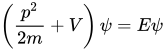
where p is the quantum - mechanical operator of momentum , V is the potential , m is the mass of the electron. (This equation neglects the spin-orbit effect).
In a crystalline solid, V is a periodic function, with the same periodicity as the crystal lattice. Bloch's theorem states that the solutions of this differential equation can be written as follows:

where k is the vector (called the wave vector), n is the discrete index (called the zone index), and u n , k is the function with the same periodicity as the crystal lattice.
For any given n, the associated states are called a zone. In each zone, there will be a relationship between the wave vector k and the state energy E n , k , called the dispersion law. The calculation of this variance is one of the main applications of the k · p perturbation theory.
Perturbation Theory
The theory acquired a modern form in the works of Kane who considered perturbation theory for narrow-gap semiconductors [3] . The periodic function u n , k satisfies the following equation of Schrödinger type: [4]

where the Hamiltonian is equal

Note that k is a vector consisting of three real numbers with dimension of inverse length, and p is a vector consisting of operators. Explicitly

In any case, this Hamiltonian is written as the sum of two terms:

This expression is the basis for perturbation theory. The “unperturbed Hamiltonian” is equal to H 0 , which is actually equal to the exact Hamiltonian at k = 0 (that is, at the Gamma point). "Disturbance" . The analysis of these results is called the “k · p perturbation theory” because of the term proportional to k · p. The result of this analysis is an expression for E n , k and u n , k in terms of energies and wave functions at k = 0.

Note that the contribution of “disturbance” it gets smaller as k approaches zero. Therefore, the k · p perturbation theory is most accurate for small values of k . However, if a sufficient number of terms are included in the expansion of the perturbation theory, then the theory can be sufficiently accurate for any value of k , that is, in the entire Brillouin zone. If the minimum of the conduction band is at another point, for example, k 0 , then the expression for the Hamiltonian can be modified for this case [5] :
![{\ displaystyle H _ {\ mathbf {k}} = H _ {\ mathbf {k} _ {0}} + \ left [{\ frac {\ hbar} {m_ {e}}} (\ mathbf {k} - \ mathbf {k} _ {0}) \ cdot (\ hbar \ mathbf {k} _ {0} -i \ hbar \ mathbf {\ nabla}) + {\ frac {\ hbar ^ {2}} {2m_ {e }}} | \ mathbf {k} - \ mathbf {k} _ {0} | ^ {2} \ right],}](https://wikimedia.org/api/rest_v1/media/math/render/svg/a99ab6938d408d64f6c3bd7af1de06d9651c15bd)
Where

The terms containing k - k 0 in this case are small corrections, which are a perturbation.
Non-degenerate zone
For a non-degenerate zone (that is, for a zone whose energy at the point k = 0 differs from the energy of any other zone) with an extremum at k = 0, and in the absence of spin-orbit interaction , the k [4] :


Where and Are the wave function and the energy of the quasiparticle in the nth zone with the wave vector k , respectively, and and - similar values for a quasiparticle with zero quasimomentum .


Since k is a real vector, i.e. a set of digits, and not an operator, the matrix elements are rewritten as:

So you can calculate the energy for any k using only a few unknown parameters: E n , 0 and . The matrix elements given by the last expression are related to the dipole moments of the transition. They are called optical matrix elements and are usually obtained from the analysis of experimental data, such as optical absorption [6] .
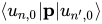
In practice, the sum over n 'is often limited only to two neighboring zones, since their contribution is most important (given the denominator). However, to increase the accuracy, especially for large k , it is necessary to take into account several zones, and in addition also additional orders of the perturbation theory.
Effective Mass
The dispersion law described above can be used to calculate the effective mass of conduction electrons in a semiconductor [7] . To calculate the dispersion law in the case of the conduction band, we take the energy E n0 of the bottom of the conduction band E c0 and only those terms in the sum associated with the top of the nearest valence band for which the difference in the denominator is the smallest since the contribution of these terms to the sum is the largest. Then the denominator is equal to the band gap E g , which gives the following expression for the energy of the conduction electron:

Then the effective mass in the direction ℓ is equal to:

Without considering matrix elements in detail, we can make an important conclusion that the effective mass depends on the band gap and becomes zero when the band gap is zero [7] [8] .
Useful estimates for the matrix elements of direct-gap semiconductors give: [9]
- eB


which is true with an accuracy of about 15% or better for most semiconductors of groups IV, III – V, and II – VI. [ten]
Mobile charge carriers in the valence band are called holes. It turns out that there are two types of holes with different effective masses. They are called heavy and light. Their effective masses are anisotropic.
Accounting for spin-orbit interaction
Taking into account the spin-orbit interaction, the Schrödinger equation for u takes the form [11] :

where [12]

here Pauli matrices . One can work with this Hamiltonian in the same way as stated above.

Degenerate zones
To calculate degenerate or close bands, in particular for the valence band in materials like gallium arsenide, the equation can be analyzed using a suitable version of perturbation theory [4] [11] . Models of this type include the Luttiger-Kohn model [13] and the Kane model . [12] .
Notes
- ↑ Bardeen J.,. An Improved Calculation of the Energies of Metallic Li and Na // J. Chem. Phys .. - 1938.- T. 6 . - S. 367 . - DOI : 10.1063 / 1.1750270 . Archived January 19, 2018.
- ↑ Seitz F. The Modern Theory of Solids = The Modern Theory of Solids. - 2nd ed. - New York: McGraw Hill, 1940 .-- S. 352. - 698 p. - ISBN 0070560307 . - ISBN 978-0070560307 .
- ↑ Kane EO Band structure of narrow gap semiconductors. - Berlin: Springer, 1980 .-- S. 13-31. - ISBN 978-3-540-10261-8 . - DOI : 10.1007 / 3-540-10261-2 .
- ↑ 1 2 3 P. Yu, M. Cardona. Fundamentals of Semiconductors: Physics and Materials Properties . - 3rd. - Springer , 2005 .-- P. Section 2.6, pp. 68 ff '. - ISBN 3-540-25470-6 .
- ↑ Marconcini P., Macucci M. The kp method and its application to graphene, carbon nanotubes and graphene nanoribbons: the Dirac equation // La Rivista del Nuovo Cimento. - 2011 .-- T. 34 . - S. 489-584 . - DOI : 10.1393 / ncr / i2011-10068-1 . - arXiv : 1105.1351 . Archived January 19, 2018.
- ↑ Kane, 1980 , p. 13.
- ↑ 1 2 WP Harrison. Electronic Structure and the Properties of Solids. - Reprint. - Dover Publications , 1989 .-- P. 158 ff . - ISBN 0-486-66021-4 .
- ↑ See Yu & Cardona, op. cit. pp. 75-82
- ↑ A direct-gap semiconductor has the top of the valence band and the bottom of the conduction band for the same value of k , usually at the Γ-point, where k = 0.
- ↑ See Table 2.22 in Yu & Cardona, op. cit.
- ↑ 1 2 C. Kittel. Quantum Theory of Solids. - Second Revised Printing. - New York: Wiley , 1987. - P. 186-190. - ISBN 0-471-62412-8 .
- ↑ 1 2 Evan O. Kane. Band Structure of Indium Antimonide ( Neopr .) // Journal of Physics and Chemistry of Solids . - 1957.- T. 1 . - S. 249 . - DOI : 10.1016 / 0022-3697 (57) 90013-6 . - .
- ↑ JM Luttinger, W. Kohn. Motion of Electrons and Holes in Perturbed Periodic Fields (Eng.) // Physical Review : journal. - 1955. - Vol. 97 . - P. 869 . - DOI : 10.1103 / PhysRev . 97.869 . - .