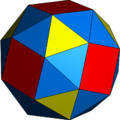
 Flat-nosed cube or plane-nosed cuboctahedron | 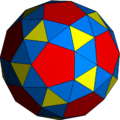 Flat nosed dodecahedron or nasal icosododecahedron |


The snub operation or clipping vertices is an operation applied to polyhedra. The term appeared from the names given by Kepler to two Archimedean bodies - a flat - nosed cube (cubus simus) and a flat-nosed dodecahedron (dodecaedron simum) [1] . In the general case, flat-nosed forms have a chiral symmetry of two types, with clockwise and counterclockwise orientations. According to Kepler’s names, cutting off vertices can be considered as stretching a regular polyhedron, when the original faces move away from the center and rotate relative to the centers, polygons with centers at these vertices are added instead of the original vertices, and pairs of triangles fill the space between the original edges.
Coxeter generalized the terminology with a slightly different definition for a wider variety of .
Operation Conway's snub
John Conway investigated generalized operations on polyhedra, defining what is now called the Conway notation for polyhedra , which can be applied to polyhedra and mosaics. Conway called the Coxeter operation semi-snub (semi-snub) [2] .
In this notation, snub is defined as a composition of dual and gyro operators, 
| Polyhedra | Euclidean Mosaics | Hyperbolic mosaics | ||||
|---|---|---|---|---|---|---|
| Notation Conway | sT | sC = sO | sI = sD | sQ | sH = sΔ | sΔ 7 |
| Flat-nosed polyhedron | Tetrahedron | Cube or Octahedron | Icosahedron or Dodecahedron | Square mosaic | Hexagonal mosaic or Triangular mosaic | Heptagonal mosaic or |
| Picture | ||||||
In 4-dimensional spaces, Conway believes that a should be called a half-plane 24-cell , since it does not represent an alternate , as its counterpart in 3-dimensional space. Instead, it is an alternate, [3] .
Coxeter snub operations, right and quasi-correct
| Source body | Fully truncated polyhedron r | Truncated polyhedron t | h |
|---|---|---|---|
Cube | Cuboctahedron Fully truncated cube | Truncated cuboctahedron Beveled truncated cube | Plane nosed cuboctahedron Flat-nosed full-truncated cube |
| C | CO rC | tCO trC or trO | htCO = sCO htrC = srC |
| {4.3} | or r {4,3} | or tr {4,3} | htr {4.3} = sr {4.3} |
| or | or | or | |
The terminology of “Coxeter's snub” (cutting off the vertices) is somewhat different and means truncation , according to which the plane-nosed cube is obtained by the operation snub (cutting off the vertices) from the cuboctahedron , and the plane-nosed dodecahedron is obtained from the icosododecahedron . This definition is used in the names of Johnson’s two bodies - the flat-faced duclinoid and the flat- nosed square antiprism , as well as in the names of higher-dimensional polyhedra, such as the 4-dimensional , or s {3,4,3}.
The correct polyhedron (or mosaic) with the Shlefly symbol, and Coxeter chart has a truncation defined as with chart , and a nasal shape defined as an truncation with Coxeter chart . This construction requires q to be even.
Quasiregular Polyhedron or r { p , q }, with a Coxeter diagram or has a quasi-correct truncation defined as or tr { p , q } (with Coxeter diagram or ) and a quasiregular plane-nosed shape defined as an truncation of full truncation or htr { p , q } = sr { p , q } (with Coxeter diagram or )
For example, a Kepler's flat-nosed cube is obtained from a quasiregular cuboctahedron with a vertical Shlefli symbol (and Coxeter chart ) and more precisely called the plane-nosed cuboctahedron , which is expressed by the Shlefli symbol (with Coxeter chart ) The plane-nosed cuboctahedron is an alternative to the truncated cuboctahedron ( )
Regular polyhedra with an even order of vertices can also be reduced to a plane-nosed shape as an alternate truncation, similar to a plane-nosed octahedron ( ) (and the flat-nosed tetrahedron , ) represents a pseudo- icosahedron , a regular icosahedron with pyritohedral symmetry . The flat-nosed octahedron is an alternate form of a truncated octahedron , ( ), or in the form of tetrahedral symmetry: and .
| Truncated t | Alternate h | |
|---|---|---|
| Octahedron O | Truncated octahedron tO | Ploskosa octahedron htO or sO |
| {3,4} | t {3,4} | ht {3,4} = s {3,4} |
The operation of cutting off the vertices (noses) of Coxeter also makes it possible to determine the n- antiprism as or based on n-prisms or , but is a regular osohedron , a degenerate polyhedron, which is an admissible mosaic on a sphere with two-sided or moon-like faces.
| Picture | ||||||||
|---|---|---|---|---|---|---|---|---|
| Charts Coxeter | | | | | | | ... ... | |
| Symbol Loafs | s {2,4} | s {2,6} | s {2,8} | s {2,10} | s {2,12} | ... | ||
| sr {2,2} | sr {2,3} | sr {2,4} | sr {2,5} | sr {2,6} | sr {2.7} | sr {2,8} ... ... | sr {2, ∞} | |
| Notation Conway | A2 = T | A3 = O | A4 | A5 | A6 | A7 | A8 ... | A∞ |
The same process applies to flat-nosed mosaics:
| Triangular mosaic Δ | Truncated Triangular Mosaic tΔ | Flat nosed triangular mosaic htΔ = sΔ |
|---|---|---|
| {3,6} | t {3,6} | ht {3,6} = s {3,6} |
Examples
| Space | Spherical | Euclidean | Hyperbolic | |||||
|---|---|---|---|---|---|---|---|---|
| Picture | ||||||||
| Diagram Coxeter | ... | |||||||
| Symbol Loafs | s {2,4} | s {3,4} | s {4,4} | ... | ||||
| Space | Spherical | Euclidean | Hyperbolic | |||||
|---|---|---|---|---|---|---|---|---|
| Picture | ||||||||
| Diagram Coxetere | ... | |||||||
| Symbol Loafs | sr {2,3} | sr {3,3} | sr {4,3} | sr {5,3} | sr {6,3} | ... | ||
| Notation Conway | A3 | sT | sC or sO | sD or sI | sΗ or sΔ | |||
| Space | Spherical | Euclidean | Hyperbolic | |||||
|---|---|---|---|---|---|---|---|---|
| Picture | ||||||||
| Diagram Coxeter | ... | |||||||
| Symbol Loafs | sr {2,4} | sr {3,4} | sr {4,4} | ... | ||||
| Notation Conway | A4 | sC or sO | sQ | |||||
Inhomogeneous flat-bottomed polyhedrons
In heterogeneous polyhedra, for which an even number of edges converge to the vertices, vertices can be cut off, including some infinite collections, for example:
| Flat Nose Square Bipyramid |
|---|
| Flat Hexagonal Bipyramid |
| Picture | ... | |||
|---|---|---|---|---|
| Symbol Loafs | ss {2,4} | ss {2,6} | ss {2,8} | ss {2,10} ... |
| ssr {2,2} | ssr {2,3} | ssr {2,4} | ssr {2,5} ... |
Homogeneous flat-stellated stellate polyhedrons of Coxeter
Plane-star stellated polyhedra are constructed according to the Schwartz triangle (pqr) with rational mirrors, in which all the mirrors are active and alternate.
| s {3 / 2,3 / 2} | | | | |
| | | | | |
Flat-faced polyhedra and Coxeter honeycombs in high-dimensional spaces
In the general case, regular 4-dimensional polyhedra with the Shlefli symbol , and Coxeter chart has a flat-nosed shape with an extended Shlefly symbol and chart .
Fully truncated polyhedron = r {p, q, r} , and has snub symbol = sr {p, q, r} , and .
Examples
There is only one homogeneous plane-nosed polyhedron in 4-dimensional space, the plane- . The correct twenty-four-cell has the Schleaf symbol , and Coxeter chart , and the flat-nosed 24-cell is represented by and chart diagram of Coxeter . It also has a lower symmetry construction with index 6 as or s {3 1,1,1 } and , and symmetry with index 3 as or sr {3,3,4}, or .
Connected or s {3,4,3,3}, body with lower symmetry as or sr {3,3,4,3} ( or ), and with the least symmetry as or s {3 1,1,1,1 } ( )
Euclidean honeycombs are , s {2,6,3} ( ) or sr {2,3,6} ( ) or sr {2,3 [3] } ( )
Other Euclidean (equilateral) cells are s {2,4,4} (and ) or sr {2,4 1,1 } ( ):
The only homogeneous planar hyperbolic honeycombs are planar hexagonal mosaic honeycombs , s {3,6,3} and which can also be constructed as , h {6,3,3}, . It is also constructed as s {3 [3,3] } and .
Other hyperbolic (isosceles) cells are , s {3,4,4} and .
See also
- Flat-nosed polyhedron
| The foundation | Truncation | Full truncation | Dual nost | Sprain | |||||
|---|---|---|---|---|---|---|---|---|---|
| t 0 {p, q} {p, q} | t {p, q} | t 1 {p, q} r {p, q} | 2t {p, q} | t 2 {p, q} 2r {p, q} | rr {p, q} | tr {p, q} | h {q, p} | ht 12 {p, q} s {q, p} | ht 012 {p, q} sr {p, q} |
Notes
- ↑ Kepler , Harmonices Mundi , 1619
- ↑ Conway, 2008 , p. 287.
- ↑ Conway, 2008 , p. 401.
Literature
- HSM Coxeter, MS Longuet-Higgins, JCP Miller. Uniform polyhedra // Philosophical Transactions of the Royal Society of London. Series A. Mathematical and Physical Sciences. - The Royal Society, 1954. - T. 246 , no. 916 . - S. 401-450 . - ISSN 0080-4614 . - DOI : 10.1098 / rsta . 1954.0003 .
- Coxeter, HSM 8.6 Partial truncation, or alternation // Regular Polytopes . - 3rd. - 1973. - S. 154–156. - ISBN 0-486-61480-8 .
- Coxeter . Tables I and II: Regular polytopes and honeycombs // . - 3rd. ed .. - Dover Publications, 1973. - S. 154–156. - ISBN 0-486-61480-8 .
- HSM Coxeter . Kaleidoscopes: Selected Writings of HSM Coxeter / F. Arthur Sherk, Peter McMullen, Anthony C. Thompson, Asia Ivic Weiss. - Wiley-Interscience Publication, 1995. - ISBN 978-0-471-01003-6 .
- (Paper 17) Coxeter , The Evolution of Coxeter – Dynkin diagrams , [Nieuw Archief voor Wiskunde 9 (1991) 233–248]
- (Paper 22) HSM Coxeter, Regular and Semi Regular Polytopes I , [Math. Zeit. 46 (1940) 380–407, MR 2.10]
- (Paper 23) HSM Coxeter, Regular and Semi-Regular Polytopes II , [Math. Zeit. 188 (1985) 559–591]
- (Paper 24) HSM Coxeter, Regular and Semi-Regular Polytopes III , [Math. Zeit. 200 (1988) 3–45]
- HSM Coxeter . Chapter 3: Wythoff's Construction for Uniform Polytopes // The Beauty of Geometry: Twelve Essays. - Dover Publications, 1999 .-- ISBN 0-486-40919-8 .
- Uniform Polytopes. - 1991. - (Manuscript).
- The Theory of Uniform Polytopes and Honeycombs. - University of Toronto, 1966. - (Ph.D. Dissertation).
- John H. Conway , Heidi Burgiel, Chaim Goodman-Strass. The Symmetries of Things. - 2008. - ISBN 978-1-56881-220-5 .
- Weisstein, Eric W. Snubification on Wolfram MathWorld .
- Richard Klitzing. Snubs, alternated facetings, and Stott – Coxeter – Dynkin diagrams // Symmetry: Culture and Science. - 2010 .-- T. 21 , no. 4 . - S. 329–344 .