The Copeland – Erdös constant is a real number constructed as the concatenation “0,” (“zero integers ...”) with a concatenated sequence of increasing primes in decimal notation [1] :
- 0.235711131719232931374143 ...
The constant is irrational ; this fact can be proved using the Dirichlet theorem on primes in arithmetic progression or Bertrand’s postulate [2] or Ramare’s theorem (which states that any even integer is the sum of at most six primes). This fact also follows from the fact that this constant is a normal number ; the normality of a constant in decimal notation was proved in 1949 by Arthur Heropel Copeland and Pal Erdös .
Any constant formed by the concatenation "0," with all primes in arithmetic progression where - a mutually prime number with a number and the number 10 will be irrational. For example, these are prime numbers taking the form or . According to Dirichlet's theorem, arithmetic progression contains prime numbers for any number , and these primes are also in therefore, among these concatenated primes, any desired number of zeros following each other will be contained.


Copeland's constant - Erdös can be expressed as:
- ,
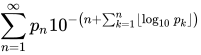
Where - this is a prime number .


Continuous fraction of a number - [0; 4, 4, 8, 16, 18, 5, 1, ...] [3] .
Similar Constants
For any positional number system with a base number:
- ,
which can be written in this number system as 0.0110101000101000101 ..., where the 1st digit is 1 if Is a prime, is irrational [4] .
Chemternoun's constant is the concatenation of all positive integers, not just primes.
Notes
- ↑ sequence A033308 in OEIS
- ↑ Hardy, Wright, 1938 .
- ↑ A030168
- ↑ Hardy, Wright, 1938 , p. 112.
Links
- Weisstein, Eric W. Copeland-Erdos Constant on Wolfram MathWorld .
- GH Hardy , EM Wright. An Introduction to the Theory of Numbers. - 5 th ed. . - Oxford University Press , 1938. - ISBN 0-19-853171-0 .