Abu Ali Hussein ibn Abdullah ibn al- Hathan ibn Аф и и ́ ́ [[[[2 2 пер пер ا пер ع Bukhara , August 16, 980 - Hamadan , June 18, 1037 ) - Medieval Persian [4] [5] [6] [7] [8] [9] [10] scientist, philosopher and physician, representative of Eastern Aristotelianism . He was a court physician of the Samanid emirs and daylemitic sultans, for some time he was a vizier in Hamadan. In total, he wrote over 450 works in 29 fields of science, of which only 274 reached us [11] . The most famous and influential philosopher and scholar of the medieval Islamic world [12] .
| Abu Ali Hussein ibn Abdullah ibn Sina | |
|---|---|
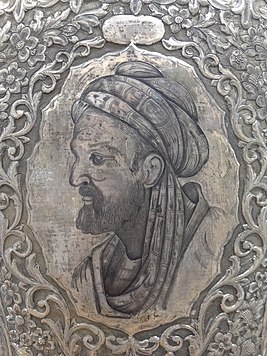 Conditional modern portrait (on a silver vase, Avicenna Mausoleum , Hamadan ) | |
| Date of Birth | |
| Place of Birth | with. Afshana , Samanid State |
| Date of death | |
| Place of death | Hamadan , Abbasid Caliphate |
| A country | |
| Direction | Eastern Aristotelism |
| Period | |
| Main interests | medicine , philosophy , astronomy , mechanics , chemistry , geology , logic , poetry |
| Influenced | , , , , , , , , , , and |
Biography
The boy from an early age showed exceptional ability and talent. By the time he was ten, he knew by heart almost the entire Quran. Then he was sent to study Muslim law at the school where he was the youngest. But soon even the most adult students of the school appreciated the boy’s mind and knowledge and came to consult him, although Hussein was only 12 years old. Later he studied logic and philosophy, geometry and astronomy under the guidance of the scientist Abu Abdallah Natili who arrived in Bukhara. From the age of 14, the young man began to study independently. And geometry, and astronomy, and music were given to him easily, until he became acquainted with Aristotle 's Metaphysics . In his autobiography, he mentioned that he had read this work several times, but could not understand it. Al-Farabi’s book with comments on “Metaphysics” helped in this.
At 16, Ibn Sina was invited to treat the emir of Bukhara himself. In his autobiography, Avicenna wrote: “I began studying medicine, supplementing reading with the observations of patients, which taught me many methods of treatment that cannot be found in books.”
After the capture of Bukhara by the Turks and the fall of the Samanid dynasty in 1002, Ibn Sina headed for Urgench , to the court of the rulers of Khorezm . Then he became known as the "prince of the doctors." In 1008, after Ibn Sina’s refusal to enter the service of Sultan Mahmoud Ghaznavi, prosperous life gave way to years of wandering. Some of the work he wrote in the saddle during his long journeys.
In 1015-1024 lived in Hamadan, combining scientific activities with very active participation in the political and public affairs of the emirate. For the successful treatment of Emir Shams al-Dawla he received the position of a vizier , but he made enemies in military circles. The emir rejected the demand of the military to betray Ibn Sin, but decided to remove him from his post and send him out of his possession. Forty days later, another bout of illness occurred with the emir, which made him find a scientist and reappoint him as his minister.
After the death of the Emir for trying to go to the service of the ruler of Isfahan for four months, he was imprisoned in a fortress. The last fourteen years of his life (1023–1037) served in Isfahan at the court of Emir , where they created favorable conditions for scientific activity. He was the chief physician and adviser to the Emir, accompanied him even in military campaigns. During these years, Ibn Sina, encouraged by criticism of his style, turned to the study of literature and philology. Also continued fruitful scientific work. Completed the "Canon of Medicine". Many manuscripts of works, including the Book of Justice (Kitab ul-insaf), were burned down during the attack on Isfahan by the Ghazni army. During one of the military campaigns of the ruler of Isfahan, Ibn Sina discovered a severe gastric illness, from which he could not cure himself. Ibn Sina died in June 1037 , before dying, dictating the will to a stranger. In the will, he ordered the release of all his slaves, awarding them, and distribute all his property to the poor.
Avicenna was buried in Hamadan near the city wall, and after eight months his ashes were transported to Isfahan and reburied in the mausoleum of the emir.
Ibn Sina was a scientist obsessed with a research spirit and a desire to encyclopedic coverage of all modern branches of knowledge. The philosopher was distinguished by a phenomenal memory and sharpness of thought.
Heritage
Healing book
The book of healing written in Arabic (Kitab al-Shifa) is devoted to logic, physics, biology, psychology, geometry, arithmetic, music, astronomy, and also metaphysics. The Book of Knowledge (Danish Name) is also an encyclopedia.
Medical works
The main medical works of Ibn Sina:
- The Canon of Medicine (or the Canon of Medicine , Kitab al-Kanun fi-t-tibb) is an encyclopedic essay in which the instructions of ancient physicians are comprehended and revised in accordance with the achievements of Arabic medicine. In the "Canon" Ibn Sina suggested that the disease can be caused by some tiny creatures. He first drew attention to the smallpox contagion, determined the difference between cholera and plague , described leprosy , separating it from other diseases, studied a number of other diseases. There are many translations of the “Canon of Medicine” into Latin. In “Canon” two books of five are devoted to the description of medicinal raw materials , medicines , methods for their manufacture and use. Of the 2,600 drugs described in Canon, 1,400 are of plant origin [13] [14] .
- “Drugs” (“Al-Adviyat al Kalbiya”) - written during the first visit to Hamadan. The work details the role of the heart in the occurrence and manifestation of pneuma, especially the diagnosis and treatment of heart disease.
- “Removing harm from various manipulations by means of corrections and warnings of errors” (“Daf al-mazurr al-kullia al-abdon al-insonia bi-tadorik anvo’hato an-tadbir”).
- “On the benefits and dangers of wine” (“Siyesat al-Badan va fazoil ash-Sharob va manofih v mazorih”) is the shortest treatise of Ibn Sina.
- "Poem about medicine" ("Urdzhus fit-tib").
- "Treatise on the pulse" ("Risolayi nabziya").
- “Events for travelers” (Phi Tadbir al-musofirin).
- "Treatise on sexual power" ("Risol fil-l-boch") - describes the diagnosis, prevention and treatment of sexual disorders.
- "A Treatise on Vinegar" ("Risol fi-s-sikandzhubin") - describes the preparation and therapeutic use of various mixtures of vinegar and honey.
- "Treatise on chicory" ("Risola fil-hindabo").
- “Blood vessels for bloodletting” (“Risola fil-uruk al-mufsud”).
- "Risola-yi zhudiya" - describes the treatment of diseases of the ear, stomach, teeth. In addition, it describes the problems of hygiene. Some researchers dispute Avicenna’s authorship.
- A copy of the Arabic manuscript "The Canon of Medicine " (Al-Ganun Fi at-Tibb) of Ibn Sina in 1030 , made in 1143 in Baghdad . Institute of Manuscripts of the National Academy of Sciences of Azerbaijan in Baku
Wellness exercises
Ibn Sina wrote in his work on the role and place of exercise in health and medical practice. Defined physical exercise - voluntary movements resulting in continuous, deep breathing.
He argued that if a person engages in moderate and timely exercise and observes the regimen, then he does not need treatment or medication. Having stopped these activities, he languishes. Exercise strengthens muscles, ligaments, nerves. He advised when taking into account the age and health. He spoke about the massage, hardening with hot and cold water.
Chemistry
In the field of chemistry, Ibn Sina discovered the process of distillation of essential oils. He was able to extract hydrochloric , sulfuric and nitric acids, potassium and sodium hydroxides.
Astronomy
In astronomy, Ibn Sina criticized the ideas of Aristotle that the stars reflect light from the Sun, arguing that the stars shine with their own light, but he believed that the planets also shine themselves. [15] He stated that he had observed the passage of Venus across the disk of the Sun on May 24, 1032. However, modern scientists doubt that he could observe this passage at a specified time in the indicated place. [16] He used this observation to substantiate that Venus , at least sometimes, in Ptolemy's cosmology is closer to the Earth than the Sun. [17]
Ibn Sina also wrote the Compendium of Almagest , with comments on the book of Ptolemy .
While in Gurgan , Ibn Sina wrote a treatise on the definition of the longitude of this city. Ibn Sina was unable to use the method used by Abu-l-Wafa and al-Biruni , and proposed a new method consisting in measuring the climax height of the moon and comparing it with the height in Baghdad by calculating according to the rules of spherical trigonometry .
In the "Book on the method preferred by other methods in the construction of an observational instrument," Ibn Sina described the observational instrument invented by him, which in his opinion was to replace the astrolabe ; For the first time, the principle of the nonius was used in this instrument to refine measurements.
Mechanics
Ibn Sina made a significant contribution to the development of the theory of embedded (or imprinted) power - the medieval theory of motion, according to which the cause of the motion of abandoned bodies is some force (later called impetius) embedded in them by an external source [18] . In his opinion, the “engine” (human hand, bow string, sling, etc.) gives the moving body (stone, arrow) some “aspiration”, similar to how fire transfers heat to water. In the role of the engine can also act gravity.
“Aspiration” is of three types: mental (in living beings), natural and violent. “Natural aspiration” is the result of gravity and manifests itself in the fall of the body, that is, in the natural movement of the body, in agreement with Aristotle . In this case, the "aspiration" can exist even in a fixed body, manifesting itself in the resistance of stillness. “Violent aspiration” is an analogue of the Philophone driving force - it is reported to the thrown body by its “engine”. As the body moves, “forceful striving” decreases due to the resistance of the environment, as a result, the body speed also tends to zero. In emptiness, “violent striving” would not change, and the body could make an eternal movement. In this one would see the anticipation of the concept of inertia, but Avicenna did not believe in the existence of a void. Ibn Sina tried to give a quantitative assessment of "violent striving": in his opinion, it is proportional to the weight and speed of body movement.
Possibly, Ibn Sina’s ideas about invested power became known in the Latin West and contributed to the further development of the theory of impetius Buridan and other scholastics [19] .
Philosophy
In the understanding of the subject of metaphysics, Ibn Sina followed Aristotle . Following Al-Farabi, Ibn Sina distinguishes between a possible existence that exists thanks to another, and an existence that exists thanks to itself is absolutely necessary. Ibn Sina confirms the purity of the world to the Creator. Creation in eternity, Ibn Sina explained using the neoplatonic concept of emanation, thus justifying the logical transition from the original single to the plurality of the created world. However, unlike Neoplatonism, he limited the process of emanation to the world of celestial spheres, considering matter not as the end result of the descent of the single, but as a necessary element of any possible existence. The cosmos is divided into three worlds: the material world, the world of eternal uncreated forms, and the earthly world in all its diversity. The individual soul forms with the body a single substance that ensures the complete resurrection of man; The bearer of philosophical thinking is a particular body that is predisposed to accepting an intelligent soul. Absolute truth can be comprehended through intuitive vision, which represents the culmination of the thinking process.
The circle of the mystical works of Ibn Sina include “The Book of the Birds”, “The Book of Love”, “The Book of the Essence of Prayer”, “The Book of the Meaning of Pilgrimage”, “The Book of Relief from the Fear of Death”, “The Book of Predestination”.
Criticism
Around Avicenna’s philosophical views there was a sharp struggle between supporters and opponents of his ideas.
The Sufis sharply opposed the rationalism of Ibn Sina, blaming his philosophy for the fact that it does not allow man to come closer to God. Nevertheless, many of the Sufis adopted Avicenna’s philosophical method and his idea of the evolutionary nature of the emanation steps along the line of ascent.
Muhammad al-Ghazali, in his famous book “The Denial of the Philosophers”, tried to refute Ibn Sina’s philosophy in all aspects. He opposed the doctrine of the primordiality and eternity of the world and its attributes, since this, according to Al-Ghazali, leads to dualism , which contradicts the monotheism of Islam . Al-Ghazali also rejects the principle of emanation, according to which God creates the world, not of his own will, but by virtue of natural necessity. He did not share the ideas about causality put forward by Ibn Sina and the impossibility of bodily resurrection.
Later, the twelfth-century thinkers of Muhammad Shahrastani continued the Al-Ghazali line in their work Kitab al-Musaraa and Fakhruddin Razi . In the 12th century, Ibn Rushd defended the ideas of eastern peripateticism in his book “Denial of refutation”. Subsequently, the views of Ibn Sina defended Nasir ad-Din al-Tusi .
Psychology
Ibn Sina also developed his own teaching on the temperament and character of a person. According to his teachings, human nature is divided into four simple types: hot, cold, wet and dry (which in modern psychology corresponds to four temperaments). These natures are not stable, but change under the influence of internal and external factors, such as meteorological conditions and the change of seasons. Changes in body fluids can also adjust the nature in the appropriate direction. In addition to simple natures, Avicenna distinguished four more complex natures, depending on the prevalence of one of the four body fluids (blood, mucus, yellow or black bile). [20]
Literature
Ibn Sina wrote many serious scientific works in the form of poems using quatrains. In this form, written "Treatise on Love", "Treatise on Birds" and some other works. There are among his works and lyrical poetic works - quatrains and rubai .
' از قعر گل سیاه تا اوج زحل
ردم مه مشکلات گیتی را ل
بیرون جستم د هر مکر و حیل
ر بند اده شد مگر بند اجل
'
From black dust to heavenly bodies
I have solved secrets of the wisest words and deeds.
I avoided treachery, unraveled all the knots,
Only the knot of death, I could not unravel.
|
|
|
The main literary works of Ibn Sina are a philosophical novel-allegory “Chai ibn Yakzan”, a twenty-couplet poem “The Bird”, “Salaman and Absal”. These works and rubai influenced the development of Arabic, Iranian and Turkic literature. In particular, the classic of the twelfth century Iranian-language poetry Omar Khayyam called Ibn Sina his teacher. [23] .
Publications
- Ibn sina Danish-name Book of knowledge. - Stalinabad , 1957.
- Ibn sina The canon of medical science: In 5 tons. - Tashkent, 1956-1960.
- Ibn sina Mathematical chapters of the "Book of Knowledge". - Dushanbe, 1967.
- Ibn sina Message of love. - Tbilisi: Metsniereba, 1976.
- Ibn sina Favorites. - M .: Book, 1980.
- Ibn sina Selected philosophical works. - M .: Science, 1980.
- Al-Biruni, Ibn Sina. Correspondence. - Tashkent: Fan, 1973.
Music
Avicenna also wrote works on the theory of music, which are parts of his encyclopedic works:
- "The Code of the Science of Music" in the "Book of Healing";
- "A summary of the music" in the "Book of Salvation";
- section about music in the "Book of Knowledge".
From a theoretical point of view, Ibn Sina, in the medieval tradition, attributed music to the mathematical sciences. He defined it as a science that studies sounds in their relationships and has the goal of establishing rules for creating a composition [24] . Based on the teachings of Pythagoras , he believed that music is subject to numbers and is in close connection with them [23] .
Ibn Sina, the first in history, brings a solid scientific base to musical history, examining music from the standpoint of not only mathematics , but also sociology , psychology , poetics , ethics and physiology [24] .
Ibn Sina, together with Al-Farabi, laid the foundation for the science of musical instruments, which was further developed in Europe at a much later time. He gives a detailed classification of types of musical instruments, explains their structure. The sixth section of the “Book of Knowledge” lists the names of almost all existing tools with their descriptions. The works of al-Farabi and Ibn Sina on the study of musical instruments laid the foundations of the instrument of study as a special field of musical science.
The great scientist is also the inventor of the gidzhak, a common instrument in Central Asia .
Memory
- In his honor, Karl Linney named the genus of plants of the Acanta family - Avicennia .
- In Tajikistan, in honor of Avicenna, the Tajik State Medical University and the mountain peak, previously known as Lenin Peak, are named.
- In Dushanbe , a square was named in his honor and a monument to the work of Azerbaijani sculptor Omar Eldarov was erected.
- In June 2009, Iran presented the Pavilion of Persian scientists to the United Nations department in Vienna ( Austria ) located on the central square of the Vienna International Center Memorial. Pavilion of Persian scientists includes statues of four famous scholars: Avicenna, Biruni , Zakaria Razi (Reiz), Omar Khayyam [25] .
- In the village Afshana in Uzbekistan there is a museum of Avicenna.
- In 1990, a medical institute was opened in Bukhara, named after Abu Ali ibn Sina.
- A monument to Abu Ali ibn Sina by sculptor Jalaliddin Mirtadzhiyev was unveiled in 2006 in Riga , in the park of the Gailiesers hospital complex.
- The asteroid Avicenna , discovered on September 26, 1973 by the Soviet and Russian astronomer Lyudmila Ivanovna Chernykh, was named after Ibn Sina.
- In honor of Ibn Sina the crater on the Moon is named .
- The program Avicenna (Avicenna), created by IBM for the automatic study of cardiograms and X-rays of the breast [27], is named after Ibn Sina.
The streets are named after Ibn Sina:
- in Samarkand ,
- in Bukhara ,
- in Ust-Kamenogorsk ,
- Ibn Sino Street in Uch-Kurgan ( Uzbekistan ),
- Avicenna street in Donetsk .
Monument of Ibn Sine in Ankara
Monument to Ibn Sine in Hamadan
Avicenna Monument in Gakh , Azerbaijan
Tombstone Avicenna, Hamadan , Iran
In fiction
- “Abugalisina” ( tat. Әbүgalisina ) is a fairy tale about Ibn Sin in the Tatar language of Kayum Nasyri [28] [29] .
- Noah Gordon, in his novel The Physician (1988), tells the story of a young Englishman studying medicine who pretends to be a Jew in order to learn the art of medicine from Ibn Sina himself, the great master of his time.
- In 2011, the Spanish writer Esequiel Teodoro published the novel “The Manuscript of Avicenna” (“El Manuscrito de Avicena”), which recreates some moments from the life of a Persian doctor.
In the cinema
- The film "Avicenna" (1956), directed by K. Ya. Yarmatov [30] .
- The film “Youth of a Genius” (1982), filmed by Uzbekfilm and Tajikfilm studios , is dedicated to Avicenna's childhood and youth. Film director Elyor Ishmukhamedov [31] .
- The 1987 Iranian television series Avicenna (“Bu-Ali Sina”) of 1987 tells about the life of a scientist from childhood to death.
- In 2013, film “ The Doctor: The Physician's Student of Avicenna ” based on the book by N. Gordon was released.
Documentaries
- 2010 - Avicenna. Light from the East / Ex Oriente Lux / Avicenna - Light From The East (director Shuhrat Makhmudov / Shuhrat Mahmudov)
Notes
- ↑ http://www.britannica.com/EBchecked/topic/45755/Avicenna/517/Additional-Reading
- ↑ Megaencyclopedia of Cyril and Methodius . Ibn Sina . The appeal date is March 14, 2017. Archived on August 22, 2011.
- ↑ Ageenko F. L. Avicenna // Dictionary of own names of the Russian language. Stress Pronunciation. Word change . - M .: Peace and Education; Onyx, 2010. - p. 58. - 880 p. - ISBN 5-94666-588-X , 978-5-94666-588-9.
- ↑ Michael Flannery. Avicenna Persian philosopher and scientist (English) . Encyclopædia Britannica . The appeal date is August 21, 2017.
- ↑ Paul Strathern. A brief history of gene therapy . - Running Press, 2005. - P. 58. - ISBN 978-0-7867-1525-1 .
- ↑ Brian Duignan. Medieval Philosophy . - The Rosen Publishing Group, 2010. - P. 89. - ISBN 978-1-61530-244-4 .
- ↑ Michael Kort. Central Asian republics . - Infobase Publishing, 2004. - P. 24. - ISBN 978-0-8160-5074-1 .
- ↑ Ibn Sina ("Avicenna") Encyclopedia of Islam . 2nd edition. Edited by P. Berman, Th. Bianquis, CE Bosworth, E. van Donzel and WP Henrichs. Brill 2009. Accessed through Brill online: www.encislam.brill.nl (2009) Quote: “He was born in 370/980 in Afshana, his mother's home, near Bukhara. His native language was Persian. "
- ↑ AJ Arberry , "Avicenna on Theology" - KAZI PUBN INC, 1995. excerpt: "Avicenna was the greatest of all Persian thinkers; as a physician and metaphysician "
- ↑ Henry Corbin , "The Voyage and the Messenger: Iran and Philosophy . " - North Atlantic Books, 1998. - P. 74 Quote: "Where is the ibn sinda, died 1037)? no less complete than of Avicenna .
- ↑ Bochalov V.I. Preface // Avicenna (Ibn Sina) On the Preservation of Health. / Comp., Ext., Approx. and the comments of V.I. Bochalov. - Voronezh, 2011. - p . 3 . ISBN 978-5-89981-656-7
- ↑ Avicenna // Britannica.
- ↑ Blinov KF and others. Botanico-pharmacognostic dictionary: Ref. manual / Under (inaccessible link) ed. K. F. Blinova, G. P. Yakovlev. - M .: Higher. school, 1990. - p. 267. - ISBN 5-06-000085-0-0 .
- ↑ Abu Ali Ibn Sina (Avicenna) - Biography
- ↑ Ariew, Roger. The phases of venus before 1610 (Eng.) // Studies in History and Philosophy of Science Part A : journal. - 1987. - March ( vol. 18 , no. 1 ). - p . 81-92 . - DOI : 10.1016 / 0039-3681 (87) 90012-4 .
- ↑ Goldstein, Bernard R. Some Medieval Reports of the Venus and the Mercury Transits (eng.) // Centaurus: journal. - John Wiley & Sons , 1969. - Vol. 14 , no. 1 . - P. 49-59 . - DOI : 10.1111 / j.1600-0498.1969.tb00135.x . - .
- ↑ Sally P. Ragep. Ibn Sīnā: Abū Alī al ‐ Ḥusayn ibn Abdallāh ibn Sīnā / Thomas Hockey. - Springer Science + Business Media , 2007. - p. 570–572.
- ↑ Rozhanskaya M.M.Mekhanika in the Medieval East. - Moscow: Science, 1976.
- ↑ Sayili A. Ibn Sīnā and Buridan on the Motion of the Projectile // Annals of the New York Academy of Sciences. - 1987. - Vol. 500. - p. 477–482.
- Ся Psjadlo Темпера. M. Temperament and character in the history of medicine and psychology: Educational reference book. - Odessa: Science and Technology, 2007. - p.19. - ISBN 978-966-8335-56-3
- ↑ 1. SEMEN LIPKIN - The Century of Translation
- ↑ Lit-world / Ibn Sina
- ↑ 1 2 Boltaev, MN Abu Ali ibn Sina - a great thinker, a scientist encyclopedist of the medieval East - Moscow: Sampo, 2002. - 400 p. - ISBN 5-8071-0005-0
- ↑ 1 2 Ivanova L. Ibn Sina (Avicenna) in the mirror of music. Some musical and theoretical views of Ibn Sina. Ibn Sina’s views on musical theory. // Bulletin of Chelyabinsk State University, 2007 link
- ↑ UNIS Monument to Be Inaugurated at the Vienna International Center, 'Scholars Pavilion' donated to International Organizations in Vienna by Iran . The appeal date is August 3, 2017.
- ↑ MPC Database on Small Bodies of the Solar System (2755) (eng.)
- ↑ IBMs automated radiologist can read images and medical records
- ↑ Abugalisina
- ↑ Nasiri, Kayum Abugalisina Archival copy dated July 22, 2015 on the Wayback Machine
- ↑ Avitsenna (Eng.) On the Internet Movie Database
- ↑ The film "Youth of a genius" on the site youtube .
Literature
- Akhadova M. A. The arithmetic part of the "Book of Knowledge" by Ibn Sina. The geometric part of the “Book of Knowledge” by Ibn Sina // Scientific Notes of the Bukhara State Institute. - 1964. - № 12 .
- Brentjes B., Brentjes S. Ibn Sina (Avicenna) / Trans. with him. P.M. Komyshanchenko. - Kiev: KSU Publishing House, 1984. - 88 pp., Ill.
- Dzhibladze G. N. Avicenza Systems: Abu Ali Ibn Sina. Exoteric essay. (Some generalizations and materials). - Tbilisi, 1986.
- Dinorshoev M. Ibn Sina Natural Philosophy. - Dushanbe, 1985.
- Zavadovsky Yu. N. Abu Ali Ibn Sina: Life and Work. - Dushanbe, 1980.
- Luther I. O. Ibn Sina's Metaphysics: Angle - Attitude, Quality, Position, or is it Still Amount? // Historical and mathematical research. - 2003. - № 8 (43) . - p . 278-302 .
- Petrov B.D. Ibn Sina (Avicenna). - M .: Medicine, 1980.
- Sagadeev A.V. Ibn Sina (Avicenna). - M. , 1985.
- Shidfar B. Ya. Ibn Sina. - M. , 1981.
- Gardet L. La pense religieuse d Avicenne (Ibn Sina). - Paris, 1951.
- Morewedge P. The metaphysica of Avicenna. - London, 1973.
- Nasr SH Three Muslim Sages. Avicenna. - Suhrawardi - lbn Arabi. - Cambridge (Mass.), 1964.
- Dinorshoev M. Ibn-Sina Natural Philosophy. - Dushanbe, 1985;
- Goodman LE Avincenna. L.-NY, 1992.
- Avicenna // Encyclopedic dictionary of Brockhaus and Efron : in 86 tons (82 tons and 4 extra). - SPb. , 1890-1907.
- Sina, Abu-Ali ibn-Hussein ibn-Abdullah ibn- // Brockhaus and Efron Jewish Encyclopedia . - SPb. 1908-1913.
- Frolova Ε. A. Ibn Sina // New Philosophical Encyclopedia : in 4 t. / Institute of Philosophy, RAS ; Nat Society-nauch. fund; Preds. scientific ed. Council V.S. Stepin . - M .: " Thought ", 2000-2001. - ISBN 5-244-00961-3 . 2nd ed., Corr. and add. - M .: “ Thought ”, 2010. - ISBN 978-5-244-01115-9 .
- Shidfar B. Ya. Ibn Sina. - M .: " Science ", 1981. - 184 p.