HVM ( [eɪtʃ viː em] ch . “ H-vi-em ”, acre. Hyper-Velocity Missile , with the English. “ Hypersonic missile ”, the military index was not assigned) - American hypersonic anti-tank guided missile with a laser-guided kinetic attack element . It was intended to be integrated into the guided weapons systems of attack aircraft and multipurpose fighters (and, in the long run, attack helicopters and helicopter gunships) to fight enemy enemy armored vehicles on the march and in the parking lot. It was developed in the 1980s by Lockheed Missiles and Space Co. in Sunnyvale , California , commissioned by the US Air Force . The development was carried out in parallel with the project of the same name by Vought [1] . Both missiles were an integral part of the aviation armament complex, which included, in addition to them, a removable starting device and a control system [2] [3] . The project was eventually collapsed in order to save budget funds [4] .
| Lockheed hvm | |
|---|---|
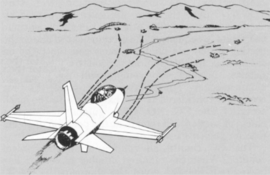 principle of combat use of HVM missiles | |
| Type of | anti-tank guided missile |
| A country |  USA USA |
| Service history | |
| Years of operation | not entered service |
| In service |  USAF (potentially) USAF (potentially) |
| Production history | |
| Manufacturer | Lockheed (rocket) |
History
| Evolutionary family tree kinetic weapons lockheed and vought
| ||||||||||||||||||||||||||||||||||||||||||||||||||||||||||||||||||||||||||||||||||||||||||||||||||||||||||||||||
- Development
Contracts with Vought and Lockheed for the development of missiles and development work were concluded in December 1981 and provided for the manufacture and submission to state tests of prototypes of hypersonic anti-tank missiles for two years. Under the terms of the contract, Lockheed allocated $ 14 million from the Air Force budget for test needs. The winner of the competition in the future received a contract for the mass production of missiles in industrial quantities [2] .
- Tests
Missile tests were carried out mainly at the White Sands range in New Mexico [5] . The first tests of unguided rockets took place at the end of June 1982. Tests with shooting at target tanks began from the end of October of the same year. Despite the fact that the US Air Force Department requested only $ 992 thousand for the needs of the 1982 fiscal year (which was a relatively modest amount by the standards of American guided weapons programs), the fiscal authorities of both chambers (US Congress and Senate) had a desperate resistance to continue funding the project , in connection with which, the management of Lockheed decided to withdraw from further competition due to economic inexpediency [6] (the tendency to oust Lockheed from the competition in various ways was outlined in 1982, the authorities predicted that the company would soon leave the project). [7]
- Resumption of work
In 1988, Lockheed, under the AAWS-H program, proposed for review by the US Army Rocket Forces Directorate a HVM variant adapted for launching from a land carrier as a heavy anti-tank missile system (based on the Bradley BMP) [8] received the MGM-166 index LOSAT [4] .
Performance characteristics
- Sources of information: [2] [3]
- General information
- Aircraft carrier - A-10 , F-16
- Ammunition - 2 blocks × 20 missiles
- Categories of targets hit - armored objects of any type, single and group targets
- Aerodynamic characteristics
- Aerodynamic layout is normal
- The average flight speed is 5400 ... 6174 km / h
- Mass-dimensional characteristics
- Length - 2030 mm
- Case diameter - 89.4 mm
- Rocket weight - about 20 kg
- Warhead
- Type of warhead - rod kinetic
- Propulsion system
- Type of remote control - solid propellant
Notes
- ↑ Hypervelocity missile . // Field Artillery Journal : The Journal of Fire Support. - March-April 1982. - Vol. 50 - No. 2 - p. 32.
- ↑ 1 2 3 Lockheed plans hypervelocity missile . // Flight International . - 12 December 1981. - Vol. 120 - No. 3788 - P. 1744 - ISSN 0015-3710.
- ↑ 1 2 World missile directory . // Flight International . - 5 February 1983. - Vol. 123 - No. 3848 - P. 325 - ISSN 0015-3710.
- ↑ 1 2 Lockheed Martin MGM-166 LOSAT / KEM . (electronic resource) / Designation Systems .
- ↑ Air Force Tests Mile-a-Second Missile . // Air Defense Artillery . - Spring 1983. - No. 1 - P. 53.
- ↑ USAF to test hypervelocity missile . // Flight International . - 26 June 1982. - Vol. 122 - No. 3815 - P. 1652 - ISSN 0015-3710.
- ↑ Projectile "DFR" . // Air et cosmos : hebdomadaire de l'actualité aérospatiale et des techniques avancées. - 15 Mai 1982. - 20e an. - Nr 907 - P. 81 - ISSN 0044-6971.
- ↑ Defense Note: Lockheed Electronics Co. (USA) . // African Defense Journal : Military information monthly. - January 1989. - No. 101 - P. 41 - ISSN 0244-0342.