Eagle ( [ˈiːɡl̩] cheat “ Eagle ”, from the English “ eagle ” , military index - AAM-N-10 ) - an American super-long-range air-to-air guided missile. It was intended for conducting an air battle against promising third-generation Soviet fighter-bombers from a distance exceeding the reach of their airborne weapons. It was developed by Bendix Corporation in conjunction with the Grumman Corporation by order of the US Navy . According to the initial design idea, the Eagle was supposed to be the longest-range airborne missile defense ever existed [1] To intercept Soviet strategic bombers and missile carriers , the missile was supposed to be equipped with a nuclear warhead [2] . The missile, together with the missile weapon control system and launcher, was part of the WS-404 weapon system [3] . “Eagle” belonged to the so-called “exclusive” missiles, since it was designed exclusively for integration into the missile weapons control system of the F6D Missileer carrier -based fighter-interceptor, which was supposed to accommodate up to six of these missiles on the external sling [4] . The refusal of a potential customer to purchase aircraft of the specified model soon led to the refusal to continue work on their weapons, which led to the scaling down of the project. Work on the creation and testing of the rocket was carried out in 1959-1961. [5] The project cost the US Treasury $ 53 million. [5]
| AAM-N-10 Eagle | |
|---|---|
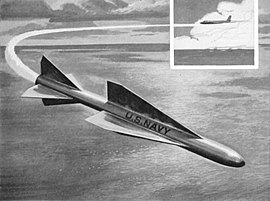 rocket lays a turn (figure) | |
| Type of | guided missile |
| A country |  USA USA |
| Service History | |
| Years of operation | did not enter service |
| In service |  US Navy (customer) US Navy (customer) |
| Production history | |
| Designed by | 1958 |
| Manufacturer | Bendix / Grumman (rocket), Aerojet ( RDTT ), Sperry / Sanders ( ARGSN ) |
Background
The Eagle missile was one of the elements of the US Navy's comprehensive rearmament program, which included a variety of non-standard and conventional fleet artillery weapons. In June 1958, the Missiles and Rockets magazine published material stating that the Eagle was a special pride for naval missile designers, “the most advanced air-to-air system ever conceived,” but with the choice of a contractor for the further implementation of the design plan, the naval command was in no hurry [6] .
History
- Contractor Selection
After the General Directorate of Armament of the US Navy issued the requirements of the tactical and technical specifications for the designed missile in the fall of 1958, more than a dozen military industry companies joined the competition for the right to receive a general contract for experimental design work and serial production of missiles: Chance Vought , General Electric , United Aircraft , Westinghouse , Sperry , Douglas El Segundo , North American and the team in pairs Radio Corp. of America paired with Convair and Bendix paired with Grumman . TTZ included the following mandatory requirement: the missile must have sufficient noise immunity in order to overcome the opposition of radio - electronic suppression means, airborne jamming stations of Soviet aircraft, for this the guidance loop should be protected from electronic warfare , the missile guidance system should be combined, include themselves radar and optical (infrared) elements. Pre-projects proposed by Douglas, North American and a pair of Bendix-Grumman, implemented a combined guidance system, which includes an on-board target illumination station of their own design and an active homing radar developed by Sanders Associates [7] .
On January 2, 1959, the victory of the Bendix-Grumman tandem was announced, with which a contract was concluded for further R&D.
Involved Structures
The following commercial structures participated in the work on the armament complex, which includes the missile itself, the launcher, and the interfaced avionics equipment : [8]
- General contractor
- System Integration - Bendix Corp., Systems Division, Ann Arbor , MI ;
- Complex as a whole - Bendix Aviation Corp., Mishoka , Indiana ;
- Guidance System - Bendix Research Laboratories Division, Detroit , MI (development); Sperry-rand corp. , Sperry Gyroscope Division, Great Neck , Long Island (instrument implementation);
- Missile subsystems, assembly, factory operational control, routine maintenance - Bendix Pacific Division, North Hollywood , California (development and production);
- Subcontractors
- Hull and aerodynamic components , propulsion system , starting device, auxiliary operational and technical equipment - Grumman Aircraft Engineering Corp. Betpage , Long Island ;
- Solid propellant rocket engine - Aerojet General Corp. , Azusa , California ;
- Gas Pressure Accumulator - Garrett Corp., AiResearch Manufacturing Co., Los Angeles , California ;
- Active Homing Radar - Sanders Associates, Inc., Nashua , New Hampshire ;
- Airborne Tactical Electronic Computing System - Litton Industries, Inc. , Beverly Hills , California ;
- Airborne Pulse Doppler Radar for Target Detection and Guidance of Missiles AN / APQ-81 - Westinghouse Corp. , Air Arm Division, Baltimore , Maryland .
Performance Specifications
- Sources of information: [4]
- General information
- Carrier Aircraft - F6D
- The categories of targets hit are single- jet air attack aircraft
- Shelling area
- Detection zone
- target designation of an onboard radar - 220 km
- DRLO target designation - 370 km
- Launch Area - 300 km
- Affected Area - 200 km
- Reach in height - 30 km
- Aerodynamic performance
- Aerodynamic layout - normal
- The average flight speed in the acceleration section is 4322 km / h
- The average flight speed on the march section is 5557 km / h
- Mass and overall characteristics
- Length in the starting configuration - 4800 mm
- The length of the booster stage - 1270 mm
- Marching stage length - 3530 mm
- The diameter of the booster stage - 410 mm
- The diameter of the marching stage housing is 360 mm
- The plumage diameter of the booster stage - 1270 mm
- The diameter of the plumage of the march stage - 860 mm
- Weight in the starting configuration - 582 kg
- Boost stage weight - 287 kg
- Mass of the march stage - 295 kg
- Warhead
- Type warhead - high-explosive or nuclear W42
- Type of safety-actuating mechanism - remote action, radar, volume response
- Propulsion system
- Type of remote control - two-stage
- Acceleration engine type - RDTT
- Type of propulsion engine - RDTT
Notes
- ↑ Missiles 1961 . // Flight . - 2 November 1961. - Vol. 80 - No. 2747 - P. 714.
- ↑ Polmar, Norman . The US Nuclear Arsenal: A History of Weapons and Delivery Systems Since 1945 . - Annapolis, MD: Naval Institute Press, 2009 .-- P. 219 - 274 p. - ISBN 978-1-55750-681-8 .
- ↑ Jacobs, Horace ; Whitney, Eunice Engelke . Missile and Space Projects Guide 1962 . - NY: Springer, 1962. - P. 224 - 235 p.
- ↑ 1 2 Bendix AAM-N-10 Eagle . (electronic resource) / Designation Systems .
- ↑ 1 2 Statement of Dr. John S. Foster, Director, Department of Research and Engineering . / Authorization for Military Procurement, Research, and Development, Fiscal Year 1971. - Pt. 1 - P. 421.
- ↑ Bergaust, Erik . US Pushing Big Family of New Missiles . // Missiles and Rockets . - June 1958. - Vol. 3 - No. 7 - P. 39.
- ↑ Industry Observer . // Aviation Week . - October 13, 1958. - Vol. 69 - No. 15 - P. 23.
- ↑ Bendix Eagle Team . // Missiles and Rockets . - August 17, 1959. - Vol. 5 - No. 3 - P. 41.