The Hurwitz automorphism theorem restricts the order of the group of automorphisms — orientation -preserving conformal mappings — to a compact Riemann surface of genus g > 1, asserting that the number of such automorphisms cannot exceed 84 ( g - 1). The group for which the maximum is reached is called the Hurwitz group , and the corresponding Riemann surface is called the Hurwitz surface . Since compact Riemann surfaces are synonymous with nonsingular complex projective algebraic curves , the Hurwitz surface can also be called the Hurwitz curve [1] . The theorem is named after Adolf Hurwitz , who proved it in 1893 [2] .
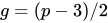
The Hurwitz boundary also holds for algebraic curves over fields of characteristic 0 and over fields of positive characteristic p > 0 for groups whose order is coprime with p , but may not be fulfilled over fields of characteristic p > 0 if p divides the order of the group. For example, a double covering of a projective line branching at all points over a simple field has the genus but the group acts on it of order .



Content
Interpretation in terms of hyperbolicity
One of the fundamental topics of differential geometry is the trichotomy between Riemannian manifolds of positive, zero, and negative curvature K. This is found in many situations and at different levels. In the context of Riemann surfaces X , according Riemann unification , this trichotomy is regarded as the difference between surfaces of different topologies:
- X is a sphere , a compact Riemann surface of zero genus with K > 0;
- X is a flat torus or an elliptic curve , a Riemann surface of genus 1 with K = 0;
- X is a hyperbolic surface of genus> 1 and K <0.
While in the first case the surface X admits infinitely many conformal automorphisms (in fact, the conformal automorphism group is a Lie group of dimension three for a sphere and dimension one for a torus), a hyperbolic Riemann surface admits only a discrete set of automorphisms. Hurwitz’s theorem states that, in fact, even more is true - it gives a boundary by the order of the group of automorphisms as a function of the genus and describes Riemann surfaces for which this boundary is exact.
The idea of proof and the construction of Hurwitz surfaces
By the unification theorem, any hyperbolic surface X , that is, such a surface for which the Gaussian curvature is equal to minus one at any point, is covered by a hyperbolic plane . The conformal mapping of the surface corresponds to orientation-preserving automorphisms of the hyperbolic plane. By the Gauss - Bonnet theorem , the surface area is
- .
To make the group of automorphisms G on X as large as possible, we need to make the area of its fundamental domain D for this action as small as possible. If the fundamental region is a triangle with angles at the vertices and giving tiling of the hyperbolic plane, then p , q and r will be integers greater than unity, and the area is
- .
Let us ask ourselves at what natural numbers the expression
strictly positive and as little as possible. This minimum value is 1/42 and
gives a unique (up to a permutation) triple of such numbers. This means that the order | G | automorphism groups is limited to
- .
However, more accurate calculations show that this estimate is halved, since the group G may contain orientation-changing transformations. For orientation-preserving conformal automorphisms, the boundary is equal to .
Build
To get an example of the Hurwitz group, we start with the (2,3,7) -paving of the hyperbolic plane. Its complete symmetry group is the complete triangle group (2,3,7) , formed by reflections relative to the sides of one fundamental triangle with angles , and . Since the reflection “throws” the triangle and changes orientation, we can combine the triangles into pairs and obtain an orientation-preserving tiling polygon. The Hurwitz surface is obtained by “locking” a part of this infinite tiling of the hyperbolic plane into a Riemann surface of genus g . This will require exactly tiles (consisting of two triangles).
The following two regular mosaics have the desired symmetry group. A rotation group corresponds to rotations around an edge, vertex, and face, while a full symmetry group may also include reflections. Note that polygons in a mosaic are not fundamental areas - a mosaic of triangles (2,3,7) finishes both of these mosaics and is not regular.
| Heptagonal mosaic of order 3 | |
The Withoff constructions make it possible to obtain additional homogeneous mosaics , giving eight homogeneous mosaics , including the two given here. They are all obtained from Hurwitz surfaces and give surface tiling (triangulation, tiling with heptagons, etc.).
From the considerations given above, we can conclude that the Hurwitz group G is characterized by the property that it is a finite factor group of the group with two generators a and b and three relations
thus, G is a finite group generated by two elements of order two and three, the product of which is of order seven. More precisely, any Hurwitz surface, that is, a hyperbolic surface on which the maximum order of the automorphism group for surfaces of a given genus is reached, can be obtained by the described construction. This is the last part of the Hurwitz theorem.
Examples of Hurwitz groups and surfaces
The smallest Hurwitz group is the projective special linear group PSL (2.7) with order 168, and the corresponding curve is the . This group is also isomorphic to PSL (3,2) .
The next curve is a MacBit curve with an automorphism group PSL (2,8) of order 504. There are many simple finite groups that are Hurwitz groups, for example, all but 64 alternating groups are Hurwitz groups. The largest non-Hurwitz group has degree 167. A 15 is the smallest alternating group, which is the Hurwitz group.
Most projective special linear linear groups of large rank are Hurwitz groups [4] . Among these groups of small ranks, there are fewer Hurwitz groups. If denoted by the exponent p modulo 7 , PSL (2, q ) is a Hurwitz group if and only if either q = 7 or . Moreover, PSL (3, q ) is a Hurwitz group only for q = 2, PSL (4, q ) for any q will not be a Hurwitz group, and PSL (5, q ) is a Hurwitz group only if or [5] . Similarly, many groups of Lie are Hurwitz type . Finite large rank are Hurwitz groups [6] . Exceptional Lie groups of type G2 and Pu groups of type 2G2 are almost always Hurwitz groups [7] . Other families of exceptional and twisted Lie groups of low rank, as Mallet showed, are Hurwitz groups [8] .
There are 12 sporadic groups that can be formed as Hurwitz groups - Janko groups J 1 , J 2 and J 4 , Fischer groups Fi 22 and Fi '24 , Rudvalis group, thompson , , the third group of Conway Co 3 , and the "monster" [9] .
Maximal orders of automorphism groups of Riemann surfaces
The maximum order of a finite group acting on a Riemann surface of genus g is defined as follows
| Gender g | Maximum order | Surface | Group |
|---|---|---|---|
| 2 | 48 | Bolz Curve | GL 2 (3) |
| 3 | 168 (Hurwitz border) | PSL 2 (7) | |
| four | 120 | S 5 | |
| five | 192 | ||
| 6 | 150 | ||
| 7 | 504 (Hurwitz border) | Macbeth Curve | PSL 2 (8) |
| eight | 336 | ||
| 9 | 320 | ||
| ten | 432 | ||
| eleven | 240 |
See also
- Triangle Group (2,3,7)
Notes
- ↑ Technically speaking, the category of compact Riemann surfaces and orientation-preserving conformal mappings is equivalent to the category of nonsingular complex projective algebraic curves and algebraic morphisms.
- ↑ Hurwitz, 1893 .
- ↑ ( Richter ) Notice that each face of a polyhedron consists of several faces of a mosaic - two triangular faces make up a square face, and so on, as in this explanatory figure .
- ↑ Lucchini, Tamburini, Wilson, 2000 .
- ↑ Tamburini, Vsemirnov, 2006 .
- ↑ Lucchini, Tamburini, 1999 .
- ↑ Malle, 1990 .
- ↑ Malle, 1995 .
- ↑ Wilson, 2001 .
Literature
- Hurwitz A. Über algebraische Gebilde mit Eindeutigen Transformationen in sich // Mathematische Annalen . - 1893. - T. 41 , no. 3 . - S. 403–442 . - DOI : 10.1007 / BF01443420 .
- Lucchini A., Tamburini MC Classical groups of large rank as Hurwitz groups // Journal of Algebra. - 1999.- T. 219 , no. 2 . - S. 531-546 . - ISSN 0021-8693 . - DOI : 10.1006 / jabr.1999.7911 .
- Lucchini A., Tamburini MC, Wilson JS Hurwitz groups of large rank // Journal of the London Mathematical Society. Second Series. - 2000. - T. 61 , no. 1 . - S. 81–92 . - ISSN 0024-6107 . - DOI : 10.1112 / S0024610799008467 .
- Gunter Malle. Hurwitz groups and G2 (q) // Canadian Mathematical Bulletin . - 1990. - T. 33 , no. 3 . - S. 349–357 . - ISSN 0008-4395 .
- Gunter Malle. Small rank exceptional Hurwitz groups // Groups of Lie type and their geometries (Como, 1993). - Cambridge University Press , 1995. - T. 207. - S. 173–183. - (London Math. Soc. Lecture Note Ser.).
- Tamburini MC, Vsemirnov M. Irreducible (2,3,7) -subgroups of PGL (n, F) for n ≤ 7 // Journal of Algebra. - 2006. - T. 300 , no. 1 . - S. 339-362 . - ISSN 0021-8693 . - DOI : 10.1016 / j.jalgebra.2006.02.030 .
- Wilson RA The Monster is a Hurwitz group // Journal of Group Theory. - 2001. - T. 4 , no. 4 . - S. 367–374 . - DOI : 10.1515 / jgth.2001.027 .
- David A. Richter. How to Make the Mathieu Group M 24 .