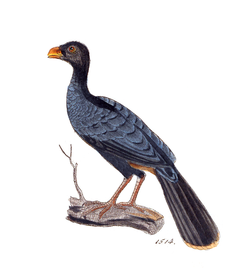
Kraksy-mitu[1] ( lat.Mitu ) is a genus of birds of the Kraks family , consisting of 4 species. Birds have an almost solid black color. They live in the tropical part of South America.
Craxu Mitu
Pointed Crax Mitu
Lesser Crested Crax
Scientific classification
Domain:
Eukaryotes
Kingdom:
Animals
Kingdom :
Eumetazoi
No rank :
Bilateral symmetrical
No rank :
Secondary
Type of:
Chordate
Subtype :
Vertebrates
Infratype :
Maxillary
Overclass :
Tetrapods
Grade:
Birds
Subclass :
Real birds
Infraclass :
Newborn
Squad:
Chicken
Family:
Kraksy
Subfamily :
Oreophasinae
Gender:
Kraksi Mitu
International scientific name
MituLesson , 1831
Content
Etymology
The generic name Mitu is derived from the word Mitú , Mutú or Mutúm , which is translated from the Tupi tribal language as “black” [2] .
Appearance
Craxu-mitu are birds weighing up to 3.5 kg; they look very similar to representatives of the genus Gokko (Crax). The coloration of males and females is predominantly black. Paws are shorter than gokko. In some species, noticeable growths on the beak [1] .
Distribution
The birthplace of the Kraks-mitu is South America , birds live in tropical forests in a large area from the northern regions of the mainland and south to the Amazon . The sharp-billed Kraks-Mitu was long considered an extinct species until several birds were found in the Brazilian state of Alagoas in 1951. Bird appearances were recorded until the 1980s, but so far the species has disappeared from the wild. The sharp-billed Kraks-Mitu breed well in captivity and several birds are kept in zoos. For 2 populations, a plot of forest was identified and further actions are planned to return to the wild [1] .
Classification
The genus Kraks-Mitu includes 4 species [1][3][4] :
Mitu mitu - Mitu , or sharp-billed Krax-Mitu
Mitu salvini - Salvin Crax , or Ecuadorian Crax Mitu
Mitu tomentosum - Lesser Crested Kraks , or Guiana Kraks-Mitu
Mitu tuberosum
Notes
↑ 1234Galushin V.M. , Drozdov N.N. , Ilyichev V.D. et al. Fauna of the World: Birds: Handbook / Ed.Doctor of Biological SciencesV. D. Ilyichev.- M .: Agropromizdat, 1991 .-- S. 94. - 50,000 copies.- ISBN 5-10-001229-3 .
↑Jobling, 2010 , p.257.
↑Boehme, Flint, 1994 , p.53.
↑HBW Alive .
Literature
Boehme R. L. , Flint V. E. The Bilingual Dictionary of Animal Names.Birds.Latin, Russian, English, German, French / Ed.ed.Acad.V. E. Sokolova .- M .: Rus.lang., RUSSO, 1994. - 845 p.- 2030 copies.- ISBN 5-200-00643-0 .
Galushin V. M. , Drozdov N. N. , Ilyichev V. D. et al. Fauna of the World: Birds: Handbook / Ed.Doctor of Biological SciencesV. D. Ilyichev.- M .: Agropromizdat, 1991 .-- 311 p.- 50,000 copies.- ISBN 5-10-001229-3 .
Jobling JA The Helm Dictionary of Scientific Bird Names.- London: A&C Black Publishers Ltd, 2010 .-- 432 p.- ISBN 978-1-4081-2501-4 .