Turpan [2] ( lat. Melanitta fusca ) is a waterfowl of the duck family.
| Scoter | |||||||||||||||||||||||||||||||||||||||||
|---|---|---|---|---|---|---|---|---|---|---|---|---|---|---|---|---|---|---|---|---|---|---|---|---|---|---|---|---|---|---|---|---|---|---|---|---|---|---|---|---|---|
 Male and female Turpan, Fig. A. Torburn [1] | |||||||||||||||||||||||||||||||||||||||||
| Scientific classification | |||||||||||||||||||||||||||||||||||||||||
| |||||||||||||||||||||||||||||||||||||||||
| International scientific name | |||||||||||||||||||||||||||||||||||||||||
Melanitta fusca ( Linnaeus , 1758 ) | |||||||||||||||||||||||||||||||||||||||||
| Area | |||||||||||||||||||||||||||||||||||||||||
 Only nests Migration areas | |||||||||||||||||||||||||||||||||||||||||
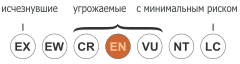
| Security status | |||||||||||||||||||||||||||||||||||||||||

Content
- 1 Description
- 2 Distribution
- 3 Nutrition
- 4 Reproduction
- 5 Subspecies
- 6 notes
- 7 Literature
- 8 References
Description
The body length reaches from 51 to 58 cm, males weigh an average of 1.5 kg, females - 1.2 kg [3] . The plumage of the male is black, there is a white spot under the eye. The base of the beak is swollen, black. the rest is orange. The legs are red. In contrast to singing, the turpan males are larger and have a more compact physique. In addition, their beak is longer and has no hump. The rainbow is gray-blue. The plumage of the female is brown; there is a white spot between the eyes and the beak. The rainbow is darker than that of males [4] . Both sexes have a white mirror on the wings.
Distribution
The species lives in the north of Eurasia and in North America. Birds nest in boreal coniferous forests, as well as on mountain lakes. Winters in the temperate zone, in Russia - on the Black and Caspian Seas.
Nutrition
It feeds on shellfish and small fish. For food dives into the water to a depth of 10 m, remaining under water for 1 minute.
Reproduction
Pairs form in late winter and spring, so that turps arrive at nesting sites, usually in pairs. Grouping is observed at the Turpan, during which several males gather around several females. The ritual of mating is the immersion of males in water, during which they approach the females underwater. Paired females demonstrate flight in the morning, during which they fly low above the ground, while shouting loudly and returning to their original place. This behavior is demonstrated before the laying of eggs. Couples protect only a small area of the area around the nest. Vapors break up while the female is still nesting. Males already then fly to their places of molting.
A nest is built on land near lakes, rivers or the coast. In the taiga, it is located no further than 100 m from an open reservoir. Sometimes turps also nest in gull colonies.
The female makes only one clutch. The number of eggs varies depending on the subspecies. The nominative form in the clutch usually has from 7 to 9 eggs. Eggs are oval in white and cream color. Hatched chicks weigh approximately 54 g. The life expectancy of birds is 13 years.
Subspecies
- Melanitta fusca fusca is distributed from Scandinavia to the Yenisei. Winters on the Caspian Sea [5] . Isolated nesting populations are found in Turkey, Armenia, Georgia, and Turkmenistan.
- Melanitta fusca stejnegeri lives in East Asia from the Yenisei to Sakhalin and the Kuril Islands. Most often found near the Lena River [5] .
- Melanitta fusca deglandi lives in North America. Based on the publication of Bradley Curtis Livezey, the International Union of Ornithologists highlights it as an independent species Melanitta deglandi [6] .
Notes
- ↑ Drawing from the book: Menzbir M.A. Hunting and fishing birds of European Russia and the Caucasus. 2 volumes and atlas. M., typographic lithography of T-va I. N. Kushnerev and Co., 1900-1902.
- ↑ Boehme R. L. , Flint V. E. The Bilingual Dictionary of Animal Names. Birds. Latin, Russian, English, German, French / Ed. ed. Acad. V. E. Sokolova . - M .: Rus. lang., "RUSSO", 1994. - S. 34. - 2030 copies. - ISBN 5-200-00643-0 .
- ↑ Kear, S. 715
- ↑ Sale, S. 129
- ↑ 1 2 Kear, S. 717
- ↑ The Condor, Volume 97, Number 1, 1995, S. 233-255 Phylogeny and Evolutionary Ecology of Modern Seaducks (Anatidae: Mergini) Archived February 5, 2012 on Wayback Machine (engl.)
Literature
- Hans-Günther Bauer, Einhard Bezzel und Wolfgang Fiedler (Hrsg): Das Kompendium der Vögel Mitteleuropas: Alles über Biologie, Gefährdung und Schutz. Band 1: Nonpasseriformes - Nichtsperlingsvögel , Aula-Verlag Wiebelsheim, Wiesbaden 2005, ISBN 3-89104-647-2
- John Gooders und Trevor Boyer: Ducks of Britain and the Northern Hemisphere , Dragon's World Ltd, Surrey 1986, ISBN 1-85028-022-3
- Janet Kear (Hrsg): Ducks, Geese and Swans . Oxford University Press, 2005, ISBN 0-19-854645-9
- Hartmut Kolbe; Die Entenvögel der Welt , Ulmer Verlag 1999, ISBN 3-8001-7442-1
- Richard Sale: A Complete Guide to Arctic Wildlife , Verlag Christopher Helm, London 2006, ISBN 0-7136-7039-8