Poplar ribbon [2] [3] [4] ( lat. Limenitis populi ) - diurnal butterfly from the family of nymphalids . The wingspan reaches 6.5-8.5 cm. The color of the upper side of the wings of both sexes is dark brown with white spots and bandages, as well as a number of orange holes at the outer edge. The underside of the wings is orange in color with bluish, bluish or greenish bordering, white bandages and spots. It inhabits mainly the forest belt of Eurasia , meeting in the north of the continent right up to the tundra belt. Gives one generation a year. The flight time lasts from June to July, sometimes through August. Males can often form clusters in moist areas of the soil and various organic residues, where they find the necessary mineral salts. Females lead a secretive lifestyle and mainly stay in the crowns of trees. Caterpillars feed on aspen , less commonly on other species of poplars . The Latin species name comes from populus , which means poplar [3] .
| Poplar ribbon | |||||||||||||||||||||||||||||||||||||||||||||||
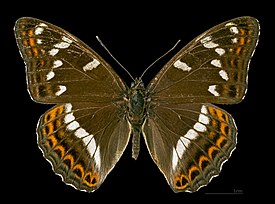 Male | |||||||||||||||||||||||||||||||||||||||||||||||
| Scientific classification | |||||||||||||||||||||||||||||||||||||||||||||||
|---|---|---|---|---|---|---|---|---|---|---|---|---|---|---|---|---|---|---|---|---|---|---|---|---|---|---|---|---|---|---|---|---|---|---|---|---|---|---|---|---|---|---|---|---|---|---|---|
| |||||||||||||||||||||||||||||||||||||||||||||||
| International scientific name | |||||||||||||||||||||||||||||||||||||||||||||||
Limenitis populi ( Linnaeus , 1758 ) | |||||||||||||||||||||||||||||||||||||||||||||||
| Synonyms | |||||||||||||||||||||||||||||||||||||||||||||||
According to the work of Bruna & Gallo 2013 [1] :
| |||||||||||||||||||||||||||||||||||||||||||||||
| Subspecies [1] | |||||||||||||||||||||||||||||||||||||||||||||||
| |||||||||||||||||||||||||||||||||||||||||||||||
Content
Description
The length of the front wing is 35–46 mm [3] [4] . The wingspan of males is 65–77 mm, and of females is 82–85 mm. The upper side of the wings of both sexes is dark brown, sometimes almost black, with a more or less noticeable greenish-blue tint. On the upper side of the front wings are white spots at the apex of the wing, an elongated spot in the central cell, as well as a large transverse band consisting of scattered spots. On the upper side of the hind wings there is a wide transverse white band, as well as a marginal strip consisting of orange crescent-shaped spot-holes. The underside of the wings is orange or bright orange with bluish, gray or green bordering, contrasting black margins at the posterior margin of the front wing, and white bandages and spots [4] [5] [6] .
The central cell on the front and hind wings is not closed. On the fore wings, veins R1, R2 do not branch, begin from the central cell. Veins R3, R4, R5 have a common trunk, which also starts from the central cell. Veins R1 and R2 go to the costal (front) edge of the anterior wing, and R3 extends to the apex of the wing, R4, R5 to the outer edge of the wing [3] . Head with bare eyes without hairs. Labial palps covered with hairs. Antennae have a gradually thickening fusiform club. The body is monochrome - black-brown. The front legs are reduced, not used when walking, devoid of claws and covered with thick hairs. Hind tibia with one pair of spurs. Sexual dimorphism is not pronounced. It manifests itself in the fact that the female is larger than the male, the white elements of the pattern of her wings are larger [4] , and the marginal grayish-blue and orange moon-shaped bandages are brighter and better expressed [6] [1] .
Variability
The species is characterized by very pronounced individual variability. It manifests itself in both sexes in the size of butterflies and the pattern on the wings, which served as the basis for the description of the many forms and aberrations of this species [7] . Among males, there is a form tremulae Esper, 1798 [7] which is characterized by strongly reduced or completely absent white bandages on the upper side of the wings [1] [3] [5] [6] . Moreover, in some parts of the range, mainly in its west, this form may occur more often nominative [3] .
The geographical variability of the species in Europe, even with some differing local subpopulations, is limited, and all populations from this territory belong to the nominative subspecies [1] .
Range
Moderate Eurasia [3] [8] . From Northern and Eastern France further to the northeast along the territory of Northern, Central and Eastern Europe to 64–66 ° north. w. [3] In East Fennoscandia, the distribution area is limited to 65 ° C. w. and 26 ° in. d., butterflies penetrate north up to Kalevala , but are regularly found only in the middle taiga subzone, south of the Belomorsk – Kostomuksha line [9] [10] . The species became extinct in Denmark [11] . The southern border of the global range over Europe runs along the southern border of the broad-leaved forest belt from the Carpathians and Transcarpathia in the north of Ukraine and central Russia to the Middle and Southern Urals and the south of the Central Russian Upland [3] . In Ukraine, the main populations live mainly in the mixed forest zone of the Right Bank , in the Carpathians and Transcarpathia, and in some places in the forest-steppe and forests of the steppe zone [12] [13] . It is found outside Europe in Siberia (up to 60–62 ° N [14] ), in the south of the Far East , in Northern Kazakhstan [14] , Mongolia , China, and Japan . In the Caucasus , the only find of the species is known on the Kabardinsky ridge in the south of the Stavropol Territory [3] . In the mountains, throughout the entire range, it rises to an altitude of 200-1500 m above sea level. [11] , in Tibet it is found at an altitude of 2800 m above sea level [15] .
Not found in Southern and Western France , in England [11] , Spain , Portugal , Italy [1] and on the islands of the Mediterranean Sea , in the Lower Danube Lowland, on the Crimean Peninsula, in the south of the European part of Russia [3] .
Subspecies
- Limenitis populi populi Linnaeus, 1758
- Nominal subspecies. The range extends from northern and eastern France (sporadically in Brittany , Drome and Vaucluse along the Rhone valley ) [11] , through the whole of central Europe east to the Urals [3] . Isolated populations are found in the Balkans ( Macedonia , Bulgaria ) [11] and in Northern Greece (the Rhodope Mountains [11] ) [1] .
- Limenitis populi ussuriensis Staudinger, 1887
- [ syn. Limenitis populi ussuriensis ab. liliputana Staudinger, 1887 ; Limenitis populi enapius Fruhstorfer, 1908 ; Limenitis populi eunemius Fruhstorfer, 1908 ; Limenitis populi fruhstorferi Krulikowsky, 1909 ; Limenitis populi kingana Matsumura, 1939 ; Limenitis populi halasiensis Huang & Murayama, 1992 ]
- It differs from the nominative subspecies by larger and more developed white spots and bandages on the upper side of the wings [16] , as well as more pronounced and bright orange, blackish and bluish-gray color elements on the lower wings [14] . Instances with the most developed and widest white stripes on the wings are found in the Amur Region and Primorsky Territory . In males of these populations, white spots on the fore wings sometimes merge into a continuous strip, while a white band on the hind wings can reach a width of 10 mm [14] . Males of the tremula form are found among representatives of this subspecies much less frequently than among individuals of the nominative subspecies in Europe [14] . Distributed from the Urals throughout temperate Asia, covering the territory of Northern Kazakhstan [14] , Mongolia , Eastern Russia, Northeast China and North Korea [1] [16] .
- Limenitis populi jezoensis Matsumura, 1919
- [syn. Limenitis populi ussuriensis ab. sakaii Sugitani, 1931 ]
- The white band on the hind wings is very narrow, in males it is already the distance to a row of orange holes, about 2 mm wide; in females - slightly wider than the distance to these holes. The subspecies range covers Japan - Hokkaido and Honshu [1] [16] .
- Limenitis populi szechwanica Murayama, 1981
- [syn. Limenitis populi batangensis Huang, 2001 ]
- The upper side of the wings is earthy-brown in color with a strong greenish-blue tint and a pronounced metallic shade, but without any reddish-brown tones [15] . The white band on the hind wings is relatively wide, in males about 3-4 mm wide. The subspecies range covers the Kandin and Batang counties in the Chinese province of Sichuan , East Tibet [1] .
Biology
It inhabits deciduous and mixed forests, floodplain forests, sections along roads, rivers and other water bodies, water meadows with fodder plants suitable for feeding caterpillars [3] . It can populate both large forest massifs and small isolated fragments of aspen forests, including young shoots [17] . It is mainly found in forest glades, edges and in roadside biotopes. The presence in the forest habitats of open areas with moist soil and fodder plants of caterpillars as part of the vegetation is the main factor in the accumulation of adults. Wild lentiches can also be found in urban landscapes, where fodder plants of caterpillars grow. Butterflies gravitate to highway asphalt and dirt roads [3] . Their attractiveness, apparently, is due to the high insolation , providing a comfortable thermal regime, and the ability to easily find organic residues for nutrition [17] . By the end of their flying time, butterflies usually fly away from typical habitats and can be found at a considerable distance from them, often in biotopes unusual for them (for example, in swamps , agricultural landscapes, etc.) [17] .
There is an asynchronous occurrence of the species in different habitats, due to the influence of local factors. Butterflies are unevenly distributed within their habitats [17] . Studies in Feoskandinavii indicate that butterflies within their habitable territories freely move at distances from 4.8 to 6-7 km [17] . Although these displacements are local, they provide an opportunity for the exchange of individuals between subpopulations and the settlement of new habitats. In general, the species is not confined to local habitats.
Unlike most other types of day butterflies, adults lead a very secretive lifestyle and spend most of the time in the upper tier of the forest - fly in the crowns of trees, occasionally going down to the ground [17] . Butterflies make the last only in search of water and decaying organic remains - rotten fruits, carrion , excrement of large animals. Males descend to the ground much more often than females. Males are characterized by territorial behavior [17] , which is manifested in the fact that they can occupy the highest point of the landscape in anticipation of females, or fly around their individual habitat, from which they drive not only males of their species, but also representatives of other species of butterflies with similar colors and dimensions [18] .
On the territory of the entire range, poplar ribbon grows in one generation per year (monovoltine species) [3] [17] . The flight time is from June to July, sometimes to August [3] [17] . In the south of the range, flight can begin at the end of May [11] . In the taiga zone, butterflies usually appear already in late June and fly until the beginning of August. In some years, the unusually early appearance of tapeworms in mid-June, being a rather rare occurrence, is due to a steady early warm spring. In years with a cold, protracted spring, butterflies fly out later than usual and occur until mid-August. The flight of butterflies includes three phases: the observed flight of males, the latent flight and the observed flight of females. The difference in the timing of the appearance of males and females is more than 10 days [17] . Such a delay in the start of flight of females in many species of butterflies is a common occurrence, due to the higher rate of preimaginal development of males [19] . However, in the poplar ribbon, unlike other species of butterflies, the females of which fly out only a few days later than the males, this period is usually very long. It is the difference in the start dates of males and females that is one of the main factors that determine the sharp fluctuations in the number of poplar ribbon from year to year. One to two days after the first females appear among flying males, a latent flight period begins when butterflies are not visually observed in the habitat. After two to four weeks, usually at the end of July, the butterflies begin to meet again, but exclusively females. At the same time, females come across quite rarely [17] .
Males often form clusters on moist soil along the banks of puddles and streams, and also feed on the corpses of small animals ( frogs , shrews , voles , etc.), manure , excrement of large animals, silage [3] [14] [11] . They can also be attracted by flowing tree sap, drops of sweat, spots of gasoline and oil on the roads [14] [11] . Thus, together with moisture, they make up for the deficiency of nitrogen , salts and trace elements [20] [21] . Nectar feeding of large umbrella plants , fieldfields , spirea [14] , is typical, first of all, for females [17] .
Life Cycle
After mating, females lay eggs one at a time on the upper side of the tip of the leaf blade of fodder plants [17] . According to other sources, females lay eggs on the leaves of the lower branches of large aspen trees at an altitude of 1 to 7 m [9] . Fodder plants of caterpillars are trees of the genus Poplar ( Populus ): aspen ( Populus tremula ), black poplar ( Populus nigra ) [3] , it is also possible to feed on willows [4] ( Salix spp. - five-stamen willow, bluish willow ) [7] . In the Southern Urals, white poplar ( Populus alba ) [14] is also a fodder plant, in Siberia it is fragrant poplar ( Populus suaveolens ) [4] , in the Far East - aspen, Maximovich poplar ( Populus maximowiczii ), Amur poplar ( Populus amurensis ), Korean poplar ( Populus koreana ) [4] . In Japan, caterpillars develop on Maximovich poplar and on various species of willow [22] .
The egg is greenish, hemispherical, similar in shape to a raspberry [4] . Its integument is divided into regular polygons with 6-8 sides [4] , with hairs emanating from each corner [14] . The stage of the egg lasts 7-8 days [14] [9] . The caterpillar develops from autumn to May next year. Young caterpillars are brown or almost black, with small warts on each segment and whitish belts on 7-8 segments of the body. Overwintered caterpillars of brown color, with a lighter yellow-brown or rusty-yellow color at both ends of the body and with a ring almost in the middle of the body. Their appearance is reminiscent of bird droppings. As it grows, the caterpillar begins to resemble a short angular twig, and the shape of the head becomes very similar to the buds of trees. In older ages, the caterpillar reaches a length of 45-52 mm and resembles a folded leaf: it is characterized by a light or dark green color, 6 and 8 segments of the body are white-earthy in color. Two rows of fleshy prickly outgrowths are located on the 2nd, 3rd, 5th, 7th and 11th segments. On other segments, these outgrowths look like small tubercles, or are invisible. On the 2nd body segment there is a pair of very large spiny processes of brown color that protrude forward above the brownish head, carrying small black horns [4] [14] .
Caterpillars are usually confined to young poplars and aspen trees, which grow in well-lit places [3] . Caterpillars feed on low trees and undergrowths. This is due to the fact that by mid-August, when the caterpillars emerge from the eggs, the leaves on old-growth fodder trees are already too stiff to feed, while on young trees the leaves are still soft [14] . Caterpillars of the first ages eat only the leaf parenchyma , leaving all the veins intact [4] . As they grow older, they begin to skeletonize leaves, eating the entire leaf blade, with the exception of the main middle vein [4] , which caterpillars are often used to rest after feeding [4] [14] . At rest, the caterpillar prefers to be on well-lit branches in an S-shaped pose. Being disturbed - bends the body even more back, hiding its head under the lower body [4] . The caterpillar “marks” its movements with silk threads, possibly to make it easier to stay on the sheet [14] .
Before wintering, they molt twice [9] [14] . Caterpillars hibernate individually in a cigar-shaped shelter from the remains of a leaf at the end of a branch [9] [7] . For this, an insect near the future shoot builds a bundle or an elongated oval cell, the lower surface of which is reinforced to the surface of the branch with silk threads. Regardless of the shape of this cell, its opening always faces the top of the twig, which allows the caterpillar to start feeding on young leaves as quickly as possible in spring [4] . However, there is also evidence of caterpillar wintering in spider webs at the tops of branches of forage trees [17] . In spring, the caterpillars again begin to feed on the same branches where they wintered. By the middle of June [3] they are pupating in the most prominent place of the crown of the fodder tree at an altitude of 2–4 m and higher [4] . Before pupation, the caterpillar makes a triangular notch at the top of the leaf, and covers the upper side of the leaf with a thick layer of silk threads, wrapping them around the leaf petiole. Thus, the edges of the sheet with the help of the threads are raised somewhat upward. After this, the caterpillar is attached near the leaf petiole, due to which the future pupa is always located almost in the middle of the leaf with its head facing its distant apex, and the cremaster to the petiole [4] . Dolly is large, yellow-white, in many Dolly is large yellow-brown or yellowish-white in color with black spots of various sizes. At the base of the pupal abdomen there is a large rounded protrusion of a protrusion in the form of a tuber, an orange-yellow color with black spots at the base. This protrusion gives the impression that the first abdominal segment of the pupa was broken and its contents protruded in the form of this shiny orange-yellow tuber, and part of the liquid spilled out and covered the entire upper and front part of the pupa [4] [23] . The front half of the pupa is shiny, as if varnished, and the rear half is matte. About 12-15 hours before the butterfly leaves, the pupa acquires a dark gray color, and the beginnings of the wings below become pitch black, shiny, a yellow pattern is visible on them. The pupal stage lasts about 10-15 days [14] .
Strength
The number of species is subject to sharp fluctuations, from season to season it can often change by two orders of magnitude or more. There are periods of several years when only a few individuals are found in the habitat of the species. The duration of the decline in numbers in different areas of the range at different times varies from 1 to 4 years [17] . Among the factors limiting the number include the peculiarities of local weather conditions, parasitism, predation and disease. A sharp change and worsening weather conditions after the departure of males can lead to their mass death and, as a result, to an increase in unfertilized females [24] . The difference in the start dates of males and females is one of the main factors that determine sharp fluctuations in the abundance of the species [17] .
At various stages of the life cycle, this species is attacked by several types of parasitoids that develop due to poplar ribbon, but are not true parasites , since as a result of their vital activity the host organism in any case dies. These include species of braconids (Braconidae) - representatives of the genus Protapanteles , as well as Glyptapanteles vitripennis and one species of ichneumonids (Ichneumonidae) - Ichneumon albiornatus [25] .
In addition to natural causes, the mortality rate is determined by the intensity of traffic on roads passing through butterflies. It is estimated that in Fenoscandinavia 10-15% of males die as a result of a collision with vehicles [17] .
Security
The species was listed in 1991 in the European Red List of Globally Threatened Animals and Plants [13] .
Poplar ribbon is included in the Red Books of Latvia (1998) (category 4), Ukraine (2009) (category 2 - vulnerable species) [13] . In Ukraine, this is a small, sometimes rare species, in some areas at the peak of the flight period, the number of butterflies can reach up to 10 individuals per 1 ha. In some local populations, the abundance decreases [13] .
In Russia, the species is included in a number of regional Red Books [26] : the Republic of Mordovia , the Saratov Region , the Republic of Tatarstan [27] , the Voronezh Region , the Lipetsk Region , the Tambov Region and Moscow .
The species is on the verge of extinction in Luxembourg . In critical condition, the population of the species is located in Belgium [28] .
Along with natural factors, the abundance of the species in these territories is reduced due to a decrease in the area of deciduous forests that are habitats of the lentochka, disturbance as a result of anthropogenic activity of the complex mosaic structure of forest communities necessary for this species, a decrease in the area of aspen forests, an increase in the recreational load, and excessive use of pesticides and pesticides in the vicinity of forests [29] .
Notes
- ↑ 1 2 3 4 5 6 7 8 9 10 Bruna DC, Gallo E. Guide to the Butterflies of the Palearctic Region: Nymphalidae. Part 6: Subfamily Limenitidinae. - Zagreb: Omnes Artes, 2013 .-- P. 15-17. - 85 p. - ISBN 978-88-87989-13-7 .
- ↑ Striganova B.R. , Zakharov A.A. The Bilingual Dictionary of Animal Names: Insects (Latin-Russian-English-German-French) /Ed. Dr. biol. sciences, prof. B.R. Striganova . - M .: RUSSO, 2000 .-- S. 269. - 1060 copies. - ISBN 5-88721-162-8 .
- ↑ 1 2 3 4 5 6 7 8 9 10 11 12 13 14 15 16 17 18 19 20 Lvovsky A.L. , Morgun D.V. Qualifiers for the flora and fauna of Russia. Issue 8 // Lepidoptera Lepidoptera of Eastern Europe. - M .: Partnership of scientific publications of KMK, 2007. - 443 p. - 2000 copies. - ISBN 978-5-87317-362-4 .
- ↑ 1 2 3 4 5 6 7 8 9 10 11 12 13 14 15 16 17 18 Korshunov Yu. P. Keys to the flora and fauna of Russia // Lepidoptera Lepidoptera of North Asia. Issue 4. - M .: Partnership of scientific publications of KMK, 2002. - S. 52, 226-228. - ISBN 5-87317-115-7 .
- ↑ 1 2 Kurt Lampert . Atlas of butterflies and caterpillars. - Minsk: Harvest, 2003 .-- 735 s. - 5,000 copies. - ISBN 985-13-1664-4 .
- ↑ 1 2 3 Sochivko A.V. , Kaabak L.V. Key to butterflies of Russia. Day butterflies. - M .: Avanta +, 2012 .-- 320 p. - 5,000 copies. - ISBN 978-5-98986-669-4 .
- ↑ 1 2 3 4 Tuzov VK, Bogdanov PV, Churkin SV, Dantchenko AV, Devyatkin AL, et al. Guide to the Butterflies of Russia and Adjacent Territories: (Lepidoptera, Rhopalocera): Libytheidae, Danaidae, Nymphalidae, Riodinidae, Lycaenidae - Vol. 2. - Sofia - Moscow: Pensoft, 2000 .-- 580 p. - ISBN 978-9546420954 .
- ↑ Bernard d'Abrera . World Butterflies. - Melbourne & London: Hill House Publishers, 2006 .-- 272 p. - ISBN 0-947352-46-5 .
- ↑ 1 2 3 4 5 Marttila O., Aarnio H., Haahtela T., Ojalainen P. Suomen päiväperhoset. - Helsinki: Kirjayhtymä, 1991 .-- 370 p.
- ↑ Gorbach V.V., Reznichenko E.S. The species composition and distribution of day butterflies (Lepidoptera, Diurna) in Southeast Fennoscandia // Scientific notes of Petrozavodsk State University. - 2009. - Issue. 184 . - No. 7 (101) . - S. 31-39 .
- ↑ 1 2 3 4 5 6 7 8 9 Tom Tolman, Richard Lewington. Collins Butterfly Guide: The Most Complete Field Guide to the Butterflies of Britain and Europe. - London: Collins, 2008 .-- P. 384. - ISBN 978-0007242344 .
- ↑ Nekrutenko Yu.P. , Chikolovets V.V. Denny Meteliki of Ukraine. - Kyiv: Vidavnitstvo Raєvskogo, 2005. - 232 p. - (Nature of Ukraine). - ISBN 966-7016-17-X . (Ukrainian)
- ↑ 1 2 3 4 Chervona book of Ukraine. Tvarinny svit / І.A. Akіmov. - K .: Globalconsulting, 2009. - P. 151. - 624 p. - ISBN 978-966-97059-0-7 .
- ↑ 1 2 3 4 5 6 7 8 9 10 11 12 13 14 15 16 17 18 Gorbunov PY, Kosterin OE The Butterflies (Hesperioidea and Papilionoidea) of North Asia (Asian part of Russia) in Nature. Vol.2. - Moscow - Cheliabinsk: Rodina & Fodio, 2003 .-- P. 22-23. - 408 p. - ISBN 9986330386 .
- ↑ 1 2 Huang, H. Report of H. Huang's 2000 expedition to SE. Tibet for Rhopalocera (Insecta, Lepidoptera) // Neue Entomologische Nachrichten. - 2001. - No. 51 . - P. 65-151.
- ↑ 1 2 3 Key to insects of the Far East of Russia. T. V. Caddis flies and lepidopterans. Part 5 / under the general. ed. P.A. Lera . - Vladivostok: Dalnauka, 2005 .-- S. 300-301. - 575 s. - 500 copies. - ISBN 5-8044-0597-7 .
- ↑ 1 2 3 4 5 6 7 8 9 10 11 12 13 14 15 16 17 Gorbach V.V., Saarinen K., Reznichenko E.S. On the ecology of poplar lentic Limenitis populi (Lepidoptera, Nymphalidae) of East Fennoscandia // Zoological Journal. - 2009. - T. 89 , No. 11 . - S. 1340-1349 .
- ↑ Tinbergen N. Animal Behavior. - M .: Mir, 1978.- 192 p.
- ↑ Tabashnik BE Population structure of pierid butterflies. III. Pest population of Colias philodice eryphile // Oecologia. - 1980. - No. 47 . - P. 175-183.
- ↑ Beck, J .; Mühlenberg, E. & Fiedler, K. Mud-puddling behavior in tropical butterflies: In search of proteins or minerals? // Oecologia. - 1999. - No. 119 . - P. 140-148.
- ↑ Smart P. The Illustrated Encyclopedia of the Butterfly World. - Transworld Publishers Ltd, 1981. - 274 p. - ISBN 0-552-98206-7 . (eng.)
- ↑ Friedrich E. Salix-Arten als futterpflanze von Limenitis populi. Weitere Bemerkungen zur Biologie des Falters // Entomologische Zeitschrift. - No. 85 . - P. 164-167.
- ↑ Gorbunov P.Yu., Olshvang V.N. Butterflies of the Middle Urals: A guide-determinant .. - Ekaterinburg: Socrates, 2007. - S. 283–284. - 352 p. - ISBN 978-5-88664-268-1 .
- ↑ Chetverikov S. S. Waves of life (from lepidopterological observations for the summer of 1903) // Problems of General Biology and Genetics. - Novosibirsk: Nauka, 1983. - S. 76-83 .
- ↑ Mark R. Shaw, Constantí Stefanescu, Saskya van Nouhuys. Parasitoids of European Butterflies // Ecology of Butterflies in Europe. - Cambridge: Cambridge University Press, 2009 .-- P. 526. - 130-156 p. - ISBN 9780521747592 .
- ↑ Protected areas of Russia - Limenitis populi (Linnaeus, 1758) . Date of appeal October 21, 2016.
- ↑ Schepovskikh A.I., Boyko B.A., Gorshkov M.A., Rogova T.V. etc. The Red Book of the Republic of Tatarstan (animals, plants, mushrooms). - Kazan: Ideal-Pers, 2006. - 822 p.
- ↑ Stéphane Claerebout. Clé de détermination photographique des papillons de jour de Belgique // Cercles des Naturalistes de Belgique ASBL. - 2010 .-- ISSN 0773-9419 .
- ↑ Kulfan, M., Kulfan, J. Red (Ecosozological) List of Butterflies (Lepidoptera) of Slovakia // Protection Nature. - 2001. - No. 20 . - S. 48-81 .
Links
- Photo gallery of various stages of development of poplar ribbon . Macroid.ru. Date of appeal October 21, 2016.
- The Red Book of Ukraine - Lentnik poplar Limenitis populi (Linnaeus, 1758) . Date of appeal October 21, 2016.
- Paolo Mazzei, Daniel Morel, Raniero Panfili. Limenitis populi (Linnaeus, 1758) . Moths and Butterflies of Europe and North Africa. Date of treatment October 21, 2016. (English)
- Protected areas of Russia - Limenitis populi (Linnaeus, 1758) . Date of appeal October 21, 2016.