Clever Geek Handbook
📜 ⬆️ ⬇️

Chandrasekhar equation

Numerical solution of the Chandrasekhar equation

The Chandrasekar equation in astrophysics is the dimensionless form of the Poisson equation for the density distribution of a spherically symmetric isothermal gas sphere under the action of its own gravitational force, named after the American astrophysicist Subramanyan Chandrasekara . [1] [2] Equation [3] has the form
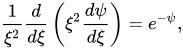
oneξ2ddξ(ξ2dψdξ)=e-ψ,{\ displaystyle {\ frac {1} {\ xi ^ {2}}} {\ frac {d} {d \ xi}} \ left (\ xi ^ {2} {\ frac {d \ psi} {d \ xi}} \ right) = e ^ {- \ psi},} {\ displaystyle {\ frac {1} {\ xi ^ {2}}} {\ frac {d} {d \ xi}} \ left (\ xi ^ {2} {\ frac {d \ psi} {d \ xi}} \ right) = e ^ {- \ psi},}

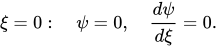
Whereξ {\ displaystyle \ xi} \ xi is a dimensionless radius,ψ {\ displaystyle \ psi} \ psi associated with the density of the gas sphere by the ratioρ=ρce-ψ {\ displaystyle \ rho = \ rho _ {c} e ^ {- \ psi}} {\ displaystyle \ rho = \ rho _ {c} e ^ {- \ psi}} whereρc {\ displaystyle \ rho _ {c}} {\ displaystyle \ rho _ {c}} represents the density of the gas in the center. The equation has no known explicit solution. If instead of isothermal matter we take polytropic, the written equation will be the Lane-Emden equation . Usually, the isothermal approximation is used to describe the core of a star. In this case, the equation is solved with the initial conditions

ξ=0:ψ=0,dψdξ=0.{\ displaystyle \ xi = 0: \ quad \ psi = 0, \ quad {\ frac {d \ psi} {d \ xi}} = 0.} {\ displaystyle \ xi = 0: \ quad \ psi = 0, \ quad {\ frac {d \ psi} {d \ xi}} = 0.}

The equation also arises in other areas of physics, for example, in the developed by D. A. Frank-Kamenetsky .

Content

Derivation of the equation

For an isothermal gas star, the pressurep {\ displaystyle p}   consists of kinetic pressure and radiation pressure :

p=ρkBWHT+fourσ3cTfour{\ displaystyle p = \ rho {\ frac {k_ {B}} {WH}} T + {\ frac {4 \ sigma} {3c}} T ^ {4}}   ,

Where

  • ρ{\ displaystyle \ rho}   - density
  • kB{\ displaystyle k_ {B}}   - Boltzmann constant
  • W{\ displaystyle W}   - average molecular weight
  • H{\ displaystyle H}   Is the mass of the proton ,
  • T{\ displaystyle T}   Is the temperature of the star,
  • σ{\ displaystyle \ sigma}   - Stefan-Boltzmann constant ,
  • c{\ displaystyle c}   Is the speed of light.

The equation for the equilibrium state of a star requires a balance between the force of pressure and the force of gravity:

oner2ddr(r2ρdpdr)=-fourπGρ,{\ displaystyle {\ frac {1} {r ^ {2}}} {\ frac {d} {dr}} \ left ({\ frac {r ^ {2}} {\ rho}} {\ frac {dp } {dr}} \ right) = - 4 \ pi G \ rho,}  

Wherer {\ displaystyle r}   equal to the radius measured from the center,G {\ displaystyle G}   is the gravitational constant . The equation is rewritten as

kBTWHoner2ddr(r2dln⁡ρdr)=-fourπGρ.{\ displaystyle {\ frac {k_ {B} T} {WH}} {\ frac {1} {r ^ {2}}} {\ frac {d} {dr}} \ left (r ^ {2} { \ frac {d \ ln \ rho} {dr}} \ right) = - 4 \ pi G \ rho.}  
 
Exact and asymptotic solutions

Introducing conversions

ψ=ln⁡ρcρ,ξ=r(fourπGρcWHkBT)one/2,{\ displaystyle \ psi = \ ln {\ frac {\ rho _ {c}} {\ rho}}, \ quad \ xi = r \ left ({\ frac {4 \ pi G \ rho _ {c} WH} {k_ {B} T}} \ right) ^ {1/2},}  

Whereρc {\ displaystyle \ rho _ {c}}   Is the density of the star in the central part, we obtain the expression

oneξ2ddξ(ξ2dψdξ)=e-ψ.{\ displaystyle {\ frac {1} {\ xi ^ {2}}} {\ frac {d} {d \ xi}} \ left (\ xi ^ {2} {\ frac {d \ psi} {d \ xi}} \ right) = e ^ {- \ psi}.}  

The boundary conditions are as follows:

ξ=0:ψ=0,dψdξ=0.{\ displaystyle \ xi = 0: \ quad \ psi = 0, \ quad {\ frac {d \ psi} {d \ xi}} = 0.}  

Atξ≪one {\ displaystyle \ xi \ ll 1}   the solution is close to

ψ=ξ26-ξfour120+ξ61890+⋅⋅⋅{\ displaystyle \ psi = {\ frac {\ xi ^ {2}} {6}} - {\ frac {\ xi ^ {4}} {120}} + {\ frac {\ xi ^ {6}} { 1890}} + \ cdot \ cdot \ cdot}  

Model Limitations

The assumption that the sphere is isothermal has some drawbacks. Although the density of the isothermal gas sphere obtained by the solution decreases with distance from the center, the decrease is still too slow to obtain a reliably determined surface and the mass of the sphere is finite [4] . It can be shown that forξ≫one {\ displaystyle \ xi \ gg 1}   ,

ρρc=e-ψ=2ξ2[one+Aξone/2cos⁡(72ln⁡ξ+δ)+O(ξ-one)]{\ displaystyle {\ frac {\ rho} {\ rho _ {c}}} = e ^ {- \ psi} = {\ frac {2} {\ xi ^ {2}}} left [1 + {\ frac {A} {\ xi ^ {1/2}}} \ cos \ left ({\ frac {\ sqrt {7}} {2}} \ ln \ xi + \ delta \ right) + O (\ xi ^ {-1}) \ right]}   ,

WhereA {\ displaystyle A}   andδ {\ displaystyle \ delta}   are constant values ​​that can be obtained by numerical solution. This behavior of the density leads to an increase in mass with increasing radius. Therefore, the model is usually suitable for describing stellar cores, where the temperature is approximately constant.

Special Decision

Conversionx=one/ξ {\ displaystyle x = 1 / \ xi}   reduces the equation to

xfourd2ψdx2=e-ψ.{\ displaystyle x ^ {4} {\ frac {d ^ {2} \ psi} {dx ^ {2}}} = e ^ {- \ psi}.}  

The equation has a special solution of the form

e-ψs=2x2,or-ψs=2ln⁡x+ln⁡2.{\ displaystyle e ^ {- \ psi _ {s}} = 2x ^ {2}, \ quad {\ text {or}} \ quad - \ psi _ {s} = 2 \ ln x + \ ln 2.}  

Therefore, you can enter a new variable-ψ=2ln⁡x+z, {\ displaystyle - \ psi = 2 \ ln x + z,}   while the equation forz {\ displaystyle z}   can be deduced:

d2zdt2-dzdt+ez-2=0,t=ln⁡x.{\ displaystyle {\ frac {d ^ {2} z} {dt ^ {2}}} - {\ frac {dz} {dt}} + e ^ {z} -2 = 0, \ quad \ quad t = \ ln x.}  

This equation can be reduced to a first order equation by introducing a variable

y=dzdt=ξdψdξ-2,{\ displaystyle y = {\ frac {dz} {dt}} = \ xi {\ frac {d \ psi} {d \ xi}} - 2,}  

then

ydydz-y+ez-2=0.{\ displaystyle y {\ frac {dy} {dz}} - y + e ^ {z} -2 = 0.}  

Other Equations

The equation can be brought to a different kind. Let be

u=ξe-ψdψ/dξ,v=ξdψdξ,{\ displaystyle u = {\ frac {\ xi e ^ {- \ psi}} {d \ psi / d \ xi}}, \ quad v = \ xi {\ frac {d \ psi} {d \ xi}} ,}  

then

uvdvdu=u-oneu+v-3.{\ displaystyle {\ frac {u} {v}} {\ frac {dv} {du}} = {\ frac {u-1} {u + v-3}}.}  

Properties

  • If aψ(ξ) {\ displaystyle \ psi (\ xi)}   is a solution to the Chandrasekhar equation thenψ(Aξ)-2ln⁡A {\ displaystyle \ psi (A \ xi) -2 \ ln A}   also is a solution to the equation for an arbitrary constantA {\ displaystyle A}   .
  • Solutions of the Chandrasekhar equation that are finite at the origin satisfy the conditiondψ/dξ=0 {\ displaystyle d \ psi / d \ xi = 0}   atξ=0 {\ displaystyle \ xi = 0}   .

Notes

  1. ↑ Chandrasekhar, Subrahmanyan, and Subrahmanyan Chandrasekhar. An introduction to the study of stellar structure. Vol. 2. Courier Corporation, 1958.
  2. ↑ Chandrasekhar, S., and Gordon W. Wares. “The Isothermal Function.” The Astrophysical Journal 109 (1949): 551–554. http://articles.adsabs.harvard.edu/cgi-bin/nph-iarticle_query?1949ApJ...109..551C&defaultprint=YES&filetype=.pdf
  3. ↑ Kippenhahn, Rudolf, Alfred Weigert, and Achim Weiss. Stellar structure and evolution. Vol. 282. Berlin: Springer-Verlag, 1990.
  4. ↑ Poisson, Eric, and Clifford M. Will. Gravity: Newtonian, Post-Newtonian, Relativistic. Cambridge University Press, 2014.
Source - https://ru.wikipedia.org/w/index.php?title=Chandrasekhar_ equation&oldid = 93343392


More articles:

  • Ethiopia General Elections (2015)
  • Kubalach (mountain)
  • Micropsy
  • Al Hassan Bin Abu Mu
  • Manja
  • Moscow Book House
  • Palmyra Alphabet
  • Parker, Michael
  • Amman Daniel
  • Akimov, Leonid Petrovich

All articles

Clever Geek | 2019