The evolutionary chronology of hominid taxa is a brief review of the evolutionary development of pre- hominids and hominids along the time boundaries of their origin, including the species Homo sapiens .
At different times, different fossil monkeys were considered our direct ancestors, and this question remains open. Almost nothing is known about the structure of the arms and legs of most of these monkeys, in order to decide whether any of them had the ability to move on two rather than four limbs. A possible founder of the hominid family may be a uranopithecus , whose bones were discovered in northern Greece , who lived about 10 million years ago. This species may well be the ancestor of modern apes and humans.
The genetic method for comparing human DNA and monkeys showed that 8–4 million years ago there was a separation of the paths of our ancestors and the ancestors of modern apes. Most likely, the ancestors of the orangutan , gorilla , and then the chimpanzee first separated from the main trunk. This means that modern humans have closer family relationships with chimpanzees. A comparison of human and chimpanzee DNA indicates that their last common ancestor lived about 5 to 4 (according to other sources up to 2) million years ago. This date generally coincides with the available data on bone finds. The fragmentation of many minerals does not allow us to determine and clearly attribute the belonging of finds to one or another species. The main source of information about the earliest stages of human origin has been and remains the bones of Australopithecus , many of which have been preserved in sediments from 4 to 2 million years old, and there are more and more new finds.
The accumulated anthropological and archaeological material made it possible to clarify the time and geographical location of ancient hominins . It was in East Africa (the modern territories of Ethiopia and Kenya) that the first human population formed - 2.4 million years ago (and possibly earlier).
With the discovery of new fossil finds, the improvement of the methods of paleoanthropological diagnostics and phylogenetic systematics, it is quite logical to review previously existing ideas about the species status of these finds and their place in the general classification system [1] [2] .
| Name (representatives) | Development time | Description | Illustration | ||
|---|---|---|---|---|---|
| ( Superfamily ) Hominoids ( lat. Hominoidea ) [3] | |||||
| Tailless anthropoid apes | 35-25 million liters. n | Lack of tail, larger body. The transition from trees to land. 20 million liters n Gibbon separated. | |||
| ( Family ) Gibbon ( Latin Hylobatidae ) [3] | |||||
| Real gibbons Nomascus
| 30 million liters n | Tailless primates living in Southeast Asia; lifestyle is monogamous . 20 million liters n - Branch branch of gibbons. | |||
| ( Family ) Hominids ( lat. Hominidae ) [3] | |||||
| ( Subfamily ) Pongina ( lat. Ponginae ) [3] | |||||
| Orangutans | 16-13 million liters n Branch of orangutan branch | ||||
| ( Subfamily ) Hominins ( lat. Homininae ) | |||||
| ( Tribe ) Gorillini ( lat. Gorilla ) [3] | |||||
| Gorillas | 10 million liters n Gorilla Line Branch | ||||
| ( Tribe ) Gominini ( lat.Hominini ) | |||||
| ( Subtribe ) Panin ( lat. Pan ) [3] | |||||
Common chimpanzee
| The separation of the ancestors of chimpanzees and humans occurred 8-5 million liters. n., and the common ancestor of humans and chimpanzees supposedly lived another 5 to 2 million liters. n | ||||
| ( Subtribe ) Hominina ( lat.Hominina ) | |||||
| ( Genus ) Sahelanthropes [4] [5] ( Group: early Australopithecus ) [comm. 1] [6] | |||||
| Sahelanthropus Chad ( Sahelanthropus tchadensis ) | 7-6 million liters n | The first bipedal monkey-man discovered in the Republic of Chad. The average height is 1.5 m, the brain volume is about 380 cm 3 . |  | ||
| ( Genus ) Orrorins [4] [5] ( Group: Early Australopithecus ) [6] | |||||
| Orrorin ( Orrorin tugenensis ) | 6.2-5.6 million liters n | A pre-human with clearly pronounced upright posture, who lived on the territory of modern Kenya. Average height 1.3 m. | |||
| ( Genus ) Ardipithecus [4] [5] ( Group: Early Australopithecus ) [6] | |||||
| Ardipitec ( Ardipithecus kadabba ) | 5.5-5.2 million liters n | Preman from Ethiopia. Height 1.5 m. | |||
| Ardipitec ( Ardipithecus ramidus ) | 4.4 million liters n | Preman from Ethiopia. Height 1.2 m, weight 40 kg | 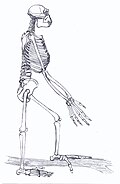 | ||
| ( Genus ) Kenyanthropes [4] [5] ( Group: australopithecus gracile ) [6] | |||||
| Kenyanthropus ( Kenyanthropusplatyops ) (“Kenyan Man’s Face”) | 3.3 million liters n | A pre-human discovered in modern Kenya. Had pronounced signs of the genus Australopithecus. The volume of the brain is 550 cm 3 | |||
| ( Genus ) Australopithecus ( lat. Australopithecus ) [4] [7] | |||||
| Early | |||||
| Anam Australopithecus ( Australopithecus anamensis ) | 4.2-3.9 million liters n | A species of Australopithecus genus that lived in Kenya | |||
| Gracile | |||||
| Afar Australopithecus ( Australopithecus afarensis ) | 3.9 (4.4) - 2.5 million liters. n | A small species of Australopithecus that lived in Kenya and Ethiopia. Growth - 1-1.5 m, weight - about 30-60 kg, brain volume - 400-430 cm 3 | |||
| Bahr el-Ghazal Australopithecus ( Australopithecus bahrelghazali ) | 3.5-3 million liters. n | The most western find found in Chad | |||
| African Australopithecus ( Australopithecus africanus ) | 3.5-2.4 million liters. n | Found in South and East Africa. Had a more voluminous skull. Growth about 1-1.5 m, weight 20-45 kg, brain volume - about 425-450 cm 3 | |||
| Australopithecus garhi ( Australopithecus garhi ) | 2.5 million liters n | Found in Ethiopia. Perhaps they are a "transitional link" from the genus Australopithecus to the genus of people. A. garhi brain volume of 450 cm 3 | |||
| ( Genus ) Parantropes ( lat. Paranthropus ) [4] ( Group: massive Australopithecus ) [6] | |||||
| Ethiopian Parantrop ( Paranthropus aethiopicus ) | 2.6-2.3 million liters. n | From East Africa (Ethiopia, Kenya) with a highly developed jaw, a bony crest on the skull, large teeth. The volume of the brain is 420 cm 3 | |||
| Paranthropus boisei ( "the man cracking nuts" ) | 2.1-1.1 million liters n | Pre-man from East Africa, with large teeth. Height 1.4 m, weight 35-50 kg, brain volume 450-545 cm 3 |  | ||
| Massive Paranthropus ( Paranthropus robustus ) | 2-1.2 million liters n | Found in South Africa; considered related to Australopithecus. Brain volume 520 cm 3 | |||
| ( Genus ) People ( lat. Homo ) [4] [8] | |||||
| Early Homo | |||||
| Rudolph Man ( Homo rudolfensis ) or ( Pithecanthropus rudolfensis ) | 2.5-1.8 million liters. n | The first most ancient man discovered in the territory of modern Kenya . The average height is 1.55 m, weight 45 kg. |  | ||
| Skilled Man ( Homo habilis ) or ( Australopithekus habilis ) | 2.1-1.6 million liters n | The oldest man from East Africa found in Tanzania ; then to Kenya and Ethiopia. Height 1.3–1.45 m, weight 25–45 kg, brain volume 500–650 cm 3 , the presence of a speech center — Brock's center . |  | ||
| Archanthropes (ancient people, "Pithecanthropus") | |||||
| Working Man ( Homo ergaster ) | 1.8-1.4 (1.2) million liters n | Early East African homo erectus; settled in Asia, evolved into Homo erectus. Height 1.8 m, brain volume approximately 900 cm 3 . |  | ||
| Georgian man ( Homo georgicus ) | 1.75 million liters n | The oldest man from Georgia, similar to the early homo erectus. Height 1.45-1.65 m, weight 50-60 kg, brain volume approximately 550-780 cm 3 . | 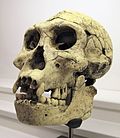 | ||
| Homo erectus ( Homo erectus ) | 1.8-0.4 million liters n | Could be a direct ancestor of modern people. Evolved from the Rudolph Man . The brain volume reached 850-1200 cm 3 . Height up to 1.5 m. |  | ||
| The Man Before ( Homo antecessor ) | 780 thousand liters n | Found in modern Spain . Presumably historically the first person in Europe. The face resembled that of a modern person. Height 1.7 m, brain volume 1100 cm 3 . It is considered the forerunner of the Neanderthal and Cro-Magnon . |  | ||
| Heidelberg Man ( Homo heidelbergensis ) | 600-200 thousand liters. n | An intermediate species (pre-paleoanthropus) between archanthropes and paleoanthropes ( Neanderthals ). Africa left 800 thousand years ago. He lived in Europe 500-100 thousand years ago. 200-150 thousand liters. n there was a separation of lines leading to Neanderthals and Cro-Magnons. |  | ||
| Paleoanthropes (ancient people, "Neanderthaloids") | |||||
| Neanderthal man ( Homo neanderthalensis ) | 200—27 thousand liters n | Occupied a vast territory in Europe, Western Asia , Africa. He had a massive physique, wide powerful bones and short limbs, a large head on a short neck, a flat face, a wide nose and a massive lower jaw. Growth 155-165 cm. The brain volume reached 1600-1700 cm 3 . The early form - "progressive" existed in the interval 200-100 thousand years ago; later - “classical” - 100-27 thousand years BC. |  | ||
| Neoanthropes (modern people, " Cro-Magnon-like ") | |||||
| Modern man ( Homo sapiens ) | 195 thousand liters n - modernity | Origin - Africa. About 100 thousand years ago, it infiltrated the Middle East , in Europe replaced other forms of more ancient people. The brain volume is 1400-1900 cm 3 . | 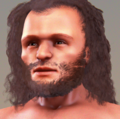 | ||
| Floresian man ( Homo floresiensis ) | 130-95 thousand liters. n | The dwarf form of man discovered on the island of Flores ( Indonesia ). Growth 1 m. Brain volume 400 cm 3 . | 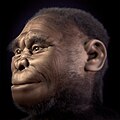 | ||
Content
Notes
Comments
- ↑ Australopithecus means a group of hominoids possessing a combination of a monkey skull and human locomotion .
References to sources
- ↑ Georgievsky, 2009 .
- ↑ Zubov A. A. Formation and initial resettlement of the genus “Homo” / ed. S.V. Vasilieva. - SPb. : Aletheia, 2011 .-- 224 p. - ISBN 978-5-91419-371-0 .
- ↑ 1 2 3 4 5 6 Chronicle of human evolution . Public project of Igor Garshin . Date of treatment January 14, 2019.
- ↑ 1 2 3 4 5 6 7 Georgievsky, 2009 , p. 108, 109.
- ↑ 1 2 3 4 Markov A.V. The Origin and Evolution of Man . Problems of Evolution . Date of treatment January 13, 2019.
- ↑ 1 2 3 4 5 Thirst. I, II., 2002 , p. 11-14.
- ↑ Throb. I, II., 2002 , p. 5, 11-14.
- ↑ Throb. III, IV., 2004 , p. 10-12.
Literature
- Georgievsky A. B. Evolutionary anthropology (historical and scientific research). IEEE RAS . - SPb. : Nestor-Istoriya, 2009. - 256 p. - ISBN 978-59818-7301-0 .
- Drobyshevsky S.V. Predecessors. Ancestors? Part I. Australopithecus. Part II "Early Homo ." Monograph / ed. E.N. Khrisanfova. - Moscow - Chita : ZIP SibUPK, 2002. - 180 p. - ISBN 978-5-382-01245-2 .
- Drobyshevsky S.V. Predecessors. Ancestors? Part I. Australopithecus. Part II "Early Homo ." Monograph. (4th edition) . - M .: LCI, 2016 .-- 328 p. - ISBN 978-5-9710-3964-8 .
- Drobyshevsky S.V. Predecessors. Ancestors? Part III. Archanthropes. Part IV Hominids, transitional from archanthropes to paleanthropes. Monograph / ed. V. M. Kharitonov. - M .: URSS editorial , 2004 .-- 344 p. - ISBN 5-354-00966-9 .
- Drobyshevsky S.V. Predecessors. Ancestors? Part V. Paleoanthropes. Monograph / ed. V. M. Kharitonov. - Moscow : KomKniga , 2006 .-- 264 p. - ISBN 5-484-00426-8 .
- Go Maitland. Missing link. (The emergence of man) / ed. Yu. G. Rychkova. - M .: Mir, 1977. - T. Second book. - 160 p.
- Vishnyatsky L. B. The history of one accident, or the Origin of man . - Fryazino: Publishing house "Century 2", 2005. - 240 p. - ISBN 5-85099-154-9 .
Links
- Human evolutionary tree . Project: Anthropogenesis.RU . Date of treatment January 13, 2019.
- The Pongid family . Biology . Date of treatment January 13, 2019.