Musa Tashmukhamedov ( Uzbek Muso Toshmuhammad ; 1904/1905 - 1968 ) is an Uzbek, Soviet poet and writer who worked under the pseudonym Aybek ( Uzbek Oybek ). People's writer of the Uzbek SSR ( 1965 ). Academician of the Academy of Sciences of the Uzbek SSR ( 1943 ). Laureate of the Stalin Prize of the first degree ( 1946 ). Member of the CPSU (b) since 1948 [1] .
| Musa Tashmukhamedov | ||||
|---|---|---|---|---|
| Uzbek Muso toshmuhammad | ||||
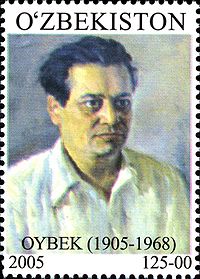 Aybek (Musa Tashmukhamedov) | ||||
| Birth name | Musa Tashmukhamedov | |||
| Aliases | Aybek | |||
| Date of Birth | December 28, 1904 ( January 10, 1905 ) | |||
| Place of Birth | Tashkent Syrdarya region (Russian Empire) | |||
| Date of death | July 1, 1968 (63 years old) | |||
| Place of death | Tashkent UzSSR , USSR | |||
| Citizenship |  Russian Empire → Russian Empire →  the USSR the USSR | |||
| Occupation | poet , prose writer , translator | |||
| Years of creativity | 1930s - 1960s | |||
| Direction | socialist realism | |||
| Genre | novel | |||
| Language of Works | Uzbek | |||
| Awards |   | |||
| Awards |
| |||

Content
Biography
Musa Tashmukhamedov was born on December 28, 1904 ( January 10, 1905 ) in Tashkent into a poor family of a weaver, who constantly roamed his goods in the steppe and mountain villages of then Turkestan. Sometimes the father took his son with him. A very impressionable and thoughtful boy listened with great pleasure to various stories and tales.
At that time, representatives of the poor class who wished to educate their children could only go to primary school. So Musa, at the age of seven, was sent to study with the usual jokes in which parents gave the teacher the order:
Call him Muhammad Musa,
Your honor, your meat
Leave us only his bones.
The writer reflected his memories of this school in the novel "Childhood" (1962), which was published in 1963. The story is a brilliant example of memoir literature. Aibek, following little Musa, step by step reveals his life path, shows the formation of his character, the formation of his personality. Along with changes in society, moral ideals, the views of the little hero are changing, and his dreams and aspirations are becoming increasingly apparent.
Aybek’s work is multifaceted. Like many Uzbek writers, Aybek began his literary journey with poetry. In 1923, his first poem “Whose Land?” Was published. He is one of the first Uzbek novelists. He penned such works as: “Sacred Blood”, “Navoi”, “Wind of the Golden Valley”, “The Sun Will Not Fade”, “The Great Way”. He began to write as a student of the Faculty of Economics of SAGU , who graduated in 1930.
The first big novel of the writer “Sacred Blood” ( 1943 ), is dedicated to the life of the peoples of Central Asia and Uzbekistan during the First World War. This novel was filmed at the Uzbekfilm studio.
From a young age, Aybek was fascinated by the works of the great Uzbek poet and thinker Alisher Navoi. But before writing a work about him, the writer carefully studied and looked at the huge archival material. In the 30s, Aibek worked on creating the image of the great thinker, poet and politician A. Navoi. Aybek wanted Navoi’s songs fly over the earth like a nightingale.
In 1939 he wrote a poem about the great poet, and in 1943 a novel was completed in which Aybek showed Navoi only as a public and statesman. His creative path is spoken only in passing and only at the end of the book. The significance of the novel Navoi, as one of the best realistic works, goes far beyond the boundaries of Uzbek literature. It has been translated into many languages, including Russian.
Aibek is the author of a number of studies, scientific articles, reviews: “The creative path of Abdullah Kadiri” (1936), “Uzbek poetry of recent years” (1933), “Uzbek literature” (1943), “Literature, history, modernity” (1966).
Aybek is also known as a translator from Russian into Uzbek. He translated into Uzbek such works as: “Eugene Onegin” by A. S. Pushkin , “Faust” by I. V. Goethe , “Masquerade” by M. Yu. Lermontov , M. Gorky , Homer (excerpts from the “Iliad”) , the epic "Davyd Sasunsky", V. G. Belinsky and others.
He was engaged in a lot of public work, a member of the joint venture of Uzbekistan. Member of the USSR Supreme Council of the 2nd convocation (1946-1950) and 5-6 convocations (1958-1966) of convocations.
Aybek died on July 1, 1968 . He was buried in Tashkent at the Chigatai Memorial Cemetery .
In memory of Aybek, the Tashkent metro station was named. The name was Kashkadarya Regional Uzbek Musical Drama Theater and Termez State Pedagogical Institute.
Awards and Prizes
- People's Writer of the Uzbek SSR (1965)
- Stalin Prize of the first degree (1946) - for the novel "Navoi" (1945)
- State Prize of the Uzbek SSR named after Khamza - for the book "Childhood" (1962)
- two orders of Lenin
- four other orders and medals
Notes
- ↑ Great Russian Encyclopedia: 30 Vol. / Chairman scientific-ed. Council Yu. S. Osipov. Repl. Ed. S. L. Kravets. T. 1. A - Questioning. - M.: Big Russian Encyclopedia, 2005 .-- 766 p.: Ill .: maps.
Links
- Aibek // Great Soviet Encyclopedia : [in 30 vol.] / Ch. ed. A.M. Prokhorov . - 3rd ed. - M .: Soviet Encyclopedia, 1969-1978.
- Website "According to the pages of Uzbek literature" (inaccessible link from 01/31/2017 [926 days])