
Landsmålsalfabetet (“The Swedish dialect alphabet”, Swedish det . Svenska landsmålsalfabetet , Swedish Dialect Alphabet ) is a phonetic alphabet developed by Swedish linguist Johan August Lundell for phonetic transcription of Swedish dialects .
The alphabet is based on the Latin alphabet with many modifications, for example, letters with various hook options, and extensions, among which the Greek letters γ and φ and the Cyrillic letters s and l . In this case, one or another modification of the symbol corresponds to the same modification of the designated sound [1] . Additional articulation (for example, the pronounced pronunciation [ k ] before the vowel [ u ] in English cool ) is indicated by the symbol in the lower index [2] [3] . Also used are diacritical marks representing suprasegmental sound units ; in particular, the macron below indicates the longitude of the sound [4] . Typically, a Landsmålsalfabetet uses lowercase letters in italics, although a more general transcription is written in direct font [5] [6] .
Initially, the alphabet consisted of 89 letters [7] , gradually it was expanded to more than 200 graphemes ; it became possible to transcribe other languages, including Russian, Chinese and dialects of English [8] .
Similar systems for Danish and Norwegian are Denmark and Norway, respectively [9] .
History and Application

In the 1870s, a number of student associations were formed at Uppsala University , the purpose of which was to fix the dialects of the Swedish language, and each of them used its own phonetic notation. Johan Lundell, then still a student, was entrusted with the creation of a universal alphabet. The system that arose in 1878 is still used in linguistics , mainly in Sweden and Finland [8] .
For the alphabet, 42 letters were borrowed from the transcription system proposed by Karl Jacob Sundeval in Om phonetiska bokstafver (On Phonetic Letters; Stockholm, 1856) [5] [7] [10] .
In 1928, Lundell published an article in the journal Studia Neophilologica , which describes his system in detail and gives examples of its use for Swedish and Russian [11] . In the alphabet at that time, there were 144 characters [5] .
The alphabet is used by the Swedish journal (“Swedish dialects and folklore”) [8] , founded by Lundell [12] , as well as in the dictionary Ordbok över folkmålen i övre Dalarna (“Dictionary of dialects in Upper Dalarna ”) 13] . The system was used by the linguist Adolf Gottard Nuren [14] [15] .
Derivative Systems
Many symbols of transcriptions used by the Swedish synologist Bernhard Karlgren in their reconstruction of the Middle Chinese language were taken from Landsmålsalfabetet [9] . The first version of his system, Karlgren a , dates back to 1915-1919 [16] [17] ; in 1922, changes were made to the transcription ( Karlgren b ), and in 1923 its simplified version, Karlgren c , was used in his Analytic Dictionary (from the English - “Analytical Dictionary”). In a Compendium of Phonetics in Ancient and Archaic Chinese published in 1954, Karlgren last modified the system ( Karlgren d ). A number of phonetic alphabets invented by other sinologists are in turn based on Karlgren transcription [18] .
Ordbok över Finlands svenska folkmål - a dictionary of Swedish dialects spoken in Finland - uses its own transcription with borrowings from Landsmålsalfabetet, including ⱸ, ⱹ and ⱺ [15] . Dictionary Ordbok över Sveriges dialekter ("Dictionary of Swedish dialects") uses a generalized version of the alphabet with a truncated set of characters, which have a capital form. In this case, a , while uppercase A corresponds to lowercase ɑ . ʃ in upper case looks like an elongated S ( ) [19] .
In addition, some Landsmålsalfabetet characters were taken over by Volke Hedblum transcription [20] .
Unicode
Some symbols of dialectology are present in Unicode since its first version, as they are included in IPA or other alphabets. Back in 2001, the Unicode Consortium was presented with a draft encoding of phonetic transcription symbols [21] . With version 5.1, released in 2008, three letters of the alphabet, ⱸ, ⱹ, and ⱺ, were included in the standard [22] for the Ordbok över Finlands svenska folkmål dictionary [15] . The characters are located in the block " Extended Latin - C " ( English Latin Extended-C ) under the code positions U + 2C78, U + 2C79 and U + 2C7A, respectively, being mistakenly located in the sub-block "Additions for the Ural phonetic alphabet " ( English Additions for UPA ) [23] .
In 2008, Michael Everson filed an application for the inclusion of 106 additional letters for this alphabet, as well as the symbols of several other phonetic transcriptions, but did not contain evidence of their use [24] . At the time of the release of version 12.1 of the standard, the proposal was not accepted, although certain characters, mainly used in the Teuthonista alphabet, were encoded according to the results of other applications (partially under code positions different from those provided for Everson) [25] [26] [27] . The code range 1E000-1E00FF proposed for the Phonetic Extensions-A block is currently partially covered by the Glagolitic Supplement block [28] .
Due to the lack of characters in the encoding standard, there are fonts that are not compatible with Unicode and are designed for computer typing in Landsmålsalfabetet, such as Dialekt Sve [29] and landsm_t [30] . Dialekt Uni is Unicode compatible and displays the missing symbols of Scandinavian dialectologies in the Region for private use [29] .
Gallery
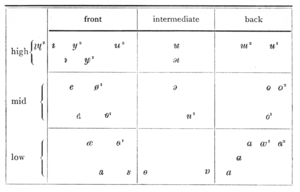
1879 Landsmålsalfabetet consonant table
Glyphs of Dialekt Uni font in the Area for Unicode Private Use (not all characters are missing in the standard)
Sundeval alphabet (1856). Uppercase and lowercase letters
The name of Lake Vänern ( Swedish: Vänern ), recorded using the phonetic transcription Landsmålsalfabetet.
Notes
- ↑ Lundell, 1928 , p. five.
- ↑ Lundell, 1928 , p. eleven.
- ↑ Grip, 1901 , p. eleven.
- ↑ Lundell, 1928 , pp. 14-15.
- ↑ 1 2 3 Lundell, 1928 , p. 6.
- ↑ Lundell, 1878 , p. 141.
- ↑ 1 2 Lundell, 1878 , p. 14.
- ↑ 1 2 3 Lundell, 1928 , p. 2.
- ↑ 1 2 Michaël Stenberg. TMH - QPSR Vol. 51 Phonetic transcriptions as a public service (English) (PDF). Royal Institute of Technology . Circulation date May 21, 2019.
- ↑ Carl Jakob Sundevall. Om phonetiska bokstäver : [ Swede. ] // Kungliga Svenska vetenskapsakademiens handlingar. - 1858. - T. 1 (1855, 1856), issue. 1 (1855). - S. 25-92.
- ↑ Lundell, 1928 .
- ↑ Svenska landsmål och svenskt folkliv . ISSN 0347-1837 (Swedish) . gustavadolfsakademien.se . Kungliga Gustav Adolfs Akademien . Circulation date May 26, 2019.
- ↑ Ordbok över folkmålen i övre Dalarna (OÖD) (Swedish) . sprakochfolkminnen.se . Institutet för språk och folkminnen. Circulation date May 23, 2019.
- ↑ Noreen, Adolf. Vårt språk 1. - Lund: Gleerup, 1903. - S. 496.
- ↑ 1 2 3 Therese Leinonen, Klaas Ruppel, Erkki I. Kolehmainen, Caroline Sandström. Proposal to encode characters for Ordbok över Finlands svenska folkmål in the UCS (PDF). unicode.org (January 26, 2006). Circulation date May 21, 2019.
- ↑ Bernhard Karlgren. Etudes sur la phonologie chinoise (Fr.) . - Leyde et Stockholm, 1915.
- ↑ Bernhard Karlgren. Qualitative phonetics // A mandarin phonetic reader in the Pekinese dialect . - Stockholm: KB Norstedt & Söner, 1918. - S. 6-9.
- ↑ Branner, David Prager. Appendix II: Comparative transcriptions of rime table phonology // The Chinese Rime Tables: Linguistic Philosophy and Historical-Comparative Phonology (English) / John Benjamins. - Amsterdam, 2006 .-- Vol. 271. - P. 265-302. - (Current Issues in Linguistic Theory). - ISBN 978-90-272-4785-8 .
- ↑ Ordbok över Sveriges dialekter (Swedish) / Gunnar Nyström. - 1991–2000. - T. 1. - S. 9.
- ↑ Eriksson, 1961 , pp. 138-139.
- ↑ Benny Brodda, Lars Törnqvist. Encoding of Swedish dialect transcripts ( PDF) (March 10, 2001). Circulation date May 21, 2019.
- ↑ Unicode 5.1.0 Unicode (April 4, 2008). Circulation date May 12, 2019.
- ↑ Latin Extended-C . Range: 2C60–2C7F (English) (PDF) . Unicode Circulation date May 21, 2019.
- ↑ Exploratory proposal to encode Germanicist, Nordicist, and other phonetic characters in the UCS (English) (PDF). unicode.org (November 27, 2008). Circulation date May 21, 2019.
- ↑ Combining Diacritical Marks Extended . Range: 1AB0-1AFF (English) (PDF) . Unicode Circulation date May 21, 2019.
- ↑ Combining Diacritical Marks Supplement . Range: 1DC0–1DFF (English) (PDF) . Unicode Circulation date May 21, 2019.
- ↑ Latin Extended-E . Range: AB30 – AB6F (English) (PDF) . Unicode Circulation date May 21, 2019.
- ↑ Glagolitic Supplement . Range: 1E000-1E02F (English) (PDF) . Unicode Circulation date May 24, 2019.
- ↑ 1 2 Dialekt (Swedish) . Circulation date May 21, 2019.
- ↑ Some fonts / Några typsnitt / teckensnitt (Swedish) . Circulation date May 21, 2019.
Literature
- Eriksson, Manne. Svensk ljudskrift 1878-1960. En översikt över det svenska landsmålsalfabetets utveckling och användning huvudsakligen i tidskriften Svenska Landsmål (Swedish) / genom Dag Strömbäck. - Bilaga, 1961. - 184 p. - (Svenska landsmål och Svenskt folkliv).
- Grip, E. I. Ljudfysiologisk översikt. - In: Skuttungemålets ljudlära : [ Swede. ] // Nyare bidrag till känedom om de Svenska landsmålen ock Svenskt folklif / genom JA Lundell. - Stockholm: Nordiska Bokhandeln, 1901. - S. 9-16.
- Kemp, J. Alan. Phonetic transcription: History // Encyclopedia of Language and Linguistics. - 2. - Elsevier Science, 2006. - T. 9. - S. 407. - ISBN 978-0080443652 .
- Lundell, JA Det svenska landsmålsalfabetet : [ Swede. ] // Nyare bidrag till känedom om de Svenska landsmålen ock Svenskt folklif / genom JA Lundell. - Stockholm: Samson & Wallin, 1878. - S. 11-158.
- Lundell, JA The Swedish dialect alphabet (Eng.) // Studia Neophilologica: journal. - 1928. - Vol. 1 , no. 1 . - P. 1-17 . - DOI : 10.1080 / 00393272808586721 .
Links
- Landsmålsalfabetet (Swedish) (PDF). sprakochfolkminnen.se . Institutet för språk och folkminnen. Circulation date May 21, 2019.
- Landsmålsalfabetet, Nordisk familjebok , T. 15 (1911) 1044 , 1045-6 , 1047-8 (Swedish) .
- Patrik Bye. Lydskrift ( normal ) (html) (inaccessible link) . uit.no. University of Tromso (July 29, 2003). Date of treatment June 12, 2019. Archived March 4, 2016.