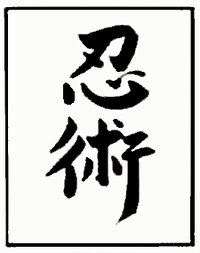
Ninjutsu ( Jap. 忍術 , “the art of secrecy”) - formed in Japan in the XV-XVI centuries. a complex discipline that includes the art of espionage, the technique of sabotage work behind enemy lines, elements of survival, and much more. In popular literature and popular culture, it is often interpreted as Japanese martial art [1] .
| Ninjutsu | |
|---|---|
| 忍術 | |
 | |
| Other names | Ninpo, Shinobi Jutsu |
| A country |  Japan Japan |
| Famous followers | Masaaki Hatsumi |
Content
Origin
It is believed that the secret ninja clans arose in Japan at the same time as the samurai estate in the 9th - 12th centuries . The prototype of the ninja are the sects of the mountain hermits of the Yamabushi of the VIII century , who professed the direction of Buddhism of the Shingon school. Yamabushi encouraged the hard and exhausting training of their followers, and carefully preserved the knowledge collected over the centuries in medicine , chemistry , astrology . Yamabushi were committed to a complete merger with nature. Initially, the secret ninjutsu schools had nothing to do with military organizations, either in their training methodology or in their philosophy. However, over time there have been changes.
The origin of the martial art of ninjutsu is associated, like most eastern martial arts, with Chinese sources. However, the term “ninjutsu” covers only a few features of ninjutsu art, such as concealment, creation, and maintaining an aura of mystery. The functions of the ninja included penetrating the enemy, committing sabotage or killing and returning after the successful completion of the mission.
Traditionally, the ninja served as mercenaries who offered themselves as spies , assassins, saboteurs , political provocateurs and terrorists to the large and small rulers of the Japanese feudal era. Ninjas offered their services only to those who were willing to pay for them. Families of the ninja were closely knit collectives integrated into larger groups - clans . A stranger practically did not have the opportunity to join such a group and become a ninja, for this it was necessary to be born in a family of professionals . Art and other tricks were kept secret and transmitted only from father to son. Revealing a secret meant death at the hands of a ninja from the same clan.
The heyday of ninjutsu fell on the Sengoku Jidai period ( 1467 - 1568 ). At this time, the peak of feudal wars took place, and then there were about 70 ninja clans. Legends about the ninja also belong to this period. Documentary evidence confirms the existence of the Iga and Kok schools in this era.
In Japanese culture, ninjas are often opposed to samurai . The fact is that the samurai above all set the ideals of the Bushido military code and, in accordance with them, strove to fight with dignity and prepare for death in the best way. The ninja professed the exact opposite philosophy. The main thing for the ninja is to complete the task, and since their main task is reconnaissance, for its successful completion it was necessary to survive at all costs. For the ninja there could be no forbidden actions, there could not exist any moral and religious ethical restrictions in the methods of warfare. Any means are good for victory, and the ninja successfully used all of them.
Learning Basics
Ninjutsu teaches that one cannot achieve absolute security. Every action violates the harmony that already exists in the world, thereby provokes resistance, generates a response that is all the more powerful and dangerous, the more the established balance is violated. The way out is to understand well in which harmony is violated, and to be able to minimize undesirable consequences.
The teachings of all ninjutsu schools were based on three interconnected blocks of skills, which together formed a flexible system of confronting any conceivable danger.
- The first block of skills can be described as the art of using the environment and special devices to defeat the enemy. This included recognition of traces and secretive movement, camouflage and overcoming obstacles, ambushes and deception of the enemy’s feelings. The purpose of the training was to merge with the world through the conquest of 5 basic "elements" - in the Chinese version - Earth, Water, Tree, Fire and Metal; in the Japanese version - Earth (Ti), Water (Sui), Fire (Ka), Air (Fu) and the Void (The first basis of everything, Ku. It’s being accumulated on the “Third block”). The warrior who achieved such a merger became invisible and inaccessible to the enemy, and art was collectively called tompo - the art of disguise.
- The second block is the art of fighting an armed and unarmed adversary. This block includes two main sections:
- Taijutsu - the art of body ownership
- Bu-jutsu - working with weapons
- Taijutsu - the art of body ownership
- The third block of skills is devoted to the mobilization of the internal resources of the body based on the so-called "altered states of consciousness" achieved through special psycho-training (Nimpo-mikkyo)
Ninja Martial Arts
According to the Japanese historian A. M. Gorbylev, the ninja did not have a separate original system of hand-to-hand combat and combat with various types of weapons, and the martial arts styles already existing in Japan studied and adapted the ninja to their needs. Ninja clans used the old form of ju-jutsu for hand-to-hand combat, and the corresponding budo styles ( Kenjutsu , Bojutsu , Sojutsu , Shuriken-jutsu, etc.) for hand-to-hand combat. At the same time, Gorbylev distinguishes the following differences between the shinobi bu-jutsu and the samurai styles of martial arts, due to the tactics of the ninja:
- More punches than samurai ju-jutsu.
- Emphasis on asphyxiating tricks as quieter than throwing.
- Emphasis on fighting in small rooms and confined spaces (shrubs, bamboo thickets, narrow corridors, traditional Japanese rooms with a low ceiling, etc.). Fighting in a small room (both with and without weapons) imposes certain restrictions on the equipment used: there is no place for sweeping strikes and long weapons, so they are replaced by short strokes, fencing injections and small-sized shortened types of weapons (for example, ninjas used shorter compared to samurai swords).
- Preference for sudden attacks from a hidden position (from an ambush, behind, at night, etc.)
- Emphasis on techniques to stun the enemy, so that in case of disclosure of a scout to gain time for flight [2] .
None of the current schools of Japanese bujutsu can convincingly prove that it comes from medieval ninjas. Perhaps the ninja techniques have been preserved and are being studied in the reconnaissance and sabotage units of the Self-Defense Forces of Japan .
When fleeing, two hand-to-hand combat techniques were used. The ninja fell sharply under the feet of a catching enemy and forced him to fly head over heels through himself. If the enemy was approaching from the side, the ninja braked sharply, let him pass by and hit with a sword on the back [3] .
According to the Japanese historian A.M. Gorbylev, the ninjas devoted much less time to hand-to-hand combat than fans of film-militants think of this. Serious hand-to-hand training entails specific changes in the appearance, thereby unmasking the ninja. Therefore, according to Gorbylev, the ninja focused on the techniques of a surprise attack from close range using small-sized hidden weapons instead of a deep study of martial arts and conducting a traditional open match [4] .
Ninja Costume and Armor
According to the Japanese historian Gorbylev, the ninja never used a black tight-fitting suit, popular in films and novels. Night ninja costumes were reddish brown, ashen, tan or dark gray. According to Gorbylev, it was these shades that made it possible to completely merge with the night haze, while a completely black suit stands out sharply in these conditions. The ninja costume had baggy outlines [2] . In the afternoon, ninjas wore casual clothes that allowed them to merge with the crowd.
Ninja Clans
- Iga is one of the most famous and influential clans. A similar situation was achieved with the support of the Tokugawa government.
- Koka (Koga) is the second most influential school along with the Iga school, also supported by the Shogunate .
- Kissyu
- Fuma is a large ninja clan, some of which served as Hojo Ujinao .
- The garden
- Momoti (included in Iga)
- Fujibayashi (included in Iga)
- Negoro - originated and practiced among the warrior monks ( `` sohei '' ) of the Negoro-ji monastery. Known for training methods in the field of rifle shooting.
- Sayka (Saiga) - specialized in shooting from rifles.
- Shirai
- Shinto
- Hakuun - founded, according to legend, by a hermit named Hakuun Doshi (Tao White Cloud) in the Kumano Mountains approx. 1181–1182, where it was practiced in the Yamabushi environment. The schools of Goton-juho-ryu (school of five ways of escape and ten methods), Genjitsu-ryu (“Realistic School”), Gen-ryu (School of Darkness), Kishu-ryu (School of Kishu Province) and Ryumon-ryu (later Dragon Gate School). All of them are known only by name.
- Hattori (part of Iga)
Ninja Equipment
- Camouflage costume - shinobi-shojoku, shinobi-shozoku details: uwigi (jacket) and dojime (belt), yoke-bakama (pants), zukin (mask), tekko (hand overlays), kyahan or asimaki (leg windings), tabi (socks with a separate thumb), warajis (sandals) and uwappari (upper jacket) and nababukuro ("backpack" of the ninja).
- Removable robe ( 変 わ り 御 物 kavari-go-mono )
- Amigasa ( Japanese 編 み 笠 woven straw hat in the form of a low cone )
- Armor
- Kusari-katabira (mail armor)
- Tatami-gusoku (types of kiko and kurataginu) - light armor.
- Shields
- Tetsu no kame
- Jigu itasa
Ninja Weapons
- Weapon
- Wick (Hinawa-teppo)
- Flint (Hiuchi Isiju)
- Wind (kashiju) - a wind gun , is a tube in which arrows (needles, spikes) are inserted
- Wakizashi-teppo (a gun disguised as a wakizashi sword )
- Yadate-teppo (a gun disguised as a brush case)
- Kiseru-teppo (a gun disguised as a pipe)
- A gun
- Mokuho ("wooden gun")
- Harinuki-zutsu (“papier-mâché tube”)
- Incendiary
- Fire arrows chia
- Bohia - fire stick
- Silence - throwing incendiary arrow
- Hidake - Fire Bamboo
- Hisyaken ("fire shaken")
- Poisoning agents
- Moppan
- Fuyo no ogi
- Nemuribi
- Kusagame
- Fuses and Wicks
- Hokuchi, Hinawa, Hinoki-Hinawa, Take-Hinawa, Gujin-Hinava, Ame-Shinogi-Hinava, Ame-Hinawa, Mizu-Hinawa
- Swords, spears, axes, knives
- Shinobi Gatana Ninjato - Ninja Sword
- Tanto - knife
- Konaginate - short naginata
- Shibaki Yari - Spear
- Kamayari - spear-sickle
- It is an ax
- Sikomi-zue - hidden weapons (swords, knives with a straight blade, disguised as household items)
- Claws
- Tekkokagi, Nekote (cat's paw), shuko, asiko (claws for legs)
- Kusari Kama - half-serps with rope and weight or with a chain, Kama - sickle
- War Poles and Batons
- Jo, shakujo, rokujo, shimonkuzue, bo , hambo, cosikiribo, mimikiribo, etc.
- Variable Length Weapons
- Musubinawa - a rope with a weight
- Kusari - chain, other names (depending on length and weights): kusari-fundo, tama-gusari, sode-gusari, kusari-jutte, ryo-bundo, etc.
- Throwing bombs and grenades
- Throwing weapons
- Hankyu (half bow) and Yumiya (arrows)
- Fukia ( Fukibari ) - firing of poisoned arrows from a wind gun
- Shuriken (throwing "stars" and "arrows" of the ninja)
- Shaken ("asterisk"), types: sanko, juji, roppo, happo, manzi, nagare-manzi, tekkan, etc.
- Bojo-shuriken (“shuriken-wand”), types: Bosugata, Tantogata, Kugigata, Heitegata, Harigata, Hashijo, Kusabigata, etc.
- Utine (although this is not exactly a shuriken, but a shortened arrow with a heavier tip, it resembles a dart for darts , but a larger one)
- Tsubute, Arare, Metsubushi
- Wall Climbers
- Shinobikagi - a staff with a hook at the end and loops of rope along the staff for the legs
- Staircase (tobibashigo) - rope ladder with an iron hook at the upper ends
- Kaginawa (cat) - a double, triple and more iron hook with a rope (sometimes a chain)
Japanese Ninjutsu Researchers
- Ito Gingetsu (伊藤 銀 月)
- Yunoki Shunichiro (柚木 俊 一郎)
- Nakanishi Yoshitaka (中西 義 孝)
- Adati Kenichi (足 立 巻 一)
- Nava Yumio (名 和 弓 雄)
- Nakashima Atsumi (中 島 篤 巳)
- Ishikawa Masatomo (石川 正 知)
- Tobe Shinjuro (戸 部 新 十郎)
- Yamaguchi Masayuki (山口 正 之)
- Koyama Ryutaro (小山 龍 太郎)
- Okuse Hashichiro (奥 瀬 平 七郎)
- (初見 良 昭)
- Fujita Seiko (藤田 西湖)
- Fujita Kazutoshi (藤田 和 敏)
- (高 松寿 嗣)
- Kawakami Jinichi (川 上 仁 一)
- Kuroi Chiromitsu (黒 井 宏光)
- Ikeda Hiroshi (池田 裕)
- Isoda Mitifumi (磯 田 道 史)
- Yamada Yuji (山田 雄 司)
- Inoue Naoya (井上 直 哉)
See also
- Ninja
- Kunoichi - Female Ninja
- Bansensyukai - A Famous Ninjutsu Guide
- Assassins
- Bujinkan
Literature
- Gvozdev S.A., Krivonosov I.V. Ninja. Secrets of the demons of the night. - Minsk, 1997. - ISBN 985-6388-13-9 .
- Gorbylev A. Claws of the Invisible (Series "Martial Arts"). - Minsk, 2001. - ISBN 985-433-326-4 , ISBN 985-13-0612-6 .
- Gorbylev A. Way of the Invisible (Series "Martial Arts"). - Minsk: Harvest, 2002. - ISBN 985-13-0621-5 .
- Ratti O., Westbrook A. Samurai: history, traditions, martial art. - M .: Eksmo, 2005 .-- ISBN 5-699-04611-9 .
- Popenko V.N. Ninja School. - M., 2004. - ISBN 5-17-023841-X .
- Cumins Antony. Hattori Hanzo. The Devil Ninja. - 2010. - ISBN 160481697X. ISBN 160481697X . ISBN 160481697X . ISBN 160481697X . ISBN 160481697X . ISBN 160481697X . ISBN 160481697X . ISBN 1-60481-697-X . ISBN 1-60481-697-X . ISBN 1-60481-697-X .
- Cumins Antony. Shinobi Soldiers. An Investigation into the Ninja. - 2009. - ISBN 1604816740. ISBN 1604816740 . ISBN 1604816740 . ISBN 1604816740 . ISBN 1604816740 . ISBN 1604816740 . ISBN 1604816740 . ISBN 1-60481-674-0 . ISBN 1-60481-674-0 . ISBN 1-60481-674-0 .
- Cumins Antony. Shinobi Soldiers II: A Further investigation into the Ninja. - 2010. - ISBN 1604818107. ISBN 1604818107 . ISBN 1604818107 . ISBN 1604818107 . ISBN 1604818107 . ISBN 1604818107 . ISBN 1604818107 . ISBN 1-60481-810-7 . ISBN 1-60481-810-7 . ISBN 1-60481-810-7 .
- Cummins E. Looking for the Ninja. - M., 2017 .-- ISBN 978-5-4444-2237-3 .
Notes
- ↑ Gorbylev A.M. The Path of the Invisible: The True Story of Nin-Jutsu (1997), p. 11 .; Cummins Antony. Shinobi Soldiers. An Investigation into the Ninja (2009) p. 16. Archived October 18, 2014 on Wayback Machine
- ↑ 1 2 Invisible claws A. Gorbylev
- ↑ Japan: The Way of the Hand and Sword. No. 1/2004. A. Gorbylev. The Secret of Invisibility p. 42
- ↑ Japan: The Way of the Hand and Sword. No. 2/2002. A. Gorbylev. “The Initial Tricks of the Ninjutsu” p. 32