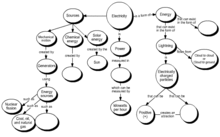
A concept map or concept diagram is a diagram that displays the connections between concepts. [1] This is a graphic tool that is used by pedagogical designers , engineers , technical writers and others to structure knowledge in a chosen field.
Ideas and information are usually displayed on the concept map in rectangles or circles, which are interconnected by arrows with signatures in the form of a tree-like descending hierarchy. Relations between concepts can be signed by keywords such as calls , demands , contributes to others, which determine the relationship between ideas or concepts. [2]
The way to visualize these connections between different concepts is called concept mapping (borrowing the English concept of concept mapping along with the concept of mind mapping from English mind mapping ). Concept maps are used to define ontologies of computer systems, for example, to model the relationships between objects in a specific area or in the UML language.
Content
Description
A concept map is a way of displaying information between ideas , images and words in the same sense that a sentence parsing scheme displays its grammatical and syntactic structure, a roadmap shows the location of objects, roads and cities, and an electrical diagram displays the connections between elements of an electrical device. On a concept map, each word or phrase is associated with another, and from these connections you can restore their relationship with the main concept of the map. The concept of the map is one of the ways of developing logical thinking and learning abilities, helping students to understand the place of an individual idea in the context of a certain area and to establish the relationship between the concepts. [3]
A good concept map exists in the context of the context posed by a specific “key question”, while a link diagram usually has only links coming from the central object of the diagram. Some studies suggest that the brain stores information in the form of pairs of “situations” and “reactions” that are activated during declarative memory , which in turn consists of “assumptions” and “pieces of information”. [4] [5] Since the concept cards are designed to conform to the structure of declarative memory, they simplify the understanding of new concepts and make learning more effective for those who use them and who make them up.
Difference from other visualizations
- Thematic cards . Concept maps are pretty similar to thematic maps, and they both display concepts or themes in graph form. Unlike various schemes and ways of visualizing ideas, processes and organizations, concept maps, as conceived by their creator Joseph Novak , are unique in the philosophy underlying them: “concept maps are defined by concepts or theories created from concepts that are central elements in the knowledge of reality. ” [6]
- Connection diagrams . Concept maps and thematic maps differ from the connection diagram in that they are not limited only to the tree structure of the graph. Another difference between concept maps and a connection diagram is how spontaneously and quickly they are created. The relationship diagram reflects thoughts on one topic and helps with brainstorming. A concept map can be a map, a representation system, a real (abstract) system, or a group of concepts. Less restrictions are imposed on concept cards: they can consist of several clusters, in contrast to connection diagrams limited only by the uniqueness of the central object.
History
The concept map was introduced by Joseph D. Novak and his research team at Cornell University in the 1970s as a way to explain new information to students. [7] Subsequently, concept maps began to be used to increase the effectiveness of training, as a way of displaying expert knowledge in teamwork in training, in government and in business. Concept cards come from the current in a philosophy called constructivism . In particular, constructivism assumes that students actively “build” knowledge.
Novak’s work was based on the cognitive theories of David Ausubel , who emphasized the importance of learning basic concepts before exploring the concept that is based on them: “The most important factor affecting learning is what the student already knows. Recognize this and teach accordingly. ” [8] Novak taught six-year-old children how to create concept maps using the answer to the question“ What is water? ”“ What causes the seasons to change? ”. In his book Learning How to Learn, Novak writes that “effective learning involves recognizing new concepts and theories in the context of existing cognitive structures.”
Many attempts have been made to conceptualize the process of creating concept maps. Ray McAleese, in a series of articles, suggested that the map creation process is a “dumping" process. In his 1998 article, Makalis developed ideas from the work of John Sowa [9] and articles by John Sweller and Paul Chandler. [10] The main idea of his work was that the conscious process of acquiring knowledge using peaks and connections allows a person to realize what he already knows and how to modify his existing knowledge to reflect new information. [11] Maria Birbili uses a similar idea to help young children become aware of their knowledge. [12] In this work, Makalis also developed the concept of concept maps into the concept of the “arena of knowledge”, a virtual space in which students can learn what they already know and what they don’t know yet.
Usage
Concept maps are used to help create new ideas, and are believed to help develop creativity . [2] They are also sometimes used in brainstorming . Although the look of a concept map very often very much depends on the person who created it, concept maps can be used to explain complex ideas.
Formalized concept maps are used in software design , where the use of the UML diagram language is common among other similar approaches.
Concept maps can also be considered as the first step in constructing an ontology , and can be used to represent formal arguments like argument maps .
Concept cards are very common in education and business. For example:
- Keeping notes and summarizing a large amount of information.
- Creation of new knowledge. For example, structuring implicit knowledge or combining the knowledge of different people into a single whole.
- Preservation of knowledge. For example, visualization of their experience by employees before leaving or retiring.
- In teamwork or in transferring expert knowledge.
- Help create a common vision and understanding in a team or organization.
- Pedagogical design . Concept maps are used as “advanced organizers” by David Ausubel to display the initial contextual framework for further information and training.
- Employee training: Concept maps are used as “advanced organizers” by David Ausubel to indicate the context of the training and the relationship with the work of students and learning objectives as part of their organization strategy.
- Explain complex ideas and arguments to other people.
- The study of the components of complex concepts, their argumentation and related terminology
- Detailing the structure of an idea, a sequence of ideas or consecutive arguments in order to identify errors and gaps in the argument of the opponent in the dispute.
- Strengthening metacognitive processes (learning to learn).
- Improving language skills.
- Assessing the student's understanding of the studied objects, concepts and the relationships between them.
- Extension of the lexicon.
Links
- ↑ Peter J. Hager, Nancy C. Corbin. Designing & Delivering: Scientific, Technical, and Managerial Presentations, 1997 ,. 163.
- ↑ 1 2 Joseph D. Novak & Alberto J. Cañas (2006). "The Theory Underlying Concept Maps and How To Construct and Use Them" , Institute for Human and Machine Cognition . Accessed Nov 24, 2008.
- ↑ CONCEPT MAPPING FUELS Archived on July 21, 2011. . Accessed Nov 24, 2008.
- ↑ Anderson, JR, & Lebiere, C. (1998). The atomic components of thought. Mahwah, NJ: Erlbaum.
- ↑ Anderson, JR, Byrne, MD, Douglass, S., Lebiere, C., & Qin, Y. (2004). An Integrated Theory of the Mind. Psychological Review, 111 (4), 1036-1050.
- ↑ Novak, JD & Gowin, DB (1996). Learning How To Learn, Cambridge University Press: New York, p. 7.
- ↑ Joseph D. Novak . Institute for Human and Machine Cognition (IHMC). Date of treatment April 6, 2008.
- ↑ Ausubel, D. (1968) Educational Psychology: A Cognitive View. Holt, Rinehart & Winston, New York.
- ↑ Sowa, JF, 1983. Conceptual structures: information processing in mind and machine , Addison-Wesley.
- ↑ Sweller, J. & Chandler, P., 1991. Evidence for Cognitive Load Theory. Cognition and Instruction , 8 (4), p. 351-362.
- ↑ McAleese, R. (1998) The Knowledge Arena as an Extension to the Concept Map: Reflection in Action, Interactive Learning Environments , 6 (3), p. 251–272.
- ↑ Birbili, M. (2006) "Mapping Knowledge: Concept Maps in Early Childhood Education" , Early Childhood Research & Practice , 8 (2) , Fall 2006
Further reading
- Novak, JD Learning, Creating, and Using Knowledge: Concept Maps as Facilitative Tools in Schools and Corporations. - 2nd. - Routledge, 2009 .-- ISBN 9780415991858 .
- Novak, JD Learning How to Learn / JD Novak, DB Gowin. - Cambridge: Cambridge University Press, 1984. - ISBN 9780521319263 .
Additional links
- An example of a 1957 concept map created by Walt Disney . (link is invalid)