Halszkaraptor ( lat. , Literally - the predator Khalshki ) is a dinosaur genus of the dromaeosaurid family, found in the Late Cretaceous sediments in Mongolia [1] . Contains a single species of Halszkaraptor escuilliei .
| † Halszkaraptor |
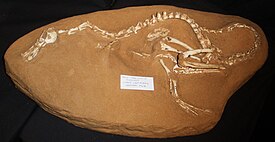
Sample holotype exhibited in Munich in 2011 |
| Scientific classification |
|---|
| No rank : | Bilateral symmetrical |
| Infraclass : | Archosauromorphs |
| No rank : | Archosauriformes |
| Group : | † Maniraptoriformes |
| Subfamily : | † Halszkaraptorinae |
|
| International scientific name |
|---|
Halszkaraptor Cau et al. 2017 |
| Single view |
|---|
† Halszkaraptor escuilliei
Cau et al. 2017 |
Geochronology
Campanian age83.6—72.1 Ma | million years | Period | Era | Aeon |
|---|
| 2,588 | Even | | | Ka | F
but
n
e
R
about
s
about
th | | 23.03 | Neogene | | 66.0 | Paleogen | | 145.5 | a piece of chalk | M
e
s
about
s
about
th | | 199.6 | Yura | | 251 | Triassic | | 299 | Permian | P
but
l
e
about
s
about
th | | 359.2 | Carbon | | 416 | Devonian | | 443.7 | Silur | | 488.3 | Ordovician | | 542 | Cambrian | | 4570 | Precambrian |
◄ Nowadays◄ Cretaceous-Paleogene extinction◄ Triassic extinction◄ Mass Permian Extinction◄ Devonian extinction◄ Ordovician-Silurian extinction◄ Cambrian explosion |
|---|
|
Researchers compared fossils to bones of crocodiles and waterfowl and found evidence of a semi-aquatic animal lifestyle. Phylogenetic analysis showed that the dinosaur was a member of its own basal subfamily Halszkaraptorinae , along with Mahakala and Hulsanpes [1] .
The Halszkaraptor holotype was most likely found in the Jadokhta Formation in southern Mongolia and for several years was in a private collection, being illegally taken out of the country, until it came to the fossil merchant Francois Escuillier. He identified it as a new species and passed it to paleontologists Pascal Godefroix and Andrea Cau [2] [3] . After authentication, Kau and other prominent paleontologists described the new taxon in a detailed study published in the journal Nature . The name of the genus is given in honor of the Polish explorer Halska Osmulskaya , and the species name is in honor of Eskuilye [2] [3] .
Reconstruction of the appearance of
Halszkaraptor escuilliei It is believed that Halszkaraptor was the size of a mallard and possessed anatomy features that allowed him to spend time both in water and on land. Such features include long clawed hind legs and shorter forelimbs, similar to those found in animals with webbed feet or fins [2] [3] . A short tail shifted the center of gravity of the animal forward, which is more useful for swimming than for walking. The body was more vertical than that of other theropods due to anatomical adaptation - lengthening of the hind limbs due to the hip joint and femur [1] . The jaws of the dinosaur carried many sharp, bent inward teeth. The long neck and special nerve endings on the muzzle, with which he sensed water fluctuations, suggested that he was hunting water prey [2] [3] . Despite the fact that Halszkaraptor was well adapted to the aquatic lifestyle, he had to get to the ground for reproduction, since dinosaurs laid eggs on land [2] .
Halszkaraptor is the only known predatory dinosaur, besides a spinosaurus , adapted to a semi-aquatic lifestyle [2] [4] .
The cladogram below reflects the results of a phylogenetic analysis conducted in 2017 by Andrea Cau and his colleagues, using the latest data from Theropod Working Group [1] .
| Dromaeosauridae | | Halszkaraptorinae | |
|
|
| Unenlagiinae |
|
|
| Shanag |
|
|
| Zhenyuanlong |
|
|
| Microraptoria |
| | Eudromaeosauria |
| Bambiraptor |
|
|
| Tianyuraptor |
|
|
| Dromaeosaurinae |
|
| Velociraptorinae |
|
|
|
|
|
|
|
|
|
|
|
|
|
|
|
|
|
