Anan Panyarachun [6] [7] [8] ( Thai อานันท์ ปัน ยา ร ชุน ; born August 9, 1932 in Bangkok , Siam ) - Thai diplomat and statesman, Thai ambassador to several countries [2] [3] [4 ] [5] and the Prime Minister of the kingdom in 1991-1992 [9] .
| Anan Panyarachun | |||||||||||||
|---|---|---|---|---|---|---|---|---|---|---|---|---|---|
| thai อานันท์ ปัน ยา ร ชุน English Anand panyarachun | |||||||||||||
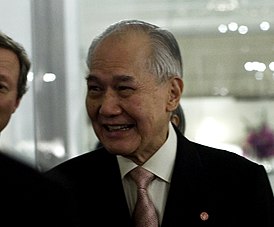 Ex-premier at a reception in honor of Princess Mach Chakri Sirindhorn January 12, 2010 | |||||||||||||
| |||||||||||||
| Head of the government | Thaksin Chinnavat | ||||||||||||
| Monarch | Phumipon Adulyadej | ||||||||||||
| Predecessor | position established | ||||||||||||
| |||||||||||||
| Head of the government | Chavalit Yongchayut | ||||||||||||
| |||||||||||||
| |||||||||||||
| Predecessor | |||||||||||||
| Successor | Suchinda Kraprajun | ||||||||||||
| |||||||||||||
| Predecessor | Michai Ruchuphan | ||||||||||||
| Successor | |||||||||||||
| |||||||||||||
| Predecessor | Pan bathmenti | ||||||||||||
| Successor | Sudhi Prasavinitchay | ||||||||||||
| |||||||||||||
| |||||||||||||
| Predecessor | |||||||||||||
| Successor | |||||||||||||
| |||||||||||||
| Predecessor | |||||||||||||
| Successor | Banbot Banich Surapol | ||||||||||||
| |||||||||||||
| Monarch | Phumipon Adulyadej | ||||||||||||
| Predecessor | Somchai Anuman Rajadon | ||||||||||||
| Successor | Pracha Guna Kasem | ||||||||||||
| Birth | August 9, 1932 (87 years old) Bangkok , Siam | ||||||||||||
| Father | Cern Panyarachun | ||||||||||||
| Mother | Pruek Chotikasatien | ||||||||||||
| Spouse | Sodsri Panyarachun | ||||||||||||
| Children | daughters Nanda and Darani | ||||||||||||
| The consignment | non-partisan | ||||||||||||
| Education | Higher in Economics and Law, University of Cambridge | ||||||||||||
| Academic degree | Bachelor of Arts , 20 Honorary Doctorates | ||||||||||||
| Activities | politician, diplomat, businessman | ||||||||||||
| Religion | |||||||||||||
| Autograph |  | ||||||||||||
| Awards | Thailand orders
Foreign orders
| ||||||||||||
| Site | anandp.in.th | ||||||||||||


Biography and career
Anan Panyarachun is the youngest of twelve children in the rich Bangkok family of Makha Ammat Three Pia Prichanusata (aka Sern Panyarachun) and his wife Kunjin Prichanusat (aka Pruek Chotikasatien) The father of the future politician was an influential educational figure who reached the post of permanent secretary by the time of the birth of his youngest son Siam's Ministry of Education (actually the non-public head of the ministry). In 1932, Pia Prichanusat resigned from the civil service, taking up publishing; He was the editor of The Siam Chronicle , which subsequently served as the basis for the creation of the , as well as the founder and first chairman of the Thai Press Association.
He received secondary education in Bangkok schools Surasak, Amnuysilp and Bangkok Christian College. In 1948, parents sent their son to continue their education in the UK. Anan graduated from high school at London Dalwich College , and in 1952 he entered the prestigious Trinity College of Cambridge University for higher economic and legal education. In addition to studying, he was actively involved in sports at both colleges and was a member of squash and tennis teams.
After graduating with honors from the Trinity College in 1955 with a bachelor ’s degree in humanities and returning to his homeland, he joined the Thai Ministry of Foreign Affairs . From 1958 to 1964 he was secretary of the Minister of Foreign Affairs of Tanat Homan .
In 1964, he was appointed first secretary and later adviser to the Permanent Mission of Thailand to the UN in New York, thereby starting a career as a diplomat. In 1967, he received the highest diplomatic rank of ambassador and was appointed acting head of the Permanent Mission of Thailand to the UN, and, concurrently, the Thai Ambassador to Canada. In 1972, received a new appointment on American contingency, becoming the kingdom's ambassador to the United States and, concurrently, remaining the permanent representative of Thailand to the UN.
At the end of 1975 he returned to Thailand, where he was appointed Permanent Secretary of the Ministry of Foreign Affairs since January 1976. He played a leading role in this post in ensuring the withdrawal of US troops from Thailand.
Soon, however, he comes under investigation on suspicion of communist ties in connection with the “witch hunt” after the military coup of 1976, probably due to the Foreign Ministry’s active efforts to normalize diplomatic relations between Thailand and China, and is actually suspended from business. although it remains at the rank of ambassador [10] . After the investigation team on civil servants cleared him of all charges, Panyarachun was returned to the diplomatic service and sent by the ambassador to Germany. However, in late 1978 - early 1979, he left the civil service in business [11] .
Already in 1979, he became vice chairman of the board of directors of Saha-Union Group and director of several of its subsidiaries (later, in 1991, heading the board), in 1984 he received the post of director of Siam Commercial Bank Public Co. Ltd. , and in 1989 - Chairman of the Board of Directors of Eastern Star Real Estate [12] . In addition to direct participation in business, Anan Panyarachun continued his activities in the field of development and regulation of interstate economic relations, having headed one of the ASEAN departments since 1982.
As Prime Minister
February 23, 1991 there was a military coup. As in previous Thai coups, the military formed the National Peace Council (NPKC) to rule the country. In order to strengthen his image and gain the trust of King Phumipon , on March 2, 1991, a civilian was appointed as the interim prime minister, as Anan Panyarachun was chosen [9] [13] .
Despite the “stagedness”, Panyarachun repeatedly expressed his disagreement with the position of the military and tried to pursue an independent policy, having formed the majority of his profession from technocrats [14] [15] [16] [17] [18] [19] .
Under pressure from the military junta, in March 1992, after the next election, Panyarachun was replaced by Prime Minister Suchinda Krapraiun , who also became Minister. His reign provoked massive protests, which eventually spilled over into events known as Bloody May 1992 . On May 24, 1992, the Thai king on air demanded that Suchinda release from the arrest of the mayor of Bangkok and 3,500 arrested rally participants, and resign himself. [20] .
On June 10, 1992, at the request of Parliament Speaker Artit Urayrat, Panyarachun again became Prime Minister [9] , which was welcomed by the majority of the population with approval and relief. Four days later, Anand announced the formation of his cabinet, which included twenty people who already held ministerial posts during their previous tenure. The main tasks of the new government were to restore the economy, organize free and fair elections, and neutralize the generals. The law, which allowed the use of military force against demonstrators, was repealed at the end of the same month, and a month later a number of leaders of the military junta were removed from their posts.
On September 23, 1992, after the general election, Anan Panyarachun was replaced by the leader of the Democratic Party, Chuan Likpai.
After a government career
After the 1992 general election and second resignation as Prime Minister, Panyarachun returned to business, continuing to manage the Saha-Union Group as chairman of its board of directors. He left the company’s board in 2002.
Since 1996, UNICEF Goodwill Ambassador to Thailand.
Anan Panyarachun’s experience in national and international politics was re-used by the Thai government in 1996-1997 when he was elected a member of and appointed chairman of the Drafting Committee. He oversaw the development of what became known as the 1997 “People’s Constitution” . The new constitution establishes a number of important reforms, including:
Compared to the previous Thai Constitution , the 1997 Constitution contained a number of new provisions in key areas, including:
- Decentralization of power . Elected central administrative organizations and provincial administrative organizations (PAOs) were created.
- Electoral Reform . Voting was proposed to be made mandatory. It was proposed to elect 100 members of the House on the party list, and the remaining 400 members to be elected in single-member constituencies. The constitution also introduced an educational qualification for parliamentarians, requiring at least a bachelor's degree from them;
- Reform of the law . Introduction of a bicameral parliament system. The Senate included 200 members, elected for a six-year term, and senators were forbidden to be members of political parties. The Senate could amend or approve part of the legislation, but could not propose new bills. A two-thirds vote was enough to abolish the royal veto. The senate could not be dissolved by the prime minister.
- Strengthening the executive branch . For a vote of no confidence, the prime minister required two-fifths of the House’s votes.
- A greater separation between the executive and legislative branches of government, the development of a balance system and counterweights of branches . Deputies could not be members of the government. New independent state institutions were established, such as the Constitutional Court, Administrative Court, the Office of the Auditor General, the National Anti-Corruption Commission, the National Human Rights Commission, the Consumer Protection Organization, the Environmental Organization and the Ombudsman. Many of these nominations have been approved by the Senate.
- Recognition and development of human rights . For the first time, numerous human rights were recognized, including the rights of children, the elderly and persons with disabilities; the right to freedom of information; the right to public health and free education; consumer rights; rights of traditional communities; the right to human dignity; the right to peaceful protests. This aspect of the reforms also included criminal justice reform, including a reduction in police powers to search without warrants, the right to an immediate trial within 48 hours of detention, and the right to a lawyer during police interrogations. [21]
Most of the innovations of the 1997 constitution were canceled in 2006 after another military coup .
Government Awards
Notes
- ↑ ประวัติ ความ เป็น มา ของ สำนักงาน สภา ที่ ปรึกษา เศรษฐกิจ และ สังคม แห่ง ชาติ (Thai) . National Economic and Social Advisory Council. Date of treatment November 27, 2017.
- ↑ 1 2 ทำเนียบ ราย ชื่อ อุปทูต และ เอกอัครราชทูต ไทย ประจำ ประเทศ เยอรมนี (Thai) . Royal Thai Embassy, Berlin (2015). Date of treatment November 27, 2017.
- ↑ 1 2 List of Thai Ambassadors to the US (Neopr.) . Royal Thai Embassy, Washington DC. Date of treatment November 28, 2017.
- ↑ 1 2 Ambassadors of The Royal Thai Embassy, Ottawa . Royal Thai Embassy, Ottawa, Canada. Date of treatment November 28, 2017.
- ↑ 1 2 List of Former Ambassadors . Permanent Mission of Thailand to the United Nations. Date of treatment November 28, 2017.
- ↑ The High-level Panel suggests revising the fundamental foundations of the UN . UN News Center (November 30, 2004). Date of treatment November 30, 2017.
- ↑ Kofi Annan welcomed the recommendations of the High-level Panel . UN News Center (December 2, 2004). Date of treatment November 30, 2017.
- ↑ Echo of the planet , No. 157-169. - Publishing house of TASS and the Union of Journalists of the USSR, 1991. - P. 25.
- ↑ 1 2 3 History of Thai Prime Ministers . Secretariat of the Cabinet (16 September 2014). Date of treatment November 30, 2017.
- ↑ David Murray. Angels and Devils. - White Orchid Press (1996).
- ↑ Far Eastern Economic Review, December 19, 1991
- ↑ Biography . Anand Panyarachun . Date of treatment November 4, 2016.
- ↑ Paul M. Handley. The King Never Smiles. - Yale University Press (2006).
- ↑ Bangkok Post , 3 March 1991
- ↑ Bangkok Post , 7 March 1991
- ↑ David van Praagh. Thailand's Struggle for Democracy. - Holmes & Meier (1996).
- ↑ Bangkok Post , 2 October 1991
- ↑ The Nation , 5 November 1991
- ↑ The Nation , 22 November 1991
- ↑ Kulikov A.V. Thailand: Essay on the Political History of Modern Times. - Moscow: IGUMO and IT, 2011.
- ↑ The 1997 Constitution: the path of reform; A Presentation for the Thai Update 2003 Conference in Canberra (PDF). Date of treatment November 4, 2016. Archived March 20, 2012.
Links
- anandp.in.th - official website of Anan Panyarachun
- A detailed listing of career steps, state (domestic and foreign) and public awards and prizes on the official website
- Biography of Anan Panyarachun on the United Nations website.
- Biography of Anan Panyarachun on the UNICEF website.
- Biography of Anand Panyarachun (inaccessible link) . ASEAN (February 7, 2004). Date of treatment November 30, 2017. Archived November 20, 2005.
- Former Prime Minister of Thailand leads the fight against HIV / AIDS . UNICEF (September 15, 2003). Date of treatment November 30, 2017.
- UNICEF recognizes Anand Panyarachun's 20 years of dedication to children as UNICEF Thailand Goodwill Ambassador . UNICEF (February 3, 2016). Date of treatment November 30, 2017.
- Thanet Aphornsuvan. The Search for Order: Constitutions and Human Rights in Thai Political History (inaccessible link) . Thammasat University. Date of treatment November 30, 2017. Archived on February 26, 2008.