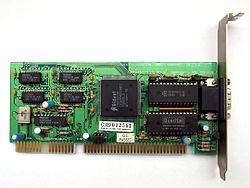

Trident Microsystems is a supplier of video processors for flat panels ( plasma , LCD , etc.). Before, Trident was a developer of GPUs and sound cards for PCs.
History
In the mid-1980s, Trident (along with Oak Technologies ) earned a reputation for selling low-cost (at that time) and slow SVGA chipsets. Many all-in-one motherboards used Trident VGA chipsets. While the PC graphics card market moved from simple VGA cards supporting only 2D to more advanced hardware acceleration (resolution change, SVGA output; not to be confused with 3D hardware acceleration), Trident continued to develop its policy for selling weak video chips by favorable price. In the mid-1990s, the company caught up with its main rival: the functionality of the TGUI-9680 was comparable to the S3 Graphics Trio64V +, but nonetheless the Trio64V + overtook the 9680 in true-color mode.
The fast-paced market for 3D accelerators caught many video card developers by surprise, including Trident. That was until the end of the 1990s when Trident finally released a chip capable of competing with it, it was the TGUI-9880 (Blade3D). By this time, Trident had regained its once-lost place in the production of cheap OEM video chips, where ATI , S3 , and SiS dominated at that time.
In the meantime, Trident was a pioneer in the notebook market using combined-DRAM technology, semiconductor manufacturing , which combines a graphics controller and video buffer RAM in 1 chip. Such a combined chip freed up valuable space on the laptop motherboard, whereas earlier several RAM chips were used to store video buffer data.
Despite the fact that Trident had successful 3DImage and Blade3D product lines, Intel's entry into the PC graphics card market meant the end for development in the lower price segment of graphics cards. Trident joined the motherboard developers in order to integrate its graphics technologies into chipsets (for example: ALi CyberALADDiN, VIA PLE133), but these mergers did not bring much success. Facing the fact of rising prices for research and development of new technologies (necessary to study the ever-increasing complexity of 3d rendering), in June 2003, Trident announced a complete restructuring of the company.
At the end of 2003, XGI completed the acquisition process of the former Trident GPU division.
In February 2010, Trident acquired the production of television sets and set-top boxes-receivers from NXP Semiconductors.
On January 4, 2012, in accordance with Chapter 11 of the US Bankruptcy Code, a reorganization procedure was launched, with Entropic Communications as the main bidder for the purchase.
In June 2012, CSR plc. (formerly Cambridge Silicon Radio) acquired Trident's audio product line for $ 1 million.
Graphics Chipsets
The list is not complete.
Tabletop
- 8600 - 512 kb. video memory. Screen resolution 800x600.
- 8800 ( 1988 ) - first S / VGA compatible chipset ( ISA ), 512KB 2D video
- 8900 - support for 65,536 colors, 1MB 2D video
- 9000 - the first, integrated (VGA + RAMDAC) VGA chipset
- 9000B ( 1992 )
- 9000i-1 ( 1994 ) - appeared on Trident's VC512TM ISA video cards
- 92xx, 94xx - the first accelerators for Windows
- 9440 ( 1994 ) - the first truly powerful Windows 2D accelerator (2MB PCI / VLB)
- 9660 - similar to 9440, 64-bit bus
- 9680, 9682, 9685 - hardware video accelerator (zoom + YUV-> RGB, Directdraw overlay)
- 3DImage975, 3DImage985 - the first 3D accelerator for Windows (4MB PCI / AGP)
- Blade3D ( 1999 ) - the first truly powerful Windows 3D accelerator from Trident (8MB PCI / AGP)
- Blade t16
- Blade T64 9970 (2000) - Supports AGP 4x, 64-bit memory bus.
- Blade XP 9980 - similar to T64, but has a 128-bit memory bus with a frequency of 200 MHz.
- XP4 - DirectX 8 chip.
- XP4E - AGP8x support.
- XP8 (canceled) - DirectX 9 chip, estimated cost less than $ 100.
- XP10 (canceled) - PCI Express controller.
Mobile
- Cyber9320
- Cyber9382
- Cyber9385
- Cyber9397 and Cyber9397DVD
- 9525DVD
- Cyberblade
- CyberBlade e4-128
- Cyberblade i1
- Cyberblade i7
- Blade XP
- XP4
- XP4m16 / XP4m32 - internal memory.
- XP8 (canceled) - DirectX 9 chip.
Integrated
- ALi CyberALADDiN-T ()
- ALi CyberALADDiN-P4 (CyberBLADE XP2)
- ? (codenamed Napa2T)
- ? (codenamed Napa2-P4)
- ? (codenamed Napa2-Banias)
Sound Chipsets
- Trident 4DWAVE-DX / NX, is based on the T² platform which is also used by SIS and ALi for its own audio solutions. Supports Q3D 2.0.