| Divided square mosaic | |
|---|---|
 | |
| Type of | |
| Diagram Coxeter - Dynkin |
|
| List of faces | triangle 45-45-90 |
| Configuration facets | V4.8.8 |
| Symmetry group | p4m, [4,4], * 442 |
| Rotation symmetries | p4, [4,4] + , (442) |
| Dual mosaic | Truncated Square Mosaic |
| The properties | granotransitive |


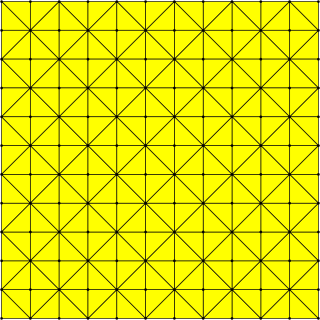
A divided square mosaic (or tetrakis-square mosaic is a mosaic in the Euclidean plane , which is built from a square mosaic by dividing each square into four isosceles right-angled triangles with vertices in the center of the squares, resulting in an endless configuration of lines . The mosaic can also be constructed by divisions of each square of the lattice into two triangles with a diagonal, while the diagonals of adjacent squares have a different direction. I have two square mosaics, one of which is rotated by 45 degrees, and its scale is increased by √2 .
Conway called the mosaic kisquadrille , that is, a quad market obtained by operation “kis” [1] . Operation “kis” adds a point to the center of a face and edges from this point to the vertices of the face, thereby breaking the faces of the square mosaic into triangles. The mosaic is also called the Union Jack grid , because it resembles the British national flag with triangles surrounding the peaks of order 8 [2] .
Mosaic is denoted as V4.8.8, since each isosceles triangular face has two types of vertices - one vertex with 4 surrounding triangles and two vertices with 8 triangles.
Content
Dual Mosaic
Mosaic is dual for a truncated square mosaic , having one square and two octagons at each vertex [3] .
Applications
A 5 × 9 fragment of a divided square mosaic is used as a game board for the Malagasy Fanorona board game . In this game, stones are stacked on top of the mosaic, and moves are carried out along the edges, capturing the enemy’s stones while there are such stones. In this game, vertices of degree 4 and vertices of degree 8 are called respectively weak intersection and strong intersection. The difference in the types of vertices plays an important role in the strategy of the game [4] . A similar board is used in the Brazilian game and for the game .
The divided square mosaic was used in a set of commemorative postage stamps issued by the US Postal Service in 1997 with a different pattern on two different stamps [5] .
This mosaic also forms the basis for the widely used “pinwheel”, “mill” and “beaten plate” in [6] [7] [8] .
Symmetry
Types of mosaic symmetry (by type of :
- symmetry cmm; when painted in four colors, the unit cell consists of 8 triangles, the fundamental region consists of 2 triangles (1/2 for each color)
- p4g symmetry; dark and light triangles, the unit cell has 8 triangles, the fundamental region consists of 1 triangle (1/2 for each black and white)
- p4m symmetry; all triangles have the same color (white) and black edges, the unit cell consists of 2 triangles, the fundamental region (1/2)
The edges of a divided square mosaic form a simplicial configuration of lines , a property common with a triangular mosaic and a .
These straight lines form the symmetry axis ( [4,4], (* 442) or p4m), which has mosaic triangles as the fundamental region . This group is isomorphic , but does not coincide with the automorphism group of the mosaic, which has additional axes of symmetry dividing the triangles, and which has half the triangles as the fundamental region.
There are many groups of subgroups of small indices p4m, (with symmetry [4,4], * 442 ), which can be seen from the Coxeter – Dynkin diagrams with nodes colored respectively with direct reflection, and the points of rotation are marked with numbers. Rotational symmetry is shown by alternating white and blue regions with one fundamental region for each subgroup shown in yellow. Moving symmetries are given by dashed lines.
Subgroups can be expressed with Coxeter - Dynkin diagrams with their diagrams of fundamental domains.
| Subgroups of small indices p4m, [4,4], (* 442) | |||||||||||
|---|---|---|---|---|---|---|---|---|---|---|---|
| Index | one | 2 | four | ||||||||
| Diagram fundamental areas of | |||||||||||
Coxeter Chart | [ 1 , 4, 1 , 4, 1 ] = [4.4] | [1 + , 4.4] = | [4,4,1 + ] = | [4.1 + , 4] = | [1 + , 4,4,1 + ] = | [4 + , 4 + ] = [(4.4 + , 2 + )] | |||||
| * 442 | * 2222 | 22 × | |||||||||
| Semi Direct Subgroups | |||||||||||
| Index | 2 | four | |||||||||
| Diagram | |||||||||||
| Coxeter | [4.4 + ] | [4 + , 4] | [(4,4,2 + )] | [1 + , 4.1 + , 4] = [(2 + , 4.4)] = = | [4.1 + , 4.1 + ] = [(4.4.2 + )] = = | ||||||
| Orbifold | 4 * 2 | 2 * 22 | |||||||||
| Direct Subgroups | |||||||||||
| Index | 2 | four | eight | ||||||||
| Daigram | |||||||||||
| Coxeter | [4.4] + | [1 + , 4.4 + ] = [4.4 + ] + = | [4 + , 4.1 + ] = [4 + , 4] + = | [(4,1 + , 4,2 + )] = [(4,4,2 + )] + = | [1 + , 4,1 + , 4,1 + ] = [(4 + , 4 + , 2 + )] = [4 + , 4 + ] + = | ||||||
| Orbifold | 442 | 2222 | |||||||||
Related polyhedrons and mosaics
Mosaic is topologically connected with a series of polyhedra and mosaics with the configuration of the vertex V n .6.6.
| Symmetry options * n 42 truncated mosaics: n .8.8 | |||||||||||
|---|---|---|---|---|---|---|---|---|---|---|---|
| Symmetry * n 42 [n, 4] | Spherical | Compact hyperbolic. | Paracom pact | ||||||||
| * 242 [2,4] | * 342 [3,4] | * 442 [4.4] | * 542 [5,4] | * 642 [6.4] | * 742 [7.4] | * 842 [8.4] ... | * ∞42 [∞, 4] | ||||
| Truncated figures | |||||||||||
| 2.8.8 | 3.8.8 | 4.8.8 | |||||||||
| n-kis figures | |||||||||||
| Config. | V2.8.8 | V3.8.8 | V4.8.8 | V5.8.8 | V6.8.8 | V7.8.8 | V8.8.8 | V∞.8.8 | |||
| Symmetry * n 42 [n, 4] | Spherical | Euclidean | Compact hyperbolic | Paracomp. | ||||
|---|---|---|---|---|---|---|---|---|
| * 242 [2,4] | * 342 [3,4] | * 442 [4.4] | * 542 [5,4] | * 642 [6.4] | * 742 [7.4] | * 842 [8.4] ... | * ∞42 [∞, 4] | |
| Common truncated figure | 4.8.4 | 4.8.6 | 4.8.8 | 4.8.10 | 4.8.12 | 4.8.14 | 4.8.16 | 4.8.∞ |
| Common truncated dual | V4.8.4 | V4.8.6 | V4.8.8 | V4.8.10 | V4.8.12 | V4.8.14 | V4.8.16 | V4.8.∞ |
See also
- Mosaics of convex regular polygons on the Euclidean plane
Notes
- ↑ Conway, Burgiel, Goodman-Strass, 2008 .
- ↑ Stephenson, 1970 .
- ↑ Weisstein, Eric W. Dual tessellation on the Wolfram MathWorld website.
- ↑ Bell, 1983 , p. 150-151.
- ↑ Frederickson, 2006 , p. 144.
- ↑ The Quilting Bible, 1997 , p. 55.
- ↑ Zieman, 2011 , p. 66.
- ↑ Fassett Kaffe, 2007 , p. 96.
Literature
- Branko Grünbaum , GC Shephard. Tilings and Patterns. - WH Freeman, 1987 .-- pp. 58-65 (Chapter 2.1: Regular and uniform tilings). - ISBN 0-7167-1193-1 .
- Williams, R. The Geometrical Foundation of Natural Structure: A Source Book of Design. - New York: Dover Publications , 1979. - S. 40. - ISBN 0-486-23729-X .
- Keith Critchlow. Order in Space: A design source book. - New York: Thames & Hudson, 1987 .-- pp. 77-76, pattern 8. - ISBN 0-500-34033-1 .
- John H. Conway , Heidi Burgiel, Chaim Goodman-Strass. Chapter 21, Naming Archimedean and Catalan polyhedra and tilings, p288 table // The Symmetries of Things . - Wellesley, MA: AK Peters, Ltd., 2008 .-- ISBN 978-1-56881-220-5 . Archived on September 19, 2010. Archived September 19, 2010 on the Wayback Machine
- John Stephenson Ising Model with Antiferromagnetic Next-Nearest-Neighbor Coupling: Spin Correlations and Disorder Points // Phys. Rev. B. - 1970. - T. 1 , no. 11 . - S. 4405-4409 . - DOI : 10.1103 / PhysRevB.1.4405 .
- Bell RC Fanorona // The Boardgame Book. - Exeter Books, 1983. - S. 150–151. - ISBN 0-671-06030-9 .
- Greg N. Frederickson. Piano-Hinged Dissections. - AK Peters, 2006 .-- ISBN 156881299X .
- The Quilting Bible . - Creative Publishing International, 1997. - ISBN 9780865732001 .
- Nancy Zieman. Quilt With Confidence . - Krause Publications, 2011 .-- ISBN 9781440223556 .
- Fassett Kaffe. Kaffe Fassett's Kaleidoscope of Quilts: Twenty Designs from Rowan for Patchwork and Quilting . - Taunton Press, 2007 .-- ISBN 9781561589388 .