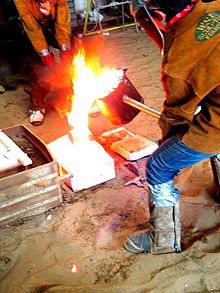
Injection is the filling of something (form, capacity, cavity) with material in a liquid state of aggregation .
According to GOST 3.1109-82: manufacture of a workpiece or product from liquid material by filling it with a cavity of a given shape and size with subsequent hardening.
In the most common sense, a typical process is the operation of obtaining products , which consists in filling a special container (form) that forms the surface or part of the surface of the manufactured product with liquid material (metals and non-metals) with a further thermo-temporary transition of the liquid material to a solid state of aggregation and obtaining as a result, a solid billet close in configuration, size and properties to the product.
Casting is also called foundry products , art products and handicrafts obtained through casting. The essence of metal casting processes and the task of foundry. Casting (or foundry) is the production method in which shaped blanks of parts are made by pouring molten metal into a pre-prepared casting mold, the cavity of which has the configuration of the workpiece blank. After solidification and cooling of the metal in the mold, a casting-blank of the part is obtained. The main objective of foundry is the manufacture of casting alloys of castings having a diverse configuration with the maximum approximation of their shape and size to the shape and dimensions of the part (when casting it is impossible to obtain a casting whose shape and dimensions correspond to the shape and dimensions of the part).
Casting classification
Casting is classified by:
- Cast material:
- metal - black (from alloys based on iron - steel and cast iron) and non-ferrous (from non-ferrous and precious metals - copper, aluminum, magnesium, tin, bismuth, lead, silver, gold) and alloys based on them.
- non-metallic - from plastics, polymers, minerals, concrete, gypsum, organic substances, ceramics, glass, salt, slag and other materials.
- Purpose of castings: industrial - technical, domestic, medical, decorative, artistic, etc.
- Precision of dimensions, degree of surface roughness of castings, presence and size of allowance for machining: rough, precise, precision.
- Special requirements for castings.
- Technologies (types, methods, methods) for producing castings: in the earth , in chill molds , in investment casting , under pressure , electroslag , in gasified models , in molds from cold-hardening mixtures, squeezing, in frozen models, centrifugal, continuous, vacuum, etc.
Variants of one technology are possible (for example, investment casting from paraffin-stearin mixtures and investment casting from fusible alloys) and a combination of different technologies (for example electroslag chill casting).
Sand casting
Sand casting is the cheapest, coarsest (in terms of dimensional accuracy and surface roughness of castings), but the most massive (up to 75-80% by weight of castings obtained in the world) casting. Initially, a casting model is made (previously - a wooden one, nowadays metal or plastic models obtained by rapid prototyping methods are often used), copying the future part. A model mounted on a model plate is covered with sand or sand (usually sand and a binder) that fills the space between it and two open drawers (flasks). Holes and cavities in the part are formed using sand-shaped casting rods placed in the form, copying the shape of the future hole. The mixture poured into the flask is compacted by shaking, pressing, or hardens in a thermal cabinet (drying oven). The resulting cavities are poured with molten metal through special openings - gates. After cooling, the mold is broken and the casting is removed. After that, the sprue system is separated (usually a stump), the flash is removed and the heat treatment is carried out.
To obtain castings using this method, various molding materials can be used, for example, sand-clay mixture or sand mixed with resin, etc. A mold is used to form the mold (a metal box without a bottom and a lid). The flask has two half-forms, that is, it consists of two boxes. The plane of contact of the two half-forms is the surface of the connector. The molding mixture is poured into the mold and rammed. An imprint of the model is made on the surface of the connector (the model corresponds to the shape of the cast). A second half-mold is also performed. Two half-molds are connected along the surface of the connector and metal is poured.
A new area of sand casting technology is the use of evacuated dry sand molds without a binder.
Vacuum film casting
The technology of casting in vacuum-film molds (HFF) is a process of shaping due to quartz sand without binder mixtures. The sand form is held due to the force of the vacuum created inside the form. Castings used in the process of the model are made of wood or plastic and have a high operational life, since during the manufacturing of molds the model is covered with a film and does not come into contact with the sand, which eliminates its wear.
Creating a form for filling takes place in 4 stages:
1) the model of the future product is covered with a plastic film and coated with non-stick paint;
2) a flask is installed on the model, sand is poured into the flask, the form is vibro-compacted;
3) the flask is covered from above with a plastic film, and the form is evacuated;
4) the flask is separated from the model.
The mold is poured with metal in the same way as in sand casting. Emissions and odors present during the combustion of mold materials from contact with liquid metal are sucked in by a vacuum system, not released into the atmosphere, which indicates the environmental friendliness of the process.
The method of vacuum-film molding is considered to be the exact type of casting, allowing to produce castings with a small wall thickness. This method is used in the manufacture of steel, cast iron, aluminum and magnesium castings. The advantage of the method is the high quality of molding, the surface of the casting is smooth and clean, not requiring additional machining, which significantly reduces the cost of products.
Chill casting
Metal casting in a chill mold is a better way. A chill mold is made - a collapsible form (most often metal) into which casting is made. After solidification and cooling, the chill mold is opened and the product is removed from it. Then the chill mold can be reused to cast the same part. Unlike other methods of casting into metal molds (injection molding, centrifugal casting, etc.), when casting in a chill mold is filled with liquid alloy and hardens without any external effect on the liquid metal, but only under the action of gravity .
The main operations and processes: cleaning the chill mold from the old cladding, warming it up to 200-300 ° C, coating the working cavity with a new cladding layer, setting the rods, closing parts of the chill mold, pouring metal, cooling and removing the resulting casting. The process of crystallization of the alloy when casting in a chill mold is accelerated, which contributes to the production of castings with a dense and fine-grained structure, and therefore with good tightness and high physical and mechanical properties. However, castings from cast iron due to the formation of carbides on the surface require subsequent annealing . With repeated use, the chill mold is warped and the dimensions of the castings in the directions perpendicular to the plane of the connector increase.
Castings made of cast iron, steel, aluminum, magnesium and other alloys are obtained in chill molds. Especially effective is the use of chill casting in the manufacture of castings from aluminum and magnesium alloys. These alloys have a relatively low melting point; therefore, one chill mold can be used up to 10,000 times (with the installation of metal rods). Up to 45% of all castings from these alloys are obtained in chill molds. When casting in a chill mold, the range of cooling rates of alloys and the formation of various structures expands. Steel has a relatively high melting point, the resistance of chill molds to steel castings decreases sharply, most surfaces form rods, so the chill casting method for steel is less used than for non-ferrous alloys. This method is widely used in serial and large-scale production.
Injection molding
LPD is one of the leading places in the foundry industry. The production of castings from aluminum alloys in various countries makes up 30-50% of the total output (by weight) of LPD products. The next group in terms of quantity and variety of castings is represented by castings from zinc alloys. Magnesium alloys are less commonly used for injection molding, which is explained by their tendency to form hot cracks and more difficult technological conditions for manufacturing castings. The production of copper alloy castings is limited by the low mold resistance.
The nomenclature of castings produced by the domestic industry is very diverse. In this way, cast billets of the most various configurations are manufactured, weighing from several grams to several tens of kilograms. The following positive aspects of the LPD process are highlighted:
- High productivity and automation of production, along with low labor input for manufacturing one casting, makes the LPD process the most optimal in the conditions of mass and large-scale production.
- Minimum or non-machining allowances, minimum roughness of non-machined surfaces and dimensional accuracy, allowing tolerances of up to ± 0.075 mm per side.
- The clarity of the resulting relief, which allows castings with a minimum wall thickness of up to 0.6 mm, as well as cast threaded profiles.
- Surface cleanliness on non-machined surfaces, allows casting to give a marketable aesthetic appearance.
Also distinguish the following negative effects of the characteristics of the LPD, leading to a loss of tightness of the castings and the impossibility of their further heat treatment:
- Air porosity, the cause of which is air and gases from a burnt lubricant, captured by the metal stream when filling the mold. What is caused by suboptimal filling conditions, as well as low gas permeability of the form.
- Shrinkage defects, manifested due to the high thermal conductivity of the molds along with difficult nutritional conditions during the hardening process.
- Non-metallic and gas inclusions that appear due to inadequate cleaning of the alloy in the transfer furnace, and also released from the solid solution.
Given the goal of obtaining a casting of a given configuration, it is necessary to clearly determine its purpose: whether high requirements for strength, tightness will be imposed on it, or will its use be limited to the decorative area. The quality of products, as well as the costs of their production, depend on the correct combination of technological modes of LPD. Compliance with the manufacturability conditions of cast parts implies their structural design, which, without reducing the basic requirements for the design, helps to obtain the specified physical and mechanical properties, dimensional accuracy and surface roughness with minimal labor input and limited use of scarce materials. It is always necessary to take into account that the quality of castings obtained by LPD depends on a large number of variable technological factors, the connection between which is extremely difficult to establish because of the speed of filling out the form.
The main parameters affecting the process of filling and forming the casting are as follows:
- pressure on the metal during filling and pre-pressing;
- pressing speed;
- gate-ventilation system design;
- temperature of the cast alloy and mold;
- lubrication and evacuation modes.
By combining and varying these basic parameters, they achieve a reduction in the negative effects of the features of the LPD process. Historically, the following traditional design and technological solutions to reduce marriage have been distinguished:
- temperature control of the cast alloy and mold;
- increased pressure on the metal during filling and pre-pressing;
- refining and refining of the alloy;
- evacuation;
- design of the gate-ventilation system;
Also, there are a number of unconventional solutions aimed at eliminating the negative impact of the features of LPD:
- filling the mold and chamber with active gases;
- the use of a double stroke locking mechanism;
- use of a double piston of a special design;
- installation of a replaceable diaphragm;
- a groove for venting air in the pressing chamber;
Lost wax casting
Another casting method - by investment casting - has been known since ancient times. It is used for the manufacture of parts of high accuracy and complex configuration that are not feasible by other casting methods (for example, turbine blades , etc.)
From the fusible material: paraffin , stearin , etc. (in the simplest case, from wax ), by pressing it into the mold, an exact product model and the gating system are made.
The model is then dipped in a liquid suspension of dusty refractory filler in a binder. A suspension is applied to the model block (model and LPS) and sprinkled, so 6 to 10 layers are applied, with each layer drying. With each subsequent layer, the grain fraction of the dusting is changed to form a dense surface of the shell shape. The model composition is smelted from the formed shell. After drying and heating, the block is calcined at a temperature of about 1000 ° C to remove gas-forming substances from the shell form.
Then the shells come to fill. Before pouring, the blocks are heated in furnaces to 1000 ° C. The heated block is installed in the furnace, and the heated metal is poured into the shell. The filled block is cooled in a thermostat or in air. When the block is completely cooled, it is sent to a knockout. Hammer blows on the sprue bowl beats ceramic, then the LPS section. Thus we get a casting.
The advantages of this method: the ability to manufacture parts from alloys that are not amenable to mechanical processing; obtaining castings with an accuracy of sizes up to 11 - 13 quality and surface roughness Ra 2.5-1.25 microns, which in some cases eliminates cutting processing; the possibility of obtaining machine components that, with conventional casting methods, would have to be assembled from separate parts. Lost wax casting is used in a single (pilot), serial and mass production.
Due to the high consumption of metal and the high cost of the process, investment casting is used only for critical parts.
Gasification casting
Foam-casting using gasified models (LGM) is the most profitable for the quality of shaped castings, cost-effectiveness, environmental friendliness and high production culture. World practice indicates a steady increase in the production of castings by this method, which in 2007 exceeded 1.5 million tons / year, it is especially popular in the USA and China (more than 1.5 thousand such sections work in China), where more and more are being poured castings without restrictions in shape and size. In the sand form, the foam model is replaced by molten metal when casting, so a high-precision casting is obtained. Most often, a dry sand mold is evacuated at a level of 50 kPa, but molding is also used in bulk and easily compacted sand mixtures with a binder. The field of application is castings weighing 0.1–2000 kg and more, the tendency to expand the use in serial and mass production of castings with overall dimensions of 40–1000 mm, in particular, in engine building for casting blocks and cylinder heads, etc.
4 types of model-forming (non-metallic) materials are consumed per 1 ton of suitable casting:
- silica sand - 50 kg
- non-stick coating - 25 kg,
- polystyrene foam - 6 kg,
- polyethylene film - 10 sq.m.
Отсутствие традиционных форм и стержней исключает применение формовочных и стержневых смесей, формовка состоит из засыпки модели песком с повторным его использованием на 95-97 %.
Центробежное литьё
Центробежный метод литья (центробежное литьё) используется при получении отливок, имеющих форму тел вращения. Подобные отливки отливаются из чугуна, стали, бронзы и алюминия. При этом расплав заливают в металлическую форму, вращающуюся со скоростью 3000 об/мин.
Под действием центробежной силы расплав распределяется по внутренней поверхности формы и, кристаллизуясь, образует отливку. Центробежным способом можно получить двухслойные заготовки, что достигается поочерёдной заливкой в форму различных сплавов. Кристаллизация расплава в металлической форме под действием центробежной силы обеспечивает получение плотных отливок.
При этом, как правило, в отливках не бывает газовых раковин и шлаковых включений. Особыми преимуществами центробежного литья является получение внутренних полостей без применения стержней и большая экономия сплава в виду отсутствия литниковой системы. Выход годных отливок повышается до 95 %.
Широким спросом пользуются отливки втулок, гильз и других заготовок, имеющих форму тела вращения, произведённые с помощью метода центробежного литья.
Центробежное литьё — это способ получения отливок в металлических формах. При центробежном литье расплавленный металл, подвергаясь действию центробежных сил, отбрасывается к стенкам формы и затвердевает. Таким образом получается отливка. Этот способ литья широко используется в промышленности, особенно для получения пустотелых отливок (со свободной поверхностью).
Технология центробежного литья обеспечивает целый ряд преимуществ, зачастую недостижимых при других способах, к примеру:
- Высокая износостойкость.
- Высокая плотность металла.
- Отсутствие раковин.
- В продукции центробежного литья отсутствуют неметаллические включения и шлак.
Центробежным литьём получают литые заготовки, имеющие форму тел вращения:
- втулки;
- венцы червячных колёс;
- барабаны для бумагоделательных машин;
- роторы электродвигателей.
Наибольшее применение центробежное литьё находит при изготовлении втулок из медных сплавов, преимущественно оловянных бронз.
По сравнению с литьём в неподвижные формы центробежное литьё имеет ряд преимуществ: повышаются заполняемость форм, плотность и механические свойства отливок, выход годного. Однако для его организации необходимо специальное оборудование; недостатки, присущие этому способу литья: неточность размеров свободных поверхностей отливок, повышенная склонность к ликвации компонентов сплава, повышенные требования к прочности литейных форм.
Литьё в оболочковые формы
Литьё в оболочковые формы — способ получения фасонных отливок из металлических сплавов в формах, состоящих из смеси песчаных зёрен (обычно кварцевых) и синтетического порошка (обычно фенолоформальдегидной смолы и пульвер-бакелита). Предпочтительно применение плакированных песчаных зёрен (покрытых слоем синтетической смолы).
Оболочковую форму получают одним из двух методов. Смесь насыпают на металлическую модель, нагретую до 300 °C, выдерживают в течение нескольких десятков секунд до образования тонкого упрочнённого слоя, избыток смеси удаляют. При использовании плакированной смеси её вдувают в зазор между нагретой моделью и наружной контурной плитой. В обоих случаях необходимо доупрочнение оболочки в печи (при температуре до 600—700 °C) на модели. Полученные оболочковые полуформы скрепляют, и в них заливают жидкий сплав. Во избежание деформации форм под действием заливаемого сплава перед заливкой их помещают в металлический кожух, а пространство между его стенками и формой заполняют металлической дробью, наличие которой воздействует также на температурный режим охлаждающейся отливки.
Этим способом изготавливают различные отливки массой до 25 кг. Преимуществами способа являются значительные повышение производительности по сравнению с изготовлением отливок литьём в песчаные формы, управление тепловым режимом охлаждения отливки и возможность механизировать процесс.
Literature
- Баринов Н. А. «Водоохлаждаемые вагранки и их металлургические возможности» , Москва, «Машиностроение» 1964