
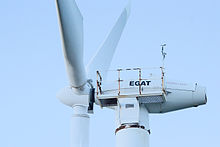
Thailand Energy is a sector of the Thai economy engaged in the production, distribution and import of various types of energy in the country. According to the Ministry of Energy, in 2013, the total energy consumption in the country amounted to 75.2 million tons. er (million tons of oil equivalent), an increase of 2.6 percent compared to the previous year [1] .
Content
Overview
Thailand produces about a third of the country's required oil. It is the second largest oil importer in Southeast Asia. Thailand is a major natural gas producer with reserves of at least 10 trillion cubic feet (283.16 billion m³).
Electricity
Ninety percent of Thai electricity-generating capacities are thermal power plants. Fuel oil plants have been replaced with natural gas, which as of 2016 provides 60% of the electricity. Coal-fired power plants produce an additional 20 percent, the rest is biomass, hydropower and biogas.
| Oil | Natural gas | Coal | NPP | Water energy | Renewable energy sources | General |
|---|---|---|---|---|---|---|
| 50.4 | 47.0 | 16,0 | 0 | 1,3 | 1.0 | 115.6 |
WWF energy experts have estimated that Thailand and its four Mekong neighbors can produce up to 100 percent of their energy from renewable sources by 2050. Their study showed that these countries can produce and use electricity from solar energy, wind energy, biogas and river hydroelectric power stations [3]
An increase in temperature leads to an increase in demand for electricity. It is estimated that cities the size of Bangkok need 2 gigawatts of additional electricity with an increase of 1 degree Celsius due to an increase in demand for air conditioning [4] .
Oil
- Production: Thailand first began producing oil [5] in 1981 at 2,000 barrels (84,000 US gallons) per day. By 2013, daily oil production increased to 459,000 barrels. Proved oil reserves are estimated at 0.4 thousand million barrels.
- Consumption: in 2013, oil consumption was 1.2 million barrels per day.
Gas
Natural gas accounts for about 60% of the fuel needed to generate electricity in Thailand [6] .
About 20 percent of all gas production is produced at the Erawan gas field in the Gulf of Thailand . The field’s capacity is estimated at 885 million MV per day [7] .
Coal
In 2013, Thailand produced about 18 million tons of brown coal and imported about 19 million tons of coal . All brown coal and six million tons of coal are used to generate electricity in the country, the rest is used in industry [8] .
Renewable Energy Sources
The use of solar energy
In March 2016, the Thai government approved the use of solar panels that produce electricity in the country. It is planned that in the near future, each house will generate 10 kW of electricity. Thailand has plenty of sunshine. The production of electricity by solar panels is scheduled to begin in early 2016 [9] .
Biofuel
The government is stimulating palm oil biofuels , which are mixed with traditional diesel to reduce oil imports. Biofuel production will be 5.97 million liters per day in 2021 [10] .
Nuclear Power
There are no nuclear power plants in Thailand. Before the Fukushima disaster, it was planned to produce about 5 gigawatts of electricity by nuclear technology by 2025 [11] .
Currently, interest in nuclear power has revived. Seven ASEAN countries, including Thailand, have signed cooperation agreements with the Russian nuclear energy agency Rosatom . The Thai Nuclear Energy Authority (GUET) works with China, Japan, and South Korea. It sent 100 specialists for training in the construction of nuclear power plants. The country plans to produce up to five percent of all electricity from nuclear plants by 2036 [12]
Thailand Energy Development Plan, 2015–2036
In Thailand, according to the 2015–2036 Development Plan [13] [14], it is necessary to build 20 new gas power plants (17,728 MW), nine “coal” power plants (7,390 MW), and receive 14,206 MW from renewable energy sources, including hydropower [ 15] .
See also
- Thai economy
Notes
- ↑ Energy in Thailand, Facts & Figures 2013 . Dept of Alternative Energy Development & Efficiency, Ministry of Energy. Date of treatment September 5, 2014.
- ↑ British Petroleum Statistical Review of World Energy 2014 . BP Date of treatment September 11, 2014. Archived September 12, 2014.
- ↑ Rujivanarom, Pratch . Mekong region could rely on 100 percent clean energy by 2050: WWF , The Nation (May 25, 2016). The appeal date is June 14, 2016.
- ↑ Shankleman, Jessica . Soaring Temperatures Will Make It Too Hot to Work, UN Warns , Bloomberg (July 19, 2016). Date of treatment July 21, 2016.
- ↑ Includes crude oil, tight oil, oil sands, NGLs (natural gas liquids). Excludes liquid fuels from biomass and coal / NG derivatives.
- ↑ Chevron Thailand to cut 800 jobs , Bangkok Post (May 16, 2016). Date of treatment May 17, 2016.
- ↑ Chevron to cut 800 workers , Bangkok Post (May 17, 2016). Date of treatment May 17, 2016.
- ↑ Thailand: Coal for 2013 . International Energy Agency . Date of treatment July 21, 2016.
- ↑ Theparat, Chatrudee . Solar rooftops, electric vehicles okayed , Bangkok Post (March 12, 2016). Date of treatment March 12, 2016.
- ↑ Ratchaniphont, Adisorn Trend of carbon dioxide emission from oil palm plantation in Krabi, Thailand . North Sea Conference & Journal . The appeal date is October 4, 2016.
- ↑ International Index of Energy Security Risk . Institute for 21st Century Energy . Institute for 21st Century Energy (2013). Date of appeal September 14, 2014.
- ↑ Rujivanarom, Pratch . With Russian help, region looks to a nuclear-powered future , The Nation (13 June 2016). The appeal date is June 14, 2016.
- ↑ National Energy Policy Committee approves Thailand's power development plan (PDP 2015) . Royal Thai Government . The appeal date is August 27, 2015.
- ↑ Pichalai, Chavalit Thailand's Power Development Plan Thailand's Power Development Plan 2015 (PDP 2015) . Ministry of Energy (Thailand) . Date accessed August 27, 2015. Archived January 24, 2016.
- ↑ Draper, John . Thailand's power dilemma amid a climate of fear , The Nation (August 27, 2015). The appeal date is August 27, 2015.