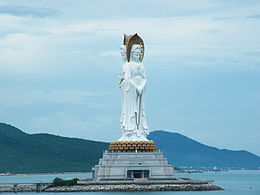
Early Buddhism
The founder of Buddhism Gautama Buddha allowed women to join his monastic sangha and fully participate in the life of the community, subject to additional conditions - eight garundhams . According to Susan Marcott, “The female monastic sangha was a radical experiment for that time ” [1] .
, speaking of the First Buddhist Council , noted [2] :
Perhaps Mahakassappa and the bhikkhus of that time were jealous of the bhikshunis who became more popular and did more educational and social work than the bhikkhus. It was their anti-woman bias that was then institutionalized in the form of eight garundhams, eight grave restrictions. We must put an end to this prejudice.
Original textPerhaps Mahakassappa and the bhikkhus of that time were jealous of the bhikkhunis being more popular and doing more teaching and social work than the bhikkhus. Their anti-women prejudice became institutionalized at that time with the eight garudhammas, the eight weighty restrictions. We must discontinue that prejudice.
Diana Y. Paul believes that according to the traditional view, women were assigned a subordinate role in early Buddhism [3] . agrees that “ in early Indian Buddhism, misogynistic traits can be found. But the presence of distinct clearly misoginist doctrines does not mean that all ancient Indian Buddhism was misoginistic ” [4] . Many [ who? ] authors positive attitude to femininity mixed with clearly negative emotions, because of what they characterized the attitude of early Buddhism to women as deeply dual [5] . Some commentators on the Aghanna Sutta of the Pali Canon understood the words of Buddha contained in it as if he considered women to be responsible for the fall of the human race. However, most Buddhists interpret this differently: they believe that the first cause of moral decline is lust as such, and not women [6] .
However, despite the unpleasant images of women in early Buddhism, the Theravada Sutta Pitaka says that you should not focus on the differences between the sexes, because this can become an obstacle to achieving nirvana . For example, in the Bhikshuni-samyutta (Sagatha-wagga, Samyutta-nikaya ) [7] , sexual discrimination is considered a trick of the demon Mara , leading away from the spiritual path. In the Somma Sutta, the Bhikshuni Soma states [8] :
Everyone who thinks “I am a woman”, or “I am a man”, or “who am I at all?” Is the one who hears Mare.
Original textAnyone who thinks "I'm a woman" or "a man" or "Am I anything at all?" - that's who Mara's fit to address
This underlines the gender neutrality of the Buddhist concept of anatman - the “non-self” strategy that Buddha taught to free himself from suffering [9] . And in the “Dependence” sutra, the Buddha claims that if a man or woman clings to their gender identity, they become dependent on it [10] .
Women's Spiritual Achievement
In different schools and traditions of Buddhism, we can find different opinions about the abilities of women to spiritual achievements [11] .
Limitations of Women's Spiritual Achievements in Buddhism
According to Bernard Faure , “ like most clerical discourses, Buddhism is actually relentlessly misoginistic as much; but he is one of the most flexible and open to complexity and contradiction ” [12] .
In the Buddhist tradition, a person’s position in secular society, his power and capabilities are often a reflection of his previous spiritual achievements. Thus, the gods live in higher spheres than people, because they have reached an appropriate level of spiritual development. Chakravartins and Buddhas living among people occupy their exclusive position also thanks to the high achievements in this and past lives. Similarly, birth in a male or female body and the condition of a person in a given society due to it is a manifestation of his karma, a consequence of his actions in past lives.
Taiwanese bhikshuni Heng-Ching Shih claims that there are five insurmountable obstacles for a woman in Buddhism, namely: she cannot become the heavenly king Brahma, Sakra, King Mara, Chakravartin or Buddha [11] . In support of this, Gautama Buddha’s words from the Bahudhatuka- sutta of the Madjhima-nikai of the Pali canon are quoted as saying that it is impossible for a woman to become “ perfect and competent One Enlightened "," universal monarch "," king of the gods "," the king of death ”or“ Brahma ” [13] . However, it is important to note that in the corresponding text of the Sanskrit “Madhyama Agama” there are no such words at all, and a number of researchers believe that they were not spoken by the Buddha, but were added later [a] . The early restrictions on a woman becoming a Buddha were later lifted in the Lotus Sutra , which opened a direct path to enlightenment for women, as well as for men [15] . Nichiren wrote that “only in the Lotus Sutra we read that the woman who perceived this sutra surpassed not only all other women, but also all men” [b] .
The Opportunity for a Woman to Have a Buddha Status
Texts of early Buddhism, such as Khandhaka , contain the words of Gautama Buddha that a woman can achieve enlightenment; but at the same time in the Bahudhatuka-sutra it is stated that there can never be a female Buddha [17] .
In Theravada Buddhism , a modern school that adheres to the oldest surviving dated texts, the transition to the state of Buddha is considered an extremely rare event, almost unattainable for modern people. The followers of this school try to achieve at least the state of an arhat ; and the Pali canon gives examples of achieving nirvana by arhats of both sexes. So, Yashodhara , the ex-wife of Buddha Shakyamuni and the mother of his only son Rahula , later became a bhikshuni nun and arhatka. And in Mahayana Buddhism, attaining the Buddha’s state is considered to be realizable and is the common goal of all Mahayana followers. But for a woman, the possibility of such complete enlightenment can open up only in one of the next lives in which she will be born a man; The Bodhisattvabhūmi, dated to the 4th century, states that enlightenment cannot be achieved while in the female body. According to Miranda Shaw, " such a belief negatively affected the attraction of women [to the practice of Buddhism], insofar as it reports on the insufficiency of the female body to achieve enlightenment ” [18] .
In Theravada, it is also believed that it is almost impossible for a woman to achieve even a bodhisattva state - a step on the way to a Buddha state. Gods, men, animals and even reptiles can become bodhisattvas, but women can not. Having a woman is seen as the result of bad karma. At the same time, Theravada does not prohibit a woman from striving for awakening and attaining it, but a woman cannot lead a Buddhist religious community. If a person, a man or a woman, shows a strong desire to achieve the state of Buddha, and Buddha [c] living at the same time confirms this, then such a person will not be born in a female body in any of the following lives. Accordingly, for the practicing Buddhist of Theravada school, the purpose of life is to be born a man in the next life and then get all the opportunities for spiritual enlightenment and attainment of the Buddha state. To do this, you need to commit righteous deeds and sincerely strive for masculinity [19] .
In tantric iconography of the Vajrayana school, there are images of female Buddhas. Sometimes they are depicted as accompanying the main idam on the meditation mandala , but Vajrayogini , Tara and Simhamukha are portrayed as the main characters in the scenes of the tantric sadhana [18] . Vajrayana Buddhism also recognizes that many female yogis have attained complete enlightenment and the state of Buddha. Among them is Yeshe Tsogyal , one of the five tantric spouses [20] of Padmasambhava , whom Vajrayana supporters venerate as a Buddha woman. And in the Karmapa, it is even believed that Tsogyal became a Buddha already in that earthly life. The website of the current Kramapa, the head of the Karma Kagyu school of Tibetan Buddhism, claims that she, thirty years before she left mundane existence, reached final awakening in a secluded retreat; it was around 796–805 AD [21] .
Miranda Shaw quotes as an example: “ Reportedly, out of all the disciples of the adherent of Naropa, two hundred men and one thousand women reached full enlightenment ” [18] .
The thirteenth chapter of the Mahayana " Lotus Sutra " contains the predictions of Buddha Shakyamuni about the future achievements of Mahaprajapati and Yashodhara [22] .
In the 20th century, , a Tibetan Buddhist nun at Drukpa Kagyu School, stated: “ I made a promise that I would achieve in a female form - and it doesn’t matter how many lives it takes ” [23] .
Female Tulku lineages
In the 15th century, Princess Chokyi-Dronme ( Wiley Chos-kyi sgron-me ) was recognized as the embodiment of Idam Vajravarahi and a female buddha in the Vajrayan tradition. Chokyi-Dronme became known as Samding Dorje Phagmo ( wily bSam-lding rDo-rje phag-mo ) and from it began a line of women- tulkus , reincarnating lamas . Currently, her twelfth reincarnation lives in Tibet.
Another female tulku line - Shugseb Jetsun Rinpoche (Wiley Shug-gseb rJe-btsun Rin-po-che ) - began at the end of the 19th century with Ani Lochen (c. 1865 - 1951) [24] [25] . Having accepted the teachings of all schools of Tibetan Buddhism, Shugseb Jetsun Rinpoche became known there that she transmitted the meditation practice of cutting off attachments of chod [26] . At the beginning of the twentieth century, Shugseb Jetsun Rinpoche, also known as Ani Lochen Chönyi Zangmo, founded the Shugseb Monastery (Waili shug gseb ), which is located thirty miles from Lhasa on the slopes of Mount Gangri Thökar [ Gangri] Th [28] . He was one of the largest and most famous women's monasteries in Tibet [24] . Shugseb was revived in exile to the Gambhir Ganj in India, already as part of the Nyingma school . But in a new place, the nuns of Shugseb continue their practices, including and [26] .
Female Monasticism
Gautam Buddha first ordained women as a nun five years after he himself attained enlightenment and ordained the first men as monks.
The first such initiation was Mahaprajapati Gotami , the aunt and adoptive mother of Gautama Buddha. Buddha doubted whether women should be ordained at all. However, according to Peter Harvey, the Buddha had hesitated before, wondered whether he should teach anyone at all, and only after the Devas persuaded him, he decided to teach people his teachings [29] .
Then these Buddhist nuns gave initiation to their students, those to theirs. Similarly, Buddhist monks received initiation from monks. As a rule, male and female lines of disciplic succession in the Buddhist monastic sangha went separately. And to this day, the possibility and reality of a woman’s initiation by a man (or vice versa) is controversial and is not recognized by all Buddhists. But there are much fewer female monastic lines of disciplic succession than male ones - they are mainly preserved in Buddhist schools in East Asia, and completely disappeared in a number of other regions and schools. Only at the end of the 20th - beginning of the 21st centuries did the renewal of the initiation of women and the revival of the traditions of bhikkhuni in Sri Lanka and other traditional Buddhist countries begin, and also Buddhist monasteries appeared in the USA and other western countries.
Personal and family life
In Anguttara Nikaya (5:33), Buddha says that wives should obey their husbands, like them and not annoy them with their own desires. In the same nikai in the Pali canon (7:59; IV 91-94), the Buddha talks with Suyat about , of which the first three types (destroyer, thief and mistress) go unhappily, and the other four ( mother, sister, girlfriend and slave) - fortunately.
According to Diana Paul, Buddhism inherited [from Hinduism] such an attitude towards women, according to which if a woman does not manifest herself as a mother, then she is a lustful seducer or even evil in the flesh [3] .
Maternity
The attitude of Buddhism towards motherhood is traditionally based on the “noble truth” about suffering ( dukkha ) as one of the main features of human existence. This was also reflected in Therigath , a collection of poems by the oldest arch nuns; Susan Marcott notes that “ in this chapter about motherhood, in every story and in every verse - sadness. The mothers mentioned there wished to become Buddhist nuns due to the death of children ” [30] .
However, in early Buddhism, motherhood was not considered solely as a source of suffering, but could have independent value. Maya , the mother of Gautama Buddha, is especially revered; in the city of Lumbini, at the alleged birthplace of Buddha, there is a temple dedicated to her [31] . But Maya died a few days after the birth of Gautama, and he was adopted by Mahaprajapati Gotami, the sister of Maya. In addition to Gautama, Mahaprajapati raised two of her own children: a and a (both called Nanda). Mahaprajapati became the first bhikshuni, and her children also entered into the monastic sangha, like the wife of Gautama Yashodhara and their son Rahula .
In Vajrayana Buddhism, women could become not only bhikshuni, but also yogis. Unlike monastic bhikshunis, yoginis could live a family life, have children and not shave their heads. Machig Labdron followed this path: having lived for some time in the monastery, she left there to reunite with her husband Topabhadra, but continued to engage in religious practice. Her says that Labdron was able to combine practice and teaching with caring for children; some of her children also became yogis. , recognized as an emanation of Machig Labdron, was a nun for four years, but then left monasticism, got married and had children. On the role of motherhood in her practice, she wrote [32] :
... in Buddhism, the image of the mother as the personification of compassion is found many times. She is ready to do anything for the sake of children. As a mother, I felt the whole depth of love and commitment; I had one for whom I was ready to give my life - in such relationships there is a very great power. I also felt then that I really did not grow before I had children. It was my path to maturity; maturity came to me with the children. However, I cannot say that my children became an inspiration to me in the sense in which I had previously understood spiritual inspiration. Moreover, the challenges of motherhood that I had to face greatly enriched my practice.
Original text... in Buddhism the image of the mother as the embodiment of compassion is used a lot. She'll do anything for the children. As a mother I felt that depth of love and commitment and having somebody who I really would give my own life for — it was very powerful to have that kind of relationship. I also felt that I didn't really grow up until I had my children. There were ways that maturity was demanded of me and having children brought forth that maturity. So I wouldn't say my children were an inspiration in the sense of what I thought would have been a spiritual inspiration before I had children. More so I think meeting the challenges of motherhood with what I had learned made my practice very rich.
Love and marriage
Although monastic celibacy is generally considered the highest ideal of life in Buddhism, the value of marriage as a social institution is also recognized [33] , and there are certain religious rules for secular family Buddhists. Despite all the differences in the rules and practice between the schools of Buddhism , marital fidelity is recognized by them all as mandatory, since it is established in awls , the fundamental principles of Buddhist spiritual practice . Extramarital sex is unacceptable for all Buddhists, both secular and religious: this is one of the five sacred commandments of Buddhist ethics . The more exact boundaries of acceptable and unacceptable sexual behavior vary depending on local customs and the characteristics of a particular Buddhist school: for example, there may be a different attitude to anal, oral and other “non-classical” sex (including between spouses), contraception, sex during pregnancy and feeding, masturbation, homosexuality and transgender.
In the early Buddhism of the Digha-nikai speaks of the respect that everyone should show to their spouse. But even then, the ideal was the renunciation of worldly life - - in his texts there is a story of the monk Nanda and his wife Janapada Kalyaani, for whom the desire to gain the bliss of Nirvana has become more valuable than romantic love and marriage. Nanda, a cousin of Gautama Buddha, with the approval of the latter, left his young wife immediately after the wedding to become a bhikkhus . In the Pali canon there are still similar stories in which romantic love is perceived as part of attachment to samsara - an endless cycle of [34] . Susan Marcott notes that the early Buddhists had the same restrained-negative attitude to romantic love and marriage as the Indian Brahmanists [35] .
But in Vajrayana Buddhism, intimate relationships between spouses are considered as one of the means of spiritual practice of the , allowing to achieve realization and enlightenment. Tantric intercourse of the spouses is depicted in the yab-yum of Tibetan Buddhism.
Explanation
- ↑ "In the early discourses, the locus classicus for this position is the Bahudhatuka-sutta of the Majjhima-nikaya, according to which a woman is incapable of occupying various positions, one of them being that of a Buddha. (9) The Bahudhatuka -sutta has several parallels which show some variations in their presentation of these impossibilities. Of particular significance is a Madhyama-agama parallel which does not mention any inability of women at all [...] These variations, together with the absence of any reference to the aggregates in the discourse versions, make it quite probable that this topic is a later addition. " [14]
- ↑ "Only in the Lotus Sutra do we read that a woman who embraces this sutra not only excels all other women but surpasses all men" [16]
- ↑ As far as one can understand, it is believed that at any time among the people in our world there is at least one who is in the state of Buddha.
Notes
- ↑ Murcott, Susan. The First Buddhist Women: Translations and Commentary on the Therigatha . - Parallax Press, 1991. - P. 4. - ISBN 0-938077-42-2 .
- ↑ Berzin A. Conference Report on Bhikshuni Ordination Lineages . Day One: Opening Addresses . Study Buddhism . Berzin Archives (July 20, 2007) . Date of treatment November 17, 2017.
- ↑ 1 2 Paul DY, Wilson F. Traditional Views of Women // Women in Buddhism: Images of the Feminine in Mahāyāna Tradition . - , 1985. - ISBN 0-520-05428-8 .
- ↑ Gross, Rita M. Buddhism After Patriarchy: A Feminist History, Analysis and Reconstruction of Buddhism . - State University of New York Press , 1992. - P. 43. - ISBN 0-7914-1403-5 .
- ↑ Cabezón JI Buddhism, Sexuality, and Gender . - State University of New York Press , 1992. - P. 3. - ISBN 0-7914-0758-6 .
- ↑ Aggana Sutta: On Knowledge of Beginnings of Human Kind . The Buddhist Cosmology (English) (PDF) . Urban Dharma Website . Date of treatment November 18, 2017.
- ↑ Bhikkhu, Bodhi. Discourses of the Ancient Nuns: (Bhikkhuni-samyutta) . translated from the Pali by Bhikkhu Bodhi . Access to Insight . Legacy Edition (1997) . Date of treatment November 18, 2017.
- ↑ Sister Soma . Translated from the Pali by Thanissaro Bhikkhu . Access to Insight . Date of treatment November 18, 2017.
- ↑ Bikkhu, Thanissaro. The Not-self Strategy (inaccessible link) . Access to Insight (1993). Date of treatment November 18, 2017. Archived February 4, 2013.
- ↑ Saññoga Sutta: Bondage . translated from the Pali by Thanissaro Bhikkhu (English) . Access to Insight (1997) . Date of treatment November 18, 2017.
- ↑ 1 2 Shih, Heng-Ching. WOMEN IN ZEN BUDDHISM: Chinese Bhiksunis in the Ch'an Tradition (inaccessible link) . ZEN, WOMEN, AND BUDDHISM . Date of treatment November 18, 2017. Archived October 27, 2009.
- ↑ Introduction // The Power of Denial: Buddhism, Purity, and Gender . - Princeton University Press , 2003. - P. 3. - ISBN 0-691-09171-4 .
- ↑ Majjhima Nikaya III III. 2. 5. Bahudhaatukasutta.m- (115) The Discourse on Many Elements . BuddhaSasana . Date of treatment November 18, 2017.
- ↑ Analayo. The bahudhatuka-sutta and its parallels on women's inabilities (English) // Journal of Buddhist Ethics. - Gale, Cengage Learning, 2009 .-- January 1.
- ↑ The Enlightenment of Women . Soka Gakkai International. Date of treatment November 18, 2017.
- ↑ Nichiren Daishonin. The Unity of Husband and Wife // The Writings of Nichiren Daishonin . - Soka Gakkai. - Vol. 1. - P. 463.
- ↑ Murcott S. The First Buddhist Women: Translations and Commentary on the Therigatha. - Parallax Press, 1991. - P. 16. - ISBN 0-938077-42-2 .
- ↑ 1 2 3 Shaw M. Passionate Enlightenment: Women in Tantric Buddhism. - New Jersey: Princeton University Press , 1994. - P. 27. - ISBN 0-691-01090-0 .
- ↑ Appleton N. In the footsteps of the Buddha? women and the Bodhisatta path Theravāda Buddhism. (Eng.) // Journal of Feminist Studies in Religion: j. - Indiana University Press, 2011 .-- March 1 ( vol. 27 , no. 1 ). - P. 33-51 . - DOI : 10.2979 / jfemistudreli . 27.1.33 .
- ↑ The Five Consorts . yoniversum.nl . Date of treatment December 20, 2017.
- ↑ Biographies: Yeshe Tsogyal, Princess Of Karchen . dharmafellowship.org . Dharma Fellowship of His Holiness the Gyalwa Karmapa. Date of treatment December 20, 2017.
- ↑ Chapter 13. Exhortation to Maintain // Lotus Sutra / Translated by The Buddhist Text Translation Society in USA.
- ↑ Cave in the Snow. - Great Britain: Bloomsbury , 1998 .-- P. 5 .-- ISBN 0-7475-4389-5 .
- ↑ 1 2 Ani Lochen // Encyclopedia of Religion. - Macmillan Reference USA, Gale Group, 2001-2006.
- ↑ Summary of Speeches at the Bhikshuni Congress: Day 2 . Session Four, Day Two: History of the Vinaya Lineages . studybuddhism.com . Berzin Archives (July 2007) . Date of treatment December 20, 2017.
- ↑ 1 2 WAiB Pages Resources on Women's Ordination
- ↑ Shuksep Nunnery
- ↑ Lochen Chönyi Zangmo
- ↑ Harvey P. An Introduction to Buddhist Ethics . - Cambridge University Press , 2000. - P. 384. - ISBN 978-0-521-55640-8 .
- ↑ Murcott S. The First Buddhist Women: Translations and Commentary on the Therigatha . - Parallax Press, 1991. - P. 74. - ISBN 0-938077-42-2 .
- ↑ Temple of Mahadevi at Lumbini . Sacred destinations . Date of treatment December 24, 2017.
- ↑ On Mothering: An Interview with Tsultrim Allione . Date of treatment November 28, 2008. Archived October 9, 2008.
- ↑ Keown, Damien; Hodge, Stephen; Tinti, Paola. A Dictionary of Buddhism . - Oxford University Press US, 2003. - P. 174. - ISBN 978-0-19-860560-7 .
- ↑ Abeysekera, Radhika. Relatives and Disciples of the Buddha . Great Male Disciples - Part B / 15. Nanda . BuddhaSasana . Binh Anson . Date of treatment December 25, 2017.
- ↑ Murcott, Susan. The First Buddhist Women: Translations and Commentary on the Therigatha. - Parallax Press, 1991. - P. 95. - ISBN 0-938077-42-2 .
Literature
- in Russian
- Balzhitova OM The position of women in Buddhism in India, Mongolia and Buryatia: the dissertation for the degree of candidate of philosophical sciences: 09.00.13 / IMBT SB RAS . - Ulan-Ude, 2007 .-- 145 p.
- Prikhodko N. Yu. Feminist discourse of world religions: the status of women in the Buddhist tradition // Vestnik TSEU. Series "Philosophy" . - Vladivostok: TSEU , 2009. - Issue. 4 . - S. 95-104 . - ISSN 2311-2271 .
- Ulanov M.S. Woman in Buddhist culture: religious and social aspects // Bulletin of the Kalmyk University. - Elista: KalmSU named after B. B. Gorodovikov , 2015. - No. 3 (27) . - S. 57–61 . - ISSN 1995-07-07 .
- Ulanov M.S., Troitsky A.A. Woman in Indian Buddhism // Bulletin of the Kalmyk University. - Elista: KalmSU them. Bb Gorodovikova, 2018 .-- No. 1 (37). - S. 174-181. - ISSN 1995-0713
- Chebunin A.V. Buddhist sutras on the attitude towards women // Buddhist texts of China, Tibet, Mongolia and Buryatia (socio-philosophical aspect) / Otv. ed. L. E. Yangutov . - Ulan-Ude: Publishing House of the Buryat State University , 2012. - P. 66-71. - 176 p. - ISBN 978-5-9793-0469-4 .
- Chetyrova L. B. Features of the translation of Buddhism in the international female Buddhist movement // Problems of translation and philosophical interpretation of Buddhism (based on Tibetan and Chinese traditions) / Otv. ed. I. S. Urbanaeva. - Ulan-Ude: BSC SB RAS , 2018 .-- S. 202—231. - 250 p. - ISBN 978-5-7925-0530-8 .
- Choyropova T. Ts. Gender stereotypes in Orthodoxy and Buddhism: A comparative analysis: the dissertation for the degree of candidate of sociological sciences: 22.00.06 / St. Petersburg State University . - SPb. , 2006. - 160 p.
- Shaw M. Passionate enlightenment. Women in Tantric Buddhism. - M .: Good book, 2001 .-- 368 p. - (Women in spiritual traditions). - ISBN 5-94015-004-7 .
- in other languages
- Rao, Vinay Kumar (2012), Women in Buddhist Art , New Delhi: Agam Kala Prakashan, ISBN 9788173201264
- Law, Bimala Churn (1927). Women in Buddhist Literature , Ceylon: Bastian & Co.
- Diana Y. Paul & Frances Wilson (1985), Women in Buddhism: Images of the Feminine in Mahāyāna Tradition , Oakland, California]: , ISBN 9780520054288 , < https://books.google.com/ books? id = frJiFdKcHyMC & printsec = frontcover > . Retrieved July 6, 2015.
- Bartholomeusz, Tessa J. (1994), Women under the Bō tree: Buddhist nuns in Sri Lanka (1. publ., Reprinted ed.), Cambridge: Cambridge University Press , ISBN 9780521461290 , < https://books.google.com / books? id = qe6LT9mzmd8C & printsec = frontcover > . Retrieved July 6, 2015.
- Karma Lekshe Tsomo (2014), Eminent Buddhist Women , Albany: State University of New York Press , ISBN 9781438451305 , < https://books.google.com/books?id=kEtbBAAAQBAJ&printsec=frontcover > . Retrieved July 5, 2015.
- Ellison Banks Findly (2000), Women's Buddhism, Buddhism's Women: Tradition, Revision, Renewal , Boston: Wisdom Publications, ISBN 9780861711659 , < https://books.google.com/books?id=PysLAAAAYAAJ >
- Karma Lekshe Tsomo (1999), Buddhist Women Across Cultures , Albany: State University of New York Press , ISBN 9780791441381 , < https://books.google.com/books?id=2c55PQaeGxsC >
- Paula Kane Robinson Arai (1999), Women Living Zen: Japanese Soto Buddhist Nuns , Oxford: Oxford University Press , ISBN 9780195344158 , < https://books.google.com/books?id=xHgBOp1olIcC&printsec=frontcover > . Retrieved July 6, 2015.
- Campbell, June (2003), Gender, Identity, and Tibetan Buddhism , Delhi: Motilal Banarsidass , ISBN 9788120817821 , < https://books.google.com/books?id=9GhnrWWfVcMC&printsec=frontcover > . Retrieved July 6, 2015.
Links
- The Dalai Lama on the importance of the role of women . "Dalailama.ru", December 31, 2011.