HESS ( English High Energy Stereoscopic System ) is a complex of Cherenkov telescopes designed to study cosmic gamma rays in the energy range from 0.03 to 100 TeV . The abbreviation was chosen in honor of Victor Hess , who first discovered cosmic rays.
| Hess | |
|---|---|
| High energy stereoscopic system | |
| Type of | gamma telescope |
| Location | |
| Coordinates | |
| Height | |
| opening date | |
| Site | |
The name also emphasizes two main features of the installation: atmospheric showers are monitored using several telescopes at different angles, and the telescopes are connected to a large system to increase the effective detection area of gamma rays. HESS allows you to explore sources of gamma radiation, several thousand times dimmer than radiation from the Crab nebula .
HESS has 5 telescopes. The mirrors of four of them have a diameter of slightly less than 12 meters, are 120 meters apart from each other and form a square. The fifth, larger telescope with a 28-meter diameter mirror is mounted in the center of the array. The first data from the system in its current form, called HESS II, was received at 0:43 in the morning of July 26, 2012.
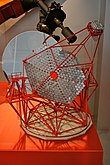
Together with other gamma-ray telescopes, HESS observes high-energy processes in the universe. Sources of gamma radiation are supernova remnants , active galactic nuclei, and plerions . Unproven physical theories are also actively checked on the telescope, for example, they are looking for gamma rays formed from the predicted annihilation of dark matter particles - WIMPs . Loop quantum gravity resulting from Lorentz covariance is also investigated.

HESS is located on the Göllschau farm owned by the Kranz family, which is located near Gamsberg in Nambia , in an area known for its excellent conditions for astronomical observation. The first of the four telescopes of the first phase of the HESS project was commissioned in the summer of 2002, all four began to function in December 2003.
In 2004, HESS was the first Cherenkov telescope to find a position in space of a source of cosmic gamma rays.
In 2005, it was announced that HESS discovered eight new sources of high-energy gamma rays, doubling the number of known sources. As of 2014, more than 90 gamma ray sources with energies of the order of TeV were opened at HESS.
In 2016, the HESS collaboration reported on observations that showed the presence of petelectron-volt photons caused by a supermassive black hole in the center of the Milky Way, and thus this black hole can be considered as a source of pete-electron-cosmic radiation as a possible alternative to supernova remnants.