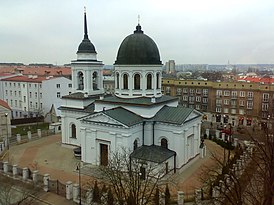
St. Nicholas Cathedral ( Polish. Sobór św. Mikołaja , full name - St. Nicholas Cathedral [1] ) - the cathedral of the Bialystok and Gdansk diocese of the Polish Orthodox Church in the city of Bialystok . Included in the Bialystok parish of St. Nicholas .
| Orthodox church | |
| St. Nicholas Cathedral | |
|---|---|
 | |
| A country |  Poland Poland |
| City | Bialystok |
| Denomination | Orthodoxy |
| Diocese | Bialystok-Gdansk |
| Architectural style | |
| Building | 1843 - 1846 |
| Relics and Shrines | relics of Gabriel Zabludovsky |
| condition | acting |
| Site | |
The cathedral was erected in 1843-1846 on the site of the old Uniate church, probably founded in the first half of the 18th century. In 1846, the new church was consecrated by Metropolitan Joseph of Vilna and Lithuania . Between the two world wars, the cathedral was one of two active Orthodox churches in the city. Since 1951, it has been the cathedral of the Bialystok and Gdansk dioceses. Since 1992, the relics of St. Gabriel Zabludovsky have been stored in it. The building was built in the style of classicism , typical of the architecture of the Orthodox churches of the Russian Empire in the second half of the 18th and first decades of the 19th century.
The Cathedral is located in the center of Bialystok, on the street. Lipova, 15. It is entered in the register of monuments on January 24, 1957 under No. A-200 [2] .
History
First Church of St. Nicholas
The first church of St. Nicholas in Bialystok, located near the current cathedral, was a courtyard of the church in Dolidi. According to some sources, it existed already in the 16th century [3] . According to other sources, the spouses Jan Clement and Catherine Varvara Branicki founded the Uniate Church of St. Nicholas until 1727 - from this year a document has been preserved in which Branicki offers 25 zloty for her abbot in the intention of his deceased relatives [4] . This is the oldest mention of the functioning of the Uniate Church in Bialystok. However, it is also likely that the first Uniate church was built by Stefan Nikolai Branitsky in the 1694-1696s. For such a version presented by Przemyslaw Chizhevsky, there is an inscription on the church antimins , which was signed by Bishop Leo (Zalensky) in 1708 [5] .
The building was on the then street. Horoskey [4] , at the Horo Gate [5] , was wooden, painted in yellow and gray, with red domes [4] . In 1773 the building is described as follows:
drewniana, wapnem tynkowana, dachówką kryta, z trzema kopułami, z krzyżami żelaznymi, gałkami pozłacanymi [6]
In the same description, which is part of the protocol of inspection of the Dolid parish, it is written that there were three altars in the church: the main one, with the icon of the Blessed Virgin Mary with two silver crowns, and two side ones dedicated, respectively, to Christ the Savior and St. Nicholas . Architecturally, the church was very close to the Western rite Catholic churches built at that time: it had a square vestibule on the western side, a rectangular nave and a narrow altar compared to the nave. The church was 14.2 meters long and 6.2 meters wide [5] .
In the Russian Empire
The construction of the new church was associated with an increase in the number of residents of Bialystok as a result of the development of local industry, as well as with an increase in the number of Orthodox Christians due to the liquidation of the Uniate Church in the Russian Empire (except the Kholm Diocese ) [7] and the influx of Russian officials [8] . In October 1838, the implementation of the temple project was entrusted to the architect Mikhailov, however, there is no convincing evidence that he was the author of the building plan [5] . In 1840, the design of a new temple was approved [8] . On March 21, 1843, the cornerstone of the new church was consecrated by Archimandrite Nicodemus, rector of the Supradustrial Monastery [8] . In 1843-1846, near the old wooden church, a new one was built, and after the work was completed, the dilapidated church was dismantled [7] . Also, the cemetery that originally surrounded the Nicholas Church was liquidated, and the surviving tombstones were transferred to the hill, where the chapel of St. Mary Magdalene is located [7] . The total cost of construction amounted to more than 36 thousand rubles in silver, of which almost 3 thousand were allocated from the treasury [8] . From the very beginning of its existence, the new church was the center of the Orthodox parish, taking on the functions of the chapel of St. Alexander Nevsky in the Branicki Palace founded in 1830 [9] .
The new temple was erected in the style of classicism , with elements characteristic of the architecture of antiquity and Byzantine cross-domed churches [3] . Construction work was supervised by David Zabludovsky [8] . In 1846, the church was commissioned and consecrated by Metropolitan Joseph of Vilna and Lithuania [7] . The church became the second cathedral of the Vilnius and Lithuanian dioceses [7] . In 1850, the temple received a set of necessary boil [9] . According to an inventory of 1859, there were five bells on the bell tower; in the temple was the Bialystok Icon of the Mother of God, revered by both Orthodox and Catholics [9] . The first repair was made in 1868-1872.
On August 25, 1897, the church was visited by Emperor Nicholas II and his wife Alexandra Fedorovna [10] . To commemorate their visit, the cathedral received donations from individuals for the purchase of the silver-framed Gospel [5] . The interior of the cathedral was decorated with frescoes from the very beginning of its work, but the original composition was destroyed before 1910 [3] . In the aforementioned year, a group of Russian artists, led by Mikhail Avilov, re-painted the temple, relying on the work of Viktor Vasnetsov in the Vladimir Cathedral in Kiev [3] . In 1910, a major overhaul of the temple roof was also carried out [11] .
In 1900, in connection with the changing borders of the dioceses, the church in Bialystok ended up in the Grodno diocese and became its second cathedral [12] . On October 24, 1910, after the repair was completed, the church was again consecrated by Bishop of Grodno and Brest Mikhail [13] .
Early 1910s
Mid 1910s
The end of the 1910s
Iconostasis in the 1910s
In independent Poland
After independence, most Orthodox churches in Bialystok were recognized as a symbol of Russification policy and transferred to the Catholic Church , but St. Nicholas Cathedral remained Orthodox [14] .
On July 11, 1936, the Pochaev Icon of the Mother of God was brought to Bialystok. One and a half thousand people took part in the prayer service sent to her in the Nikolaev Church. Two years later, the temple celebrated the 950th anniversary of the baptism of Russia [10] .
Until 1951, Nicholas Church was a simple parish church. On September 7, 1951, when the Council of Bishops of the Polish Orthodox Church formed the Bialystok and Gdansk diocese, the church received the status of a cathedral [15] . In 1955-1958, the church was renovated. The external walls and the altar were renovated, and the church of St. Seraphim of Sarov was built in the basement of the cathedral [15] . In the first years after the Second World War, the Ministry of Public Security monitored the clergy of the cathedral in the framework of the case, codenamed Nikolai [16] . From 1975 to 1976 the inner walls of the church were updated. The restoration and conservation of Avilov's frescoes was impossible, so it was decided to eliminate them and re-paint the cathedral. Only in the altar was a fresco of Avilov with the image of the Risen Christ. New paintings were performed by Joseph Lotovsky [3] .
In 1987, the cathedral was visited by the Patriarch of Constantinople Demetrius [17] , and a year later it hosted the celebration of the millennium of the baptism of Rus under the chairmanship of Metropolitan of Warsaw and all of Poland Vasily [18] . In June 1991, the church was visited by Pope John Paul II [18] .
In 1988-1990, regular repairs were carried out in the cathedral. During this restoration, the exterior plaster of the building was replaced, the icon cases and icon cases were updated and gilded, the roof and domes were covered with copper tin [3] . From 1991 to 1995, work was carried out on the arrangement of the surrounding territory [19] .
On September 21-22, 1992, the celebrations of the transfer of the relics of St. Gabriel Zabludovsky , previously stored in Grodno and transferred to the Polish Orthodox Church by Bishop of Grodno and Volkovysky Valentin [15], took place in the cathedral. The procession from the borders of the city to the cathedral was attended by over 70 thousand believers and nine Orthodox bishops from the Polish Orthodox Church and the Belarusian Exarchate , as well as the Catholic Archbishop of Bialystok Edward Kisel and Voivode Bialystok [20] .
In June 2010, the Cathedral was visited by the Patriarch of Jerusalem Theophilus III [21] , on August 18, 2012 - the Primate of the Russian Orthodox Church , the Patriarch of Moscow and All Russia Kirill , and on August 21, 2016 - the Patriarch of Antioch John X [22] .
Architecture
The cathedral was built in the style of classicism, in the plan it has the shape of a Greek cross [3] and is typical of the Orthodox church architecture of the Russian Empire in the mid-18th – mid-19th centuries. Jerzy Uscinovich compares it with the Yablochinsky Monastery and the Church of the Assumption of the Mother of God in Zabludov and names the Transfiguration Cathedral in Dnepropetrovsk, the Saints Peter and Paul Cathedral in Gomel, and the main church of the Transfiguration Monastery in Zabludov as examples. Novgorod-Seversky (all were created at the end of the 18th or the beginning of the 19th century) [23] .
On the external walls of the church are pilasters with Doric capitals, decorated with floral motifs [3] . The temple has one central hemispherical dome on a high pedestal [7] . The bell tower rises above the narthex [8] . The dome of the church was originally painted blue, and the roof was red [8] . The temple has four entrances: the main one from the western side, two lateral from the north and south, and the entrance to the sacristy [3] . The main entrance is decorated with a monumental portico [19] .
The total height of the building is 40 meters [24] .
Interior
The iconostasis of St. Nicholas Cathedral dates from 1846 and is the work of the Vilna school. To the right of the Royal Gates is the image of Christ, to the left - the Mother of God. On two deacon’s doors are icons of the archangels Michael and Gabriel [15] . The royal doors are decorated with four round icons with the images of the evangelists and two oval with the scene of the Annunciation . The upper two rows contain four icons from the cycle of the twelfth holidays . An allegorical image of the Holy Spirit in the form of a dove is located above the royal gates in a socket, and above it, made in 1900, is a list of the Pochaev Icon of the Mother of God . All this is crowned with an icon depicting the Last Supper [25] .
In addition to the icons placed in the iconostasis, there are others in the cathedral that come from different periods. Among them, of particular importance are the icons of the Protection of the Mother of God, in the northern nave, the Almighty Christ in the southern nave, the icon of St. Nicholas (the time of creation is unknown) and a copy of the icon of the Mother of God "Joy of All Who Sorrow . " Since the 18th century, the Białystok Icon of the Mother of God, a variant of the Smolensk Icon of the Mother of God, was especially revered. She was taken to Russia by clergy in 1915; her further fate is unknown. As of 2017, this image is replaced by its exact copy, which was created after 1945 [4] . Icons created for the needs of the church during its construction were written by the Moscow icon painter Adrian Malakhov [8] .
The interior of the cathedral is decorated with frescoes by Joseph Lotovsky, made in 1975-1976. They represent, respectively: Christ tempted in the wilderness (on the south wall), Christ praying in Gethsemane (on the north wall), the Nativity of the Lord and the Crucifixion (above the windows). On the southern doors you can see the images of St. Panteleimon and St. George the Victorious , and on the northern - St. Catherine and Barbara . In the western part of the central nave, above the windows, there are images of the Vilna Martyrs , Job Pochaevsky , Seraphim of Sarov and Sergius of Radonezh . On the northern wall, above the windows, you can see images of St. Sophia with his daughters Vera, Nadezhda and Love, St. Onufry , St. Anne and St. Mary Magdalene . On the walls of the narthex are scenes from the life of the patron saint of the cathedral - St. Nicholas of Myra [7] . Above the choir, there is a fresco depicting the Last Judgment , below the balcony - the image of Saints Cyril and Methodius [7] . In the dome is the Deesis - Christ Almighty surrounded by Our Lady and John the Baptist . On the twelve columns between the windows in the drum are the images of the apostles. The sails are represented by the figures of four evangelists, and beneath them, in the corners of the walls, are the saints Equal to the Apostles Constantine , Elena , Olga and Vladimir [26] .
From the very beginning of the functioning of the church, there were three tiled stoves in it, and in 1880 five more iron stoves were installed [27] .
Lower Church
In the basement of the church is the temple of Seraphim of Sarov . It houses the iconostasis of the beginning of the XX century, consisting of four icons: Christ, Our Lady, Seraphim of Sarov and Alexander Nevsky [15] . It was originally located in the church of St. Seraphim of Sarov, which operated in 1902-1918, then turned into a church [28] . The walls are decorated with images of major Orthodox holidays [28] .
Adaptation of the basement of the cathedral (a former utility room under the altar [28] ) for worship was carried out in 1955-1958 [19] . The author of the design of the lower church was Mikhail Balash . Since 2005, the Liturgy in the Polish language has been served in the lower church on Sunday, and a prayer service to the patron saint on January 15 and August 1 [28] . Since 2008, the icon of Seraphim of Sarov with a particle of his relics has been in the temple [28] .
Not far from the cathedral, on St. Nicholas 3, is the home of the bishop, in which there is a chapel in honor of Saints Cyril and Methodius [29] .
Notes
- ↑ Information . Parafia Prawosławna pw Św. Mikołaja Cudotwórcy w Białymstoku . Date of treatment February 27, 2019.
- ↑ Rejestr zabytków nieruchomych - województwo podlaskie (Polish) . Narodowy Instytut Dziedzictwa. Date of treatment November 9, 2017.
- ↑ 1 2 3 4 5 6 7 8 9 Sobór św. Mikołaja, Białystok (Polish) (unavailable link) . orthodox.bialystok.pl. Date of treatment March 8, 2012. Archived February 26, 2010.
- ↑ 1 2 3 4 Danieluk , pp. 36-37.
- ↑ 1 2 3 4 5 Kotyńska-Stetkiewicz, 2003 , pp. 45-47.
- ↑ Mironowicz , p. 6.
- ↑ 1 2 3 4 5 6 7 8 Danieluk , pp. 38-39.
- ↑ 1 2 3 4 5 6 7 8 Borowik S. Jak w Białymstoku budowano sobór św. Mikołaja (Polish) // Przegląd Prawosławny. - Białystok, 2009 .-- Kwiecień ( ed. 4 (286) ). - ISSN 1230-1078 .
- ↑ 1 2 3 Borowik S. Z dziejów parafii św. Mikołaja w Białymstoku (cz. 1) (Polish) // Przegląd Prawosławny. - Białystok, 2011 .-- Listopad ( ed. 11 (317) ). - S. 24-26 . - ISSN 1230-1078 .
- ↑ 1 2 Mironowicz , p. 35.
- ↑ Kotyńska-Stetkiewicz, 2003 , pp. 48-49.
- ↑ Mironowicz , p. eight.
- ↑ Mironowicz , p. 23.
- ↑ Mironowicz , p. eleven.
- ↑ 1 2 3 4 5 Danieluk , pp. 40-41.
- ↑ K. Sychowicz, Władza ludowa a Kościół prawosławny w województwie białostockim 1944-1956 [w:] red. JJ Milewski, A. Pyżewska, Stosunki polsko-białoruskie w województwie białostockim w latach 1944-1956, Warszawa 2005, Instytut Pamięci Narodowej, ISBN 83-89078-95-3 , s.128.
- ↑ Mironowicz , p. 42.
- ↑ 1 2 Mironowicz , p. 46.
- ↑ 1 2 3 Mironowicz , pp. 22-23.
- ↑ Mironowicz , p. 53.
- ↑ A. Radziukiewicz, A. Matreńczyk. Doświadczyliśmy gościnności Abrahama (Polish) // Przegląd Prawosławny. - 2010 .-- Lipiec ( ed. 7 (301) ). - ISSN 1230-1078 .
- ↑ Strona diecezji białostocko-gdańskiej - JŚ Patriarcha Antiochii i całego Wschodu Jan X w Białymstoku [dostęp: 08.22.2016.]
- ↑ Mironowicz , pp. 19-21.
- ↑ Mironowicz , pp. 29-30.
- ↑ Radziukiewicz, 1991 , pp. 9-14.
- ↑ Mironowicz , pp. 24-25.
- ↑ Borowik S. Z dziejów parafii św. Mikołaja w Białymstoku (cz. 2) (Polish) // Przegląd Prawosławny. - Białystok, 2011 .-- Grudzień ( ed. 12 (317) ). - S. 24-26 . - ISSN 1230-1078 .
- ↑ 1 2 3 4 5 Opis na stronie parafii
- ↑ Strona diecezji białostocko-gdańskiej. . Date of treatment May 10, 2012.
Literature
- Danieluk E. i A. Prawosławne cerkwie Białegostoku i okolic. - Białystok: Stowarzyszenie Bractwo Prawosławne św. św. Cyryla i Metodego. - ISBN 928649.
- Mironowicz A. Sobór świętego Mikołaja w Białymstoku. - Białystok: Orthdruk. - ISBN 8390605201 .
- Radziukiewicz A., Hammer W. Sobór św. Mikołaja w Białymstoku. - Białystok: Orthdruk, 1991 .-- 9-14 p. - ISBN 83-85368-00-0 .
- Kotyńska-Stetkiewicz J. Sobór katedralny pw. św. Mikołaja Cudotwórcy (Polish) // Biuletyn Konserwatorski Województwa Podlaskiego. - Białystok: Wojewódzki Urząd Ochrony Zabytków, 2003 .-- T. 8-9 . - S. 45–47 . - ISSN 1509-071X .