The Moluccan kestrel [1] ( lat. Falco moluccensis ) is a type of falcon .
| Moluccan Kestrel |
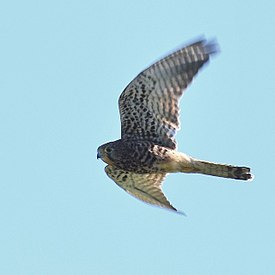 |
| Scientific classification |
|---|
| No rank : | Bilateral symmetric |
|
| International Scientific Name |
|---|
Falco moluccensis ( Bonaparte , 1850) |
|
Content
Spread from Wallace to Java. Dwells on meadows with individual trees, in light forests and on the edges of the primary and high secondary forest. Along logging roads, it sometimes penetrates forests and is occasionally found in forest areas. Inhabits and man-made landscapes [2] .
Habits resembles an ordinary kestrel [3] .
The spotted kestrel eats mainly small mammals, birds (prefers waterfowl and pigeons), lizards and insects.
The Moluccan kestrel has a nesting behavior similar to that of related species. It can nest in buildings of people, on the slopes of cliffs and in other people's abandoned nests. In Indonesia, its nests were found in various places, including the traditional dwelling with a peak roof or in the crowns of palm trees. Nests are usually occupied in March-September or October during the mating season [3] .
The Moluccan kestrel has a cry: “cue, kick, kick”, similar to the cries of related species. In flight, she tends to use another cry: “rrrit, rrrit, rrrit” [3] .
- ↑ Boehme RL , Flint V. Ye. The five-language dictionary of animal names. Birds. Latin, Russian, English, German, French / Under total. ed. Acad. V.E. Sokolova . - M .: Rus. lang, "RUSSO", 1994. - p. 49. - 2030 copies. - ISBN 5-200-00643-0 .
- ↑ Species account: Spotted Kestrel, Falco moluccensis (Neopr.) . Global Raptor Information Network . The Peregrine Fund (2010).
- ↑ 1 2 3 Ferguson-Lees, James. Raptors of the World. - 2001. - P. 853.
