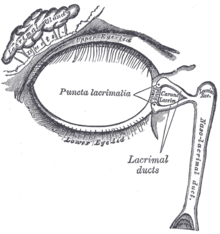
Lacrimal glands - exocrine glands located in the front of the eyes that secrete a tear are part of the lacrimal apparatus . Subdivided into [1] :
- actually (or the main ) lacrimal gland - paired (one in each eye) almond-shaped [2] .
- additional Wolfring lacrimal glands - in an amount of 8 are located at the inner edge of the conjunctival cartilage (3 in the upper, 1 in the lower in each eye).
- additional lacrimal glands of Krause - in the amount of 42-96 are located in the thickness of the eyelids at the arches of the conjunctiva - the place of transition of the conjunctiva of the eyelids to the conjunctiva of the sclera (15-40 at the upper, 6-8 at the lower in each eye).
The lacrimal gland is present in reptiles , birds and all mammals [3] .
Content
- 1 Physiology and functions
- 2 Anatomy and histology
- 2.1 Innervation
- 2.2 Blood supply
- 2.3 Lymphatic drainage
- 3 Pathology
- 4 See also
- 5 notes
- 6 Literature
- 7 References
Physiology and Functions
The tear secreted by the main lacrimal gland passes through the ducts into the conjunctival sacs and mixes with the secrets of the other glands of the conjunctiva and the eyelids participate in the formation of excess lacrimal fluid . For the most part, secretion by the main lacrimal gland occurs only reflexively with irritation of the cornea , conjunctiva and nasal mucosa, or with psychoemotional reactions ( crying ) and reaches 30 ml / min. Normally, with the constant formation of tear fluid, it does not participate [1] . The functioning of the lacrimal gland begins 2 months after birth [4] , which is why up to this age, practical lacrimation is not observed, in senile age, the function of the lacrimal gland gradually fades [5] .
In addition to the main lacrimal gland, in the conjunctiva of the sclera and eyelids there are several dozens of additional small lacrimal glands, which produce a tear to permanently moisturize the eyes with tear fluid under normal conditions. Secreted by additional lacrimal glands, the tear makes up about 10% of its total secretion , which is 0.5-2 ml / day and provides basal hydration of the eyes under normal conditions. This explains, in particular, that when the main lacrimal gland is damaged, the eye does not dry out. Additional lacrimal glands can be damaged by chemical burns of the conjunctiva [1] [4] .
The lacrimal glands of a person perform a number of the most important functions that are responsible for maintaining the normal and constant work of the cornea and conjunctiva. The lacrimal glands produce a tear - the main water-containing component of the tear fluid, which performs the optical, trophic and protective function of the outer front surface of the eyeball . The lacrimal glands secrete mucins , which make up up to 50% of the tears [1] .
Anatomy and Histology
- Lacrimal gland (lat.glandula lacrimalis )
Actually, the lacrimal gland is a complex alveolar-tubular exocrine gland , which consists of a large number of lobules separated by connective tissue , each of which, in turn, contains many acinar lobules. Each of the acinar lobules consists only of glandular cells and produces a watery serous secretion. Intralobular ducts are connected, forming interlobular ducts, which, in turn, pass into the excretory ducts. The ducts of the lacrimal gland resemble branched tubes in structure. The excretory ducts of the lacrimal gland open with several holes in the lateral (external) corner of the superior arch of the conjunctiva [6] . The excretory ducts themselves are covered with a bilayer cylindrical epithelium . Gland cells have a conical shape, with the apex oriented in the lumen of the ducts [3] .
The lacrimal gland by the tendon of the muscle that raises the upper eyelid ( lat. Musculus levator palpebrae superioris ) is divided into two parts [7] [1] :
- orbital (orbital) - the larger part (about 25 × 12 × 5 mm), located in the upper outer (lateral) part of each eye socket in the lacrimal fossa , ( Latin fossa glandulae lacrimalis ), on the lower surface of the orbital part of the frontal bone . It contains interlobular ducts, which are combined with 3-5 main excretory ducts connected to the ducts of the palpebral part, secreting a tear in the lateral part of the conjunctival sac at the upper edge of the cartilage of the eyelid.
- secular (palpebral) - the smaller part (about 11 × 8 × 2 mm), is located below the upper arch of the conjunctiva closer to the inner surface of the upper eyelid . If you turn the upper eyelid , you can see the palpebral part. Part of the ducts flows into the ducts of the orbital part of the gland, 3-9 ducts open independently in the same place as the ducts of the upper part.
The tear released from the ducts due to the capillary effect and surface tension is distributed along the conjunctival sacs and the surface of the conjunctival mucosa, and when blinking or closed eyelids and on the outer surface of the cornea, as part of the tear fluid mixes with the secrets of other glands, some accumulate in the tear lake near the inner edge of the eyes . Further, in a normal eye condition, non-evaporated excesses of tear fluid, dragging along obeyed epithelium and dust particles are removed through the drainage system of the lacrimal apparatus into the lower nasal passage of the nasal cavity , where they are mixed with the secrets of the nasal mucosa. With excessive production of tears with iron, reflexively normal or pathological, excess tear fluid accumulated in the conjunctival sacs, not having time to be removed through the drainage system, flows out through the edge of the eyelids ( lacrimation ) [4] .
- Additional lacrimal glands ( lat.glandulae lacrimales accessoriae )
The structure and secreted serous secretion are similar to the lobes of the main lacrimal gland [4] . The shape is oval or round, may have several lobules. Wolfring's additional lacrimal glands are located at the upper edge of the upper cartilage and at the lower edge of the lower cartilage of the eyelids. Additional lacrimal glands of Krause are located in the upper and lower conjunctival arches [1] .
Innervation
The lacrimal nerve emerging from the optic nerve (the first branch of the trigeminal nerve ) provides a sensitive component of the innervation of the lacrimal gland. The large stony nerve (a branch of the facial nerve ) emerging from the facial nerve provides the parasympathetic autonomic innervation of the lacrimal gland. The large stony nerve runs along the branches of the V1 and V2 trigeminal nerve.
Parasympathetic innervation originates in the bridge from the tearing core of the facial nerve. From the nucleus of the Varolian bridge, the preganglionic parasympathetic fibers go through the intermediate nerve (a small process of the facial nerve) into the cranked ganglion , but there they do not form synapses . Then, from the cranked ganglion, the preganglionic fibers pass into the large stony nerve , which carries parasympathetic secretory motor fibers through the ragged hole , where the large stony nerve connects to the deep stony nerve (which contains the postganglionic sympathetic fibers of the main cervical ganglion ), forming the pterygoid canal nerve , which then turns through the pterygoid canal into the pterygo- ganglion . Here the fibers come into contact with the postganglionic neurons , and the postganglionic fibers connect to the fibers of the maxillary nerve . In the pterygopalatine fossa, the parasympathetic secretory fibers connect to the zygomatic nerve and then pass into the lacrimal branch of the ocular part of the trigeminal nerve , which also provides sensitive innervation of the lacrimal gland.
Sympathetic postganglionic fibers emerge from the main cervical ganglion . They pass through the internal carotid plexus and deep stony nerve , connecting with a large stony nerve in the pterygoid canal . Together, the large and deep stony nerves form the nerve of the pterygoid canal , and it reaches the pterygopalatine ganglion in the pterygopalatine fossa . Unlike their parasympathetic analogues, sympathetic fibers do not form synapses in the pterygopalatine ganglia , the bodies of postganglionic neurons are located in the sympathetic trunk . Sympathetic fibers run parallel to the parasympathetic fibers that innervate the lacrimal gland.
Blood supply
The lacrimal gland is supplied with blood by the lacrimal artery , departing from the ophthalmic artery . The outflow of venous blood through the superior ophthalmic vein .
Lymphatic drainage
Lymph from the lacrimal gland flows into the superficial lymph nodes .
Ocular artery of the right eye and its branches
Nerves of the right orbit. View from above
Medial rectus muscle, lacrimal gland and nerves of the left eye. Anatomical preparation
The scheme of sympathetic and parasympathetic innervation of the connection of the main palatine and upper cervical ganglion
Pathology
Dry eyes , itching, and burning in the eyes, which are signs of dry eye syndrome or Sikka keratoconjunctivitis, can occur due to malfunctioning of the lacrimal glands. With this syndrome, the lacrimal glands produce less tear fluid. This is mainly due to the aging process or to taking certain medications. To determine the total tear production, you can use the Schirmer test (Schirmer-I test), the main tear production - the Jones test (Schirmer-II test, can also be used: test with test thread , lactoferrin test , test with dilution of fluorescein sodium , estimation of the height of the lacrimal meniscus ). Many medications or diseases that cause dry eye syndrome can also cause inadequate salivation and dry mouth. Treatment varies depending on the etiology and includes the elimination of irritating factors, stimulation of lacrimation, an increase in the number of tears, eyelid cleansing and treatment of eye inflammation [8] .
In addition, there are other pathologies of the lacrimal gland [4] :
- developmental abnormalities - the absence or underdevelopment of the main lacrimal gland
- lacrimal gland injuries
- lacrimal tumors
- dacryoadenitis - inflammation of the lacrimal gland with bacterial and viral infections, with autoimmune diseases affecting the salivary glands as well, like Sjogren , Shauman , Mikulich’s diseases
- dacryopsis is a cyst of lacrimal glands, both main and additional (in the latter it is associated with trachoma )
- displacement of the lacrimal gland (congenital or acquired)
See also
- Meibomian glands
- Garderova iron
- Eye mucus
Notes
- ↑ 1 2 3 4 5 6 Brzhesky V.V., Somov E.E. Corneal conjunctival xerosis (diagnosis, clinic, treatment) / 2nd ed., Revised. and add. // St. Petersburg: Lefty. St. Petersburg. - 2003. - 120 p. ISBN 5-93356-027-8 . (S. 5-12).
- ↑ Clinically Oriented Anatomy,, Dalley & Agur.
- ↑ 1 2 Dogel A.S. Lacrimal glands // Brockhaus and Efron Encyclopedic Dictionary : in 86 volumes (82 volumes and 4 additional). - SPb. , 1890-1907.
- ↑ 1 2 3 4 5 Avetisov S.E. , Egorov E.A. , Moshetova L.K. , Neroev V.V. , Takhchidi H.P. Ophthalmology: national leadership // M .: GEOTAR-Media . - 2008 .-- 944 p., Ill. ISBN 978-5-9704-0707-3 . (S. 72-83, 362-399).
- ↑ Tarkhanov I.R. Tears // Brockhaus and Efron Encyclopedic Dictionary : in 86 volumes (82 volumes and 4 additional). - SPb. , 1890-1907.
- ↑ "eye, human." Encyclopædia Britannica. 2010. Encyclopædia Britannica 2010 Ultimate Reference Suite DVD 2010
- ↑ Sapin M.R. , Bocharov V.Ya., Nikityuk D.B., Satyukova G.S., Selin Yu.M., Spirin B.A. Human anatomy / 2 vol. T. 2, 5th ed. reslave. and add. // M .: Medicine . - 2001 .-- 640 s., Ill. ISBN 5-225-04586-3 . (S. 583-589).
- ↑ Illustrated Anatomy of the Head and Neck, Fehrenbach and Herring, Elsevier, 2012, page 153.
Literature
- Diseases of the lacrimal organs: Monograph / B. F. Cherkunov - Samara: SE "Perspective", 2001. - 296 p. - ISBN 5-900031-43-8 .
- Lacrimal glands // Small Encyclopedic Dictionary of Brockhaus and Efron : in 4 volumes - St. Petersburg. 1907-1909.
- Lacrimal glands // Big Soviet Encyclopedia : [in 30 t.] / Ch. ed. A.M. Prokhorov . - 3rd ed. - M .: Soviet Encyclopedia, 1969-1978.
- Beloglazov V.G. Lacrimal organs // Big Medical Encyclopedia , 3rd ed. - M .: Soviet Encyclopedia. - T. 23.
- Volokonenko A.I. Conjunctiva // Big Medical Encyclopedia , 3rd ed. - M .: Soviet Encyclopedia. - T. 11.