Pacific ambistoma [2] ( lat. Dicamptodon ensatus ) is a species of caudate amphibian from the ambistome family.
| Pacific ambistoma | |||||||||||||||||||||||||||||||||
 | |||||||||||||||||||||||||||||||||
| Scientific classification | |||||||||||||||||||||||||||||||||
|---|---|---|---|---|---|---|---|---|---|---|---|---|---|---|---|---|---|---|---|---|---|---|---|---|---|---|---|---|---|---|---|---|---|
| |||||||||||||||||||||||||||||||||
| International scientific name | |||||||||||||||||||||||||||||||||
Dicamptodon ensatus ( Eschscholtz , 1833 ) | |||||||||||||||||||||||||||||||||
| Synonyms [1] | |||||||||||||||||||||||||||||||||
| |||||||||||||||||||||||||||||||||
| Security status | |||||||||||||||||||||||||||||||||

Distribution
Endemic to the United States : The range of the species covers the Pacific coast and the adjacent mountains of California , from the south of Mendocino County to the south of Santa Cruz County [1] .
Description
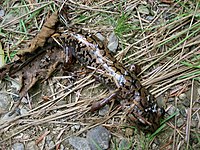
The total length varies from 17 to 30.5 cm. The head is small, wide, with a spade-shaped muzzle. The eyes are medium sized with a large black pupil. The body is massive, awkward. There are 4 fingers on the front legs, and 5 on the hind legs. The tail is quite long (about 40% of the total length), laterally compressed. It is painted brown with various shades. On the head, back and sides there is a marble or net pattern of dark spots [3] .
Lifestyle
Prefers woodlands , shrubs , rocky terrain. It occurs at an altitude of 900 m above sea level . Climbing trees well. When scared, it makes a rather loud sound, reminiscent of barking or a short squeal of low tone [4] . Active at night. It feeds on invertebrates , ambistomes of other species, lungless salamanders , small frogs, shrews , rodents and small snakes [5] .
Reproduction
Mating and breeding takes place from March to May. The female lays about 100 eggs in deep fissures of the earth or the burrows of rodents, and wraps the eggs in her body. Metamorphosis lasts up to 2 years. Larvae feed on aquatic invertebrates, fish, and other amphibians [6] .
Photo
Notes
- ↑ 1 2 Frost, Darrel R. Dicamptodon ensatus . Amphibian Species of the World: an Online Reference. Version 6.0 . American Museum of Natural History (2017).
- ↑ Ananyeva N. B. , Borkin L. Ya. , Darevsky I.S. , Orlov N.L. The five-language dictionary of animal names. Amphibians and reptiles. Latin, Russian, English, German, French. / edited by Acad. V. E. Sokolova . - M .: Rus. lang., 1988. - S. 20. - 10 500 copies. - ISBN 5-200-00232-X .
- ↑ Cope's Giant Salamander (English) information on the Encyclopedia of Life website (EOL).
- ↑ Thomas Kucera (1997), Pacific Giant Salamander , California Department of Fish and Game , < http://nrm.dfg.ca.gov/FileHandler.ashx?DocumentVersionID=17590 > . Retrieved September 29, 2011.
- ↑ Dicamptodon ensatus (California Giant Salamander, Pacific Giant Salamander ) . The IUCN Red List of Threatened Species .
- ↑ Amphibia Web. Dicamptodon ensatus . Provides information on amphibian declines, natural history, conservation, and taxonomy (2017).
Literature
- Grzimek, Bernhard Het leven de dieren deel V: Vissen (II) en amfibieën , Kindler Verlag AG, 1971, Pagina 366 ISBN 90-274-8625-5