Bristol Byzantism ( English Bristol Byzantine ) - a branch of the Neo-Byzantine style , part of the popular in the XIX century historicism , common in Bristol (UK) in the years 1850-1880.
| Bristol Byzantism | |
|---|---|
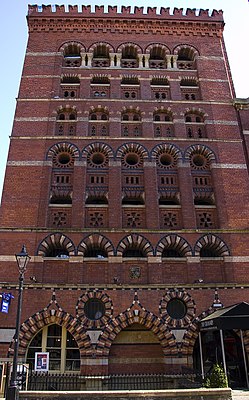 Barn in Bristol | |
| Concept | imitation of neo-byzantine style |
| A country |  United Kingdom United Kingdom |
| Established | 1850 |
| Breakup date | 1880 |
| The most important buildings | Arnolfini , Barn , Carriage Workshop |
Many buildings in this style have been demolished or demolished, but notable examples include Colston Hall [1] , Barn , Carriage Workshop [2] and several buildings on Victoria Street. Several harbor warehouses have also been preserved, including the Arnolfini contemporary art gallery [3] , Clarks Warehouse [4] , St. Vincent’s Factory [5] and Woll Hall [6] .
Content
- 1 Style
- 2 Architects
- 3 Building Examples
- 4 See also
- 5 notes
Style
Bristol Byzantism arose under the influence of Byzantine and Moorish architecture and was used in the construction of industrial buildings (warehouses and factories).
The style is characterized by a simple plan, rough materials and multi-colored bricks: red, yellow, black and white. Arched passages are decorated on the ground floor, and the upper floors are joined by horizontal or vertical groups of window openings.
The first Bristol-style Byzantine style building designed by Richard Shackleton Pope was the Bush House (the modern Arnolfini Museum), a tea warehouse in the Floating Harbor in the center of Bristol. The building is three floors with a stone basement and rectangular windows, framed by high semicircular arches, and a small attic [7] .
The term “Bristol Byzantism” was proposed by Sir John Summerson [8] .
Architects
- R. Milverton Drake
- John foster
- William Bruce Gingell
- Edward William Goodwin
- William Venn Gough
- John Henry Hurst
- Thomas Royce Lysat
- Archibald Ponton
- Richard Shackleton Pope
Building Examples
King Street Building 35 , approx. 1870
Brown's Restaurant , 1871
Carriage workshop, 1862
Clarks Warehouse, 1863
Colston Hall, 1860s
Robinson Warehouse , 1874
See also
- Neo-Moorish style
- Mudejar
- Neo-Byzantine style
- Neo Mudejar
Notes
- ↑ The Colston Hall (link unavailable) . Images of England . Date of treatment March 13, 2007. Archived December 8, 2007.
- ↑ No.104 The Carriage Works (Unavailable link) . Images of England . Date of treatment May 2, 2007. Archived on October 7, 2007.
- ↑ Bush House (inaccessible link) . Images of England . Date of treatment August 18, 2006. Archived December 7, 2007.
- ↑ Clarks Wood Company warehouse (link not available) . Images of England . Date of treatment May 15, 2007. Archived November 27, 2007.
- ↑ St Vincent's Works and attached front area railings unopened (link not available) . Images of England . Date of treatment May 2, 2007. Archived on October 7, 2007.
- ↑ No.12 The Wool Hall, including the Fleece and Firkin Public House (Link unavailable) . Images of England . Date of treatment May 12, 2007. Archived on November 8, 2007.
- ↑ Bush House . Looking at Buildings . Date of treatment October 9, 2010.
- ↑ Brace, Keith. Portrait of Bristol. - London: Robert Hale, 1996. - ISBN 0-7091-5435-6 .