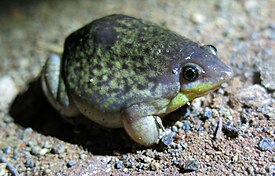
Marble pig frog [2] ( lat. Hemisus marmoratus ) is a species of tailless amphibian from the family of pig frogs .
| Marble Pig Frog |
 |
| Scientific classification |
|---|
| No rank : | Bilateral symmetrical |
| Squad: | Tailless Amphibians |
| Family: | Pig Frogs ( Hemisotidae Cope, 1867 ) |
|
| International scientific name |
|---|
Hemisus marmoratus ( Peters , 1854 ) |
| Synonyms [1] |
|---|
- Engystoma marmoratum Peters, 1854
- Kakophrynus sudanensis Steindachner, 1863
- Hemisus sudanense Steindachner, 1864
- Hemisus taitanus Peters, 1882
- Hemisus marmoratum bocage, 1895
|
| Security status |
|---|
Least ConcernedIUCN 3.1 Least Concern : 55281 |
|
Content
The range covers sub- Saharan Africa (excluding rainforest zones) from Senegal to Eritrea , western Ethiopia and Somalia , as well as southern Kenya and northern and north-eastern parts of South Africa [1] . There is an isolated population south of Lake Tana in northwestern Ethiopia [3] .
This is a chubby, almost cylindrical frog with a very sharp snout and short but strong limbs. The size of males is 22–34 mm, weight is from 1.3 to 5.0 g. Females are 37–49 mm, weighing 5.8–6.3 g, and 7.7–12 g during pregnancy [4] . The head is small with a pointed muzzle, from beige to dark olive in color. The body is loose. The color of the back is gray-brown with a dark marble pattern. The throat, sides, and back of the thigh are greenish yellow. The belly is white [5] . The eyes are small, with vertical pupils. The eardrum is not noticeable. The male's throat sac becomes dark purple during the mating season. There is a large calcaneal tubercle. Trill resembles the cricket chirping [6] .
It lives in savannas , woodlands, on irrigated lands. It is found at altitudes of up to 1800 m above sea level . Like other representatives of the genus, it digs holes and passages well, where it spends most of its life, coming to the surface only during rains and for hunting. Active at night. They feed mainly on ants , as well as termites and worms [3] .
The local population uses this species for food, in traditional medicine, and for trade, including international, for home maintenance [7] .
Reproduction occurs at the end of the dry season . The female lays 88-242 eggs in underground tunnels. This amphibian is interesting in that the female, burrowing into the ground, covers her eggs with her body, from which the juveniles emerge in the form of well-developed tadpoles . They appear a week after laying eggs. At this time, rains begin, and the tadpoles fall into the aquatic environment, where the male takes care of them. If the dry season drags on, the female can transfer the tadpoles to the water on her back. Metamorphosis lasts 3-4 weeks [3] .
- ↑ 1 2 Frost, Darrel R. Hemisus marmoratus (neopr.) . Amphibian Species of the World: an Online Reference. Version 6.0 . American Museum of Natural History (2017).
- ↑ Ananyeva N. B. , Borkin L. Ya. , Darevsky I.S. , Orlov N.L. Amphibians and reptiles. Latin, Russian, English, German, French. / edited by Acad. V. E. Sokolova . - M .: Rus. Yaz., 1988 .-- P. 52 .-- 10,500 copies. - ISBN 5-200-00232-X .
- ↑ 1 2 3 African Amphibians Hemisus marmoratus (neopr.) (2017).
- ↑ Peters, 1854: Diagnosen neuer Batrachier, welche zusammen mit der früher (24. Juli und 17. August) gegebenen Übersicht der Schlangen und Eidechsen mitgetheilt werden . Bericht über die zur Bekanntmachung geeigneten Verhandlungen der Königlich preussischen Akademie der Wissenschaften zu Berlin, vol. 1854, p. 614-628 ( [1] ).
- ↑ Amphibia Web. Hemisus marmoratus (neopr.) . Provides information on amphibian declines, natural history, conservation, and taxonomy (2017).
- ↑ Rödel, MO (2000). Amphibians of the West African Savanna. // Herpetofauna of West Africa , Vol. I. Edition Chimaira, Frankfurt, Germany. ISBN: 978-3930612161
- ↑ Hemisus marmoratus (English) . The IUCN Red List of Threatened Species .