(The idea of the proof presented below belongs to Brouwer [1] )
Since system solutions {\ displaystyle \ quad (1)}  are limited then characteristic roots {\ displaystyle \ lambda \ (A)}
  matrices {\ displaystyle A}
  satisfy equality
- {\ displaystyle Re \ lambda \ (A) \ leq \ 0,}
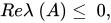
moreover, characteristic roots with zero real parts have simple elementary divisors.
Without loss of generality, suppose that the matrix {\ displaystyle A} has a quasi-diagonal form
- {\ displaystyle \ quad A = diag (A_ {1}, A_ {2}), \ quad (4)}

Where {\ displaystyle \ quad A_ {1}}  and {\ displaystyle \ quad A_ {2}}
  - respectively {\ displaystyle (p \ times p)}
  - and {\ displaystyle (q \ times q)}
  matrices {\ displaystyle \ quad (p + q)}
  such that
- {\ displaystyle Re \ lambda \ (A_ {1}) <- \ alpha <\ 0,}

- {\ displaystyle Re \ lambda \ (A_ {2}) = 0, \ quad (5)}

Indeed, this can be obtained using simple transformations. {\ displaystyle \ xi \ = S {\ boldsymbol {x}},}  and {\ displaystyle \ eta \ = S {\ boldsymbol {y}},}
  Where {\ displaystyle \ quad S}
  - constant {\ displaystyle (n \ times n)}
  is a matrix , and a one-to-one correspondence between the new integral curves {\ displaystyle {\ boldsymbol {\ xi}} (t) \ Longleftrightarrow {\ boldsymbol {\ eta}} (t)} induces a one-to-one correspondence between the old integral curves {\ displaystyle {\ boldsymbol {x}} (t) = S ^ {- 1} \ xi (t) \ Longleftrightarrow S ^ {- 1} \ eta (t) = {\ boldsymbol {y}} (t)} .
Also, from the marginal relationship {\ displaystyle {\ boldsymbol {\ xi}} (t) - {\ boldsymbol {\ eta}} (t) \ to 0,} at {\ displaystyle t \ to \ infty} obviously the limit relation follows
- {\ displaystyle {\ boldsymbol {x}} (t) - {\ boldsymbol {y}} (t) \ to 0,} at {\ displaystyle t \ to \ infty} .
{\ displaystyle \ quad 1)} Let be {\ displaystyle \ quad X (t) = diag (e ^ {tA_ {1}}, e ^ {tA_ {2}})} is the fundamental matrix of the system {\ displaystyle \ quad (1),} normalized to zero: {\ displaystyle \ quad X (t) = E,} but {\ displaystyle \ quad I_ {1} = diag (E_ {p}, 0),} and {\ displaystyle \ quad I_ {2} = diag (0, E_ {q}),} Where {\ displaystyle \ quad E_ {q}} and {\ displaystyle \ quad E_ {p}} are the identity matrices of the corresponding orders q and p, and, obviously, {\ displaystyle \ quad I_ {1} + I_ {2} = E_ {n}.}
Put {\ displaystyle \ quad X (t) = X_ {1} (t) + X_ {2} (t),} Where {\ displaystyle \ quad X_ {1} (t) = X (t) I_ {1} \ equiv diag (e ^ {tA_ {1}}, 0),} and {\ displaystyle \ quad X_ {2} (t) = X (t) I_ {2} \ equiv diag (0, e ^ {tA_ {2}})} .
Hence the Cauchy matrix {\ displaystyle \ quad K (t, \ tau) \ equiv X (t) X ^ {- 1} (\ tau) = X (t- \ tau)} can be represented as:
{\ displaystyle \ quad K (t, \ tau) = X_ {1} (t- \ tau) + X_ {2} (t- \ tau),}
and provided {\ displaystyle \ quad (5)} we have
{\ displaystyle \ lVert X_ {1} (t) \ rVert = \ lVert e ^ {tA_ {1}} \ rVert \ leq ae ^ {- \ alpha t},}
at {\ displaystyle 0 \ leq t <\ infty} {\ displaystyle \ quad (6)} and
{\ displaystyle \ lVert X_ {2} (t) \ rVert = \ lVert e ^ {tA_ {2}} \ rVert \ leq b,}
at {\ displaystyle - \ infty <t <\ infty} {\ displaystyle \ quad (7),} Where {\ displaystyle \ quad a, b} are some positive constants. Using the method of variation of arbitrary constants, the differential equation can be written in integral form
{\ displaystyle \ quad y (t) = X (t-t_ {0}) {\ boldsymbol {y}} (t_ {0}) + \ int _ {t_ {0}} ^ {t} X_ {1} (t- \ tau) B (\ tau) {\ boldsymbol {y}} (\ tau) \, d \ tau +} {\ displaystyle \ int _ {t_ {0}} ^ {t} X_ {2} (t- \ tau) B (\ tau) {\ boldsymbol {y}} (\ tau) \, d \ tau,} Where {\ displaystyle t \ in [0, \ infty)} arbitrary.
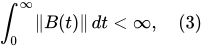
Since the matrix {\ displaystyle \ quad B (t)} completely integrated on {\ displaystyle [0, \ infty),} then all decisions {\ displaystyle {\ boldsymbol {y}} (t)} the system {\ displaystyle \ quad (2)} limited to {\ displaystyle [0, \ infty),}
and therefore the improper integral {\ displaystyle \ int _ {t_ {0}} ^ {\ infty} X_ {2} (t- \ tau) B (\ tau) {\ boldsymbol {y}} (\ tau) \, d \ tau} is convergent.
Hence, given that {\ displaystyle \ quad X_ {2} (t- \ tau) = X (t- \ tau) I_ {2} = X (t-t_ {0}) X (t_ {0} - \ tau) I_ {2 } = X (t-t_ {0}) X_ {2} (t_ {0} - \ tau),} our integral equation can be represented as
{\ displaystyle \ quad y (t) = X (t-t_ {0}) \ left \ lbrack {\ boldsymbol {y}} (t_ {0}) + \ int _ {t_ {0}} ^ {\ infty } X_ {2} (t_ {0} - \ tau) B (\ tau) {\ boldsymbol {y}} (\ tau) \, d \ tau \ right \ rbrack +} {\ displaystyle + \ int _ {t_ {0}} ^ {t} X_ {1} (t- \ tau) B (\ tau) {\ boldsymbol {y}} (\ tau) \, d \ tau - \ int _ {t} ^ {\ infty} X_ {2} (t- \ tau) B (\ tau) {\ boldsymbol {y}} (\ tau) \, d \ tau (8)}
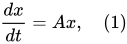
Decision {\ displaystyle \ quad {\ boldsymbol {y}} (t)} the system {\ displaystyle \ quad (2)} with initial condition {\ displaystyle \ quad {\ boldsymbol {y}} (t_ {0}) = {\ boldsymbol {y_ {0}}}} comparable solution {\ displaystyle \ quad {\ boldsymbol {x}} (t)} the system {\ displaystyle \ quad (1)} with initial condition
{\ displaystyle \ quad {\ boldsymbol {x}} (t_ {0}) = {\ boldsymbol {y_ {0}}} (t_ {0}) + \ int _ {t_ {0}} ^ {\ infty} X_ {2} (t- \ tau) B (\ tau) {\ boldsymbol {y}} (\ tau) \, d \ tau (9)}
Since decisions {\ displaystyle \ quad {\ boldsymbol {x}} (t)} and {\ displaystyle \ quad {\ boldsymbol {y}} (t)} completely determined by their initial conditions, then the formula {\ displaystyle \ quad (9)} establishes a unique correspondence between the set of all decisions {\ displaystyle \ lbrace {\ boldsymbol {y}} (t) \ rbrace} the system {\ displaystyle \ quad (2)} and many decisions {\ displaystyle \ lbrace {\ boldsymbol {x}} (t) \ rbrace} (or part of) the system {\ displaystyle \ quad (1)} . Note that the relation {\ displaystyle \ quad (9)} continuous relative to the initial value {\ displaystyle \ quad {\ boldsymbol {y}} (t_ {0}) = {\ boldsymbol {y_ {0}}}.}
{\ displaystyle \ quad 2)} We show that the correspondence between the solutions {\ displaystyle \ quad {\ boldsymbol {x}} (t)} and {\ displaystyle \ quad {\ boldsymbol {y}} (t),} which is determined by the formula {\ displaystyle \ quad (9),} is one-to-one and extends to the whole set of decisions {\ displaystyle \ lbrace {\ boldsymbol {x}} (t) \ rbrace} .
Let be {\ displaystyle \ quad Y (t)} is the fundamental matrix of the system {\ displaystyle \ quad (1)} such that {\ displaystyle \ quad Y (t_ {0}) = E} . We have
{\ displaystyle Y (t) = X (t-t_ {0}) + \ int _ {t_ {0}} ^ {t} X (t- \ tau) B (\ tau) Y (\ tau) \, d \ tau.}
But from the inequalities {\ displaystyle \ quad (6), (7)} should {\ displaystyle \ lVert X (t-t_ {0}) \ rVert \ leq max (a, b) = c,} at {\ displaystyle t \ geq t_ {0}} ; so
{\ displaystyle \ lVert Y (t) \ rVert \ geq c + \ int _ {t_ {0}} ^ {t} c \ lVert B (\ tau) \ rVert \ lVert Y (\ tau) \ rVert \, d \ tau}
and by virtue of the Gronwall-Bellman lemma we find
{\ displaystyle \ lVert Y (t) \ rVert \ geq c \, \ exp (\ int _ {t_ {0}} ^ {t} c \ lVert B (\ tau) \ rVert \, d \ tau) \ geq c \, \ exp (c \ int _ {0} ^ {\ infty} \ lVert B (\ tau) \ rVert \, d \ tau) = k, \ quad}
at
{\ displaystyle t_ {0} \ geq t <\ infty \ qquad (10),} moreover, the constant {\ displaystyle \ quad k} at the rate {\ displaystyle \ quad (10)} independent of the choice of the initial moment {\ displaystyle t_ {0} (t_ {0} \ leq 0).}
Obviously, we have {\ displaystyle {\ boldsymbol {y}} (t) = Y (t) {\ boldsymbol {y}} (t_ {0}).}
Therefore, from the formula {\ displaystyle \ quad (9)} we get {\ displaystyle {\ boldsymbol {y}} (t_ {0}) = \ lbrack E + Z (t_ {0}) \ rbrack {\ boldsymbol {y}} (t_ {0}), \ quad} Where {\ displaystyle Z (t_ {0}) = \ int _ {t_ {0}} ^ {\ infty} X_ {2} (t_ {0} - \ tau) B (\ tau) Y (\ tau) \, d \ tau, \ quad} based on {\ displaystyle \ quad (7), (10)} we deduce
{\ displaystyle \ lVert Z (t_ {0}) \ rVert \ geq \ int _ {t_ {0}} ^ {\ infty} \ lVert X_ {2} (t_ {0} - \ tau) \ rVert \ lVert B (\ tau) \ rVert \ lVert Y (\ tau) \ rVert \, d \ tau \ geq bk \ int _ {t_ {0}} ^ {\ infty} \ lVert B (\ tau) \ rVert \, d \ tau \ quad (12).}
Since the matrix {\ displaystyle \ quad B (t)} completely integrated on {\ displaystyle \ quad [0, \ infty)} then {\ displaystyle \ int _ {t_ {0}} ^ {\ infty} \ lVert B (\ tau) \ rVert \, d \ tau \ to 0} at {\ displaystyle t_ {0} \ to \ infty} therefore by virtue {\ displaystyle \ quad (12)} starting point {\ displaystyle \ quad t_ {0}} can be chosen so large that takes place {\ displaystyle \ det \ lbrack E + Z (t_ {0}) \ rbrack> 0. (13)} Further {\ displaystyle \ quad t_ {0} \ quad} we will consider fixed and assume the presence of inequality {\ displaystyle \ quad (13)} . From here and from the formula {\ displaystyle \ quad (11)} we deduce
{\ displaystyle {\ boldsymbol {y}} (t_ {0}) = \ lbrack E + Z (t_ {0}) \ rbrack <sup> -1 </sup> {\ boldsymbol {x}} (t_ {0 }). \ qquad (14)}
Since the formulas {\ displaystyle \ quad (11)} and {\ displaystyle \ quad (14)} are equivalent then for each solution {\ displaystyle \ quad {\ boldsymbol {x}} (t)} the system {\ displaystyle \ quad (1)} with initial condition {\ displaystyle {\ boldsymbol {x}} (t_ {0}) = {\ boldsymbol {x_ {0}}} \ quad} there is only one solution {\ displaystyle {\ boldsymbol {y}} (t) \ quad} the system {\ displaystyle \ quad (2),} which corresponds to the relation established above, namely, this solution, the initial condition {\ displaystyle {\ boldsymbol {y}} (t_ {0}) \ quad} which is determined by the formula {\ displaystyle \ quad (14).}
Matching Decisions {\ displaystyle {\ boldsymbol {x}} (t)} and {\ displaystyle {\ boldsymbol {y}} (t)} set by formulas {\ displaystyle \ quad (11)} and {\ displaystyle \ quad (14), \ quad} - one-to-one, i.e. every decision {\ displaystyle {\ boldsymbol {y}} (t)} one and only one solution {\ displaystyle {\ boldsymbol {x}} (t) \ quad} , and vice versa.
Note that the trivial solution {\ displaystyle {\ boldsymbol {y}} \ equiv 0 \ quad} corresponds to a trivial solution {\ displaystyle {\ boldsymbol {x}} \ equiv 0 \ quad} and due to the linearity of the relations {\ displaystyle \ quad (11)} and {\ displaystyle \ quad (14)} various solutions {\ displaystyle {\ boldsymbol {y_ {1}}} (t)} and {\ displaystyle {\ boldsymbol {y_ {2}}} (t) \ quad} the system {\ displaystyle \ quad (2),} different solutions {\ displaystyle {\ boldsymbol {x_ {1}}} (t) \ quad} and {\ displaystyle {\ boldsymbol {x_ {2}}} (t) \ quad} the system {\ displaystyle \ quad (1),} and vice versa.
For relevant decisions {\ displaystyle {\ boldsymbol {x}} (t) \ quad} and {\ displaystyle {\ boldsymbol {y}} (t) \ quad} estimate the norm of their difference. Since, it is obvious that
- {\ displaystyle {\ boldsymbol {x}} (t) = X (t-t_ {0}) {\ boldsymbol {x}} (t_ {0}), \ qquad} Where {\ displaystyle {\ boldsymbol {x}} (t_ {0})} defined by the formula {\ displaystyle \ quad (9)} then from the formula {\ displaystyle \ quad (8)} we have
{\ displaystyle {\ boldsymbol {y}} (t) - {\ boldsymbol {x}} (t) = \ int _ {t_ {0}} ^ {t} X_ {1} (t- \ tau) B ( \ tau) {\ boldsymbol {y}} (\ tau) \, d \ tau - \ int _ {t} ^ {\ infty} X_ {2} (t- \ tau) B (\ tau) {\ boldsymbol { y}} (\ tau) \, d \ tau.}
Hence, given that
{\ displaystyle \ lVert {\ boldsymbol {y}} (t) \ rVert = \ lVert Y (t) {\ boldsymbol {y}} (t_ {0}) \ lVert \ leq \ lVert Y (t) \ rVert \ lVert {\ boldsymbol {y}} (t_ {0}) \ rVert \ leq k \, \ lVert {\ boldsymbol {y}} (t_ {0}) \ rVert,} at {\ displaystyle t \ geq t_ {0},}
based on ratings {\ displaystyle \ quad (6)} and {\ displaystyle \ quad (7)} we get
- {\ displaystyle \ lVert {\ boldsymbol {y}} (t) - {\ boldsymbol {x}} (t) \ rVert \ leq \ int _ {t_ {0}} ^ {t} \ lVert X_ {1} ( t- \ tau) \ rVert \ lVert B (\ tau) \ rVert \ lVert {\ boldsymbol {y}} (\ tau) \, d \ tau + \ int _ {t} ^ {\ infty} \ lVert X_ { 2} (t- \ tau) \ rVert \ lVert B (\ tau) \ rVert \ lVert {\ boldsymbol {y}} (\ tau) \, d \ tau \ leq}
{\ displaystyle \ leq ak \, \ lVert {\ boldsymbol {y}} (t_ {0}) \ lVert \ int _ {t_ {0}} ^ {t} e ^ {- \ alpha (t- \ tau) } \ lVert B (\ tau) \ rVert \, d \ tau \, + \, bk \, \ lVert {\ boldsymbol {y}} (t_ {0}) \ rVert \ int _ {t} ^ {\ infty } \ lVert B (\ tau) \ rVert \, d \ tau. (15)}
Given the absolute integrability of the matrix {\ displaystyle \ quad B (t)} at {\ displaystyle t \ geq 2t_ {0}} we have {\ displaystyle \ int _ {t_ {0}} ^ {t} e ^ {- \ alpha (t- \ tau)} \ lVert B (\ tau) \ rVert \, d \ tau = \ int _ {t_ { 0}} ^ {\ frac {t} {2}} e ^ {- \ alpha (t- \ tau)} \ lVert B (\ tau) \ rVert \, d \ tau \, + \, \ int _ { \ frac {t} {2}} ^ {t} e ^ {- \ alpha (t- \ tau)} \ lVert B (\ tau) \ rVert \, d \ tau \ leq}
{\ displaystyle \ leq e ^ {- {\ frac {\ alpha t} {2}}} \ int _ {0} ^ {\ infty} \ lVert B (\ tau) \ rVert \, d \ tau \, + \, \ int _ {\ frac {t} {2}} ^ {t} \ lVert B (\ tau) \ rVert \, d \ tau \, <\ varepsilon \ ,,} if a {\ displaystyle \ quad t> T.}
So,
{\ displaystyle \ lim \ limits _ {t \ to \ infty} \ int _ {t_ {0}} ^ {t} e ^ {- \ alpha (t- \ tau)} \ lVert B (\ tau) \ rVert \, d \ tau = 0.}
Thus, from the inequality {\ displaystyle \ quad (15)} we deduce {\ displaystyle \ lim \ limits _ {t \ to \ infty} [x (t) -y (t)] = 0,} i.e. systems {\ displaystyle \ quad (1)} and {\ displaystyle \ quad (2)} asymptotically equivalent. It is proved.

![{\displaystyle {\frac {dy}{dt}}=[A+B(t)]y,\quad (2)}](https://wikimedia.org/api/rest_v1/media/math/render/svg/d7461e6b7281d6ab8e598a5a83d0da2f60486d62)