


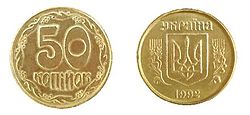
The monetary reform of 1996 is the official introduction into circulation by the constitution of Ukraine [1] (1996, Articles 99 and 102 [2] ) and other legislative acts of independent Ukraine of the new national currency - the hryvnia and its hundredth part - a penny . The essence of the reform was the denomination of devalued coupon-Carbovans at the rate of 100 thousand for 1 hryvnia. From September 2 to September 16, 1996, both monetary units circulated in circulation. The banks exchanged without restrictions and commissions until 1998.
As a result of the reform, a new monetary unit, the Ukrainian hryvnia, was created. A competent PR campaign helped to slow down inflation and had political consequences in the life of Ukraine.
Background
State independence of Ukraine was proclaimed in August 1991. The declaration of independence of Ukraine implied the need to create its own monetary unit (national currency) and its own monetary system as important conditions for political and economic independence. Since January 10, 1992, in accordance with the Verkhovna Rada ’s decree “On putting into circulation on the territory of the republic reusable coupons” ( Ukrainian, “About putting into circulation on the territory of the Republic of Bagatorazovoy vikoristannya coupons” ) of September 9, 1991, the National Bank of Ukraine was put into circulation hryvnia's predecessors - temporary banknotes that had the name of a coupon and denominated in rubles ( ukr. carbovanets ). Officially they were called Carbovans , the name coupon-Carbovans was also used, which in late 1992 was assigned the name of the Ukrainian Carbovans. Since the introduction of reusable coupons in Ukraine, two currencies have been in circulation at the same time: Soviet rubles and Ukrainian coupon-carbovans. Moreover, for payment for food and industrial goods only coupon-Carbovans were accepted for payment [3] , and for payment of goods purchased on collective farm markets and bazaars, for the payment of services and other types of payments, both the rubles of the former USSR and coupon Carbovans at the rate of one to one (1: 1). In the first months after the introduction, due to the limited circulation and high demand for coupon-carbovans (rush demand), they were valued slightly higher than Soviet rubles. Gradually, by April 1992, all cash circulation was filled up by coupon-Carbovans. In November 1992, the rubles of the former USSR were replaced by carbovans and in cashless payments . Despite the fact that the use of coupon-carbovanets in money circulation was supposed for a period of 4-6 months, they were in circulation until 1996, in fact, bearing the brunt of the inflationary blow [4] [5] [6] .
In storage in Canada and the United States were new hryvnias printed in 1992. However, high inflation forced to postpone its introduction for several years. Despite the fact that the banknotes of the new national currency of Ukraine (hryvnia) were printed in 1992, it made sense to put it into circulation only if the very high inflation rates stopped. As a result of the policy pursued by the National Bank of Ukraine , in 1993 the inflation rate exceeded 10 000%. A monetary reform under these conditions would lead to a rapid depreciation of the already printed hryvnia. Instead, an original method was proposed, which played a positive role and which was later criticized by many - linking the coupon-carbovan to the US dollar . Thus, to stabilize the situation, an administrative fixed rate was introduced and mandatory redemption of foreign currency was introduced to pay for critical imports. Gradually (over two years) it was possible to create favorable soil for the introduction of the hryvnia by bringing the commercial and official exchange rates of the US dollar as close as possible [4] .
| The cost of 1 US dollar in coupon-carbovanets by years [4] : | |||
|---|---|---|---|
| 1992 | 1993 | 1994 | 1995 |
| 208 | 4539 | 31 700 | 147 463 |
The prerequisites for the monetary reform were a slowdown in the devaluation rate, an attempt to tidy up the money supply, as well as to reassure the market and the population with promises of a stable exchange rate of the new national currency hryvnia compared to a devalued coupon. The need for the introduction of a new currency was also due to the low quality of coupon-carbovans. Bad paper, an almost complete absence of degrees of protection (only watermarks were present on the banknotes) made it possible to print fakes on color printers. In 1996 alone, 14 billion false Carbanovans were withdrawn from circulation [4] [5] [6] .
Creating New Banknotes and Coins
According to the memoirs of the author of the first banknotes of independent Ukraine, a famous Ukrainian artist and writer, People's Artist of Ukraine [7] Vasily Ivanovich Lopata , in April 1991, famous artists of the Ukrainian SSR were invited to participate in the development of sketches of the new Ukrainian currency. The sketching team included the People's Artist of Ukraine A. Danchenko, Honored Art Workers of Ukraine V. Perevalsky, Honored Artists of Ukraine V. Yurchishin, S. Yakutovich and V. Lopata himself. Work on the creation of banknotes took place under the auspices of the Verkhovna Rada of Ukraine Commission on Economic Reforms and National Economy Management, as well as the Commission on Culture and Spiritual Revival. Sketches of the banknote were considered by the Presidium of the Supreme Council under the chairmanship of Leonid Kravchuk , who approved the sketches prepared by V. I. Lopata [8] .
In 1992, in Canada, according to the sketches of V.I. Shovels , the first samples of the Ukrainian national currency were made. However, in 1992, a temporary currency designed for the transition period — the Ukrainian Carbonean, or coupon-carboanentian — was introduced into the circulation in Ukraine. It was this monetary unit during 1992-1995 that became a victim of inflation caused by the economic crisis of the transition period.
The first hryvnia banknotes were made in Canada by Canadian Bank Note Company in 1992 and were no longer printed. At the same time, new banknotes of independent Ukraine (hryvnia) in France and Italy were also printed. During the operation “Shield of Ukraine” during 1992-1993, containers with new currency under the protection of Alpha special forces were transported to Ukraine by sea and by air [9] . For the manufacture of notes, a combined technique was used - steel engraving and lithography. Subsequently, in 1994 and 1995, banknotes of the corresponding samples were issued at the Banknote and Mint of the National Bank of Ukraine. All banknotes were simultaneously put into circulation on September 2, 1996.
The first coins were minted in 1992, but only on September 2, 1996. They were made at the Mints of Italy and England, as well as at the Lugansk cartridge factory [10] [11] [12] . As a result of the reform, changeable coins with a face value of 1, 2, 5, 10, 25, 50 kopecks and negotiable coins of 1 hryvnia were introduced. The obverse of the coins shows the coat of arms and the name of the state, a floral ornament and the year of minting; on the reverse - denomination and floral ornament.
Reform Progress
According to one of the participants in the 1996 monetary reform, Viktor Suslov, about a month before the president of Ukraine signed the decree “On monetary reform in Ukraine”, a decree was secretly issued on the creation of a state commission to conduct monetary reform in Ukraine. The commission was headed by P. I. Lazarenko , the then prime minister, two deputies: the head of the National Bank of Ukraine V. A. Yushchenko and vice-premier V. M. Pynzenyk , in addition, the commission included the first deputy chairman of the National Bank V. I. Stelmakh and the head of the Committee on financial and banking activities V. I. Suslov [4] .
On August 25, 1996, President of Ukraine Leonid Kuchma signed the Decree “On Monetary Reform in Ukraine,” according to which, in order to facilitate radical market reforms and ensure the country's economy with a stable national currency, the national currency of Ukraine, the hryvnia and its one hundredth, was introduced penny [2] . On September 2, 1996, the National Bank of Ukraine (NBU) issued banknotes with a par value of 1; 2; five; ten; 20; 50 and 100 hryvnias and a small change in denominations of 1, 2, 5, 10, 25 and 50 kopecks , and also stopped issuing Ukrainian Carbovans, which were subject to exchange for the hryvnia at the exchange rate: 100 000. 100 000 carbs = 1 hryvnia. The reform was carried out in 2 weeks: from September 2 to September 16, 1996 - after the statutory deadline, the circulation of the Ukrainian carbovanets in cash circulation ceased, and the hryvnia became the only legal tender in Ukraine. Citizens of Ukraine had the opportunity to exchange coupon-Carbovans for a new state monetary unit without restrictions and without additional payment for the exchange. In accordance with the reform, from September 2, 1996, only hryvnias were issued in banks. Until September 16, both Karbovans and hryvnias were accepted everywhere for payment. Since September 16, 1996, the exchange could be made only in banks. Moreover, all banknotes withdrawn from circulation during the reform, although withdrawn from circulation, nevertheless remained (were) legal tender. The exchange procedure continued until 1998 [4] [5] [13] .
Consequences
As a result of the monetary reform of 1996, a new national currency of independent Ukraine was created, a coupon-Carbovan denomination was carried out, in addition, a competent public relations campaign of the hryvnia not only helped to slow down inflation and devaluation, but also had political consequences. Merits in its implementation were attributed to the head of the National Bank of Ukraine V.A. Yushchenko [4] [13] , putting him in the rank of the most popular politicians of the state [14] .
See also
- Constitution of Ukraine
- The first postage stamps of independent Ukraine
- Ukraine's Independence Day
Notes
- ↑ Article 99, Article 102 (Ukrainian) . Constitution of Ukraine, Law of June 28, 1996 No. 254k / 96-VR . zakon3.rada.gov.ua. Date of treatment October 14, 2017. Archived October 14, 2017.
- ↑ 1 2 About the groshova reform in Ukraine. (Ukrainian) . Decree of the President of Ukraine dated 08.25.1996 . zakon3.rada.gov.ua. Date of treatment October 14, 2017. Archived October 14, 2017.
- ↑ Postanova of the Verkhovna Rada About the introduction to the territory on the territory of the Republic of Coupons of the Bagatorazovoy Victor (Ukrainian) . The legislation of Ukraine is 09.09.1991 No. 1519-XII . zakon3.rada.gov.ua. Date of treatment November 5, 2017. Archived November 5, 2017.
- ↑ 1 2 3 4 5 6 7 Rises and falls of the hryvnia . Commander . glavcom.ua. Date of treatment November 16, 2017. Archived November 16, 2017.
- ↑ 1 2 3 History of the hryvnia on the website of the National Bank of Ukraine (in Ukrainian)
- ↑ 1 2 When Ukrainians were millionaires: 15 years ago, we introduced coupons . Today (November 9, 2007). Date of treatment November 18, 2017.
- ↑ Decree of the President of Ukraine vid 21 sickle 2001 rock No. 697 (Ukrainian)
- ↑ Vasily Lopata not only paints hryvnias, but also writes about them . Anna Yashchenko, September 29, 2007 . unian.ua.
- ↑ Vladimir Krashevsky. Professionals: Ukrainian Alpha: Terrorism Fails Archived September 23, 2015 on Wayback Machine // Bratishka magazine, June 2009
- ↑ How the hryvnia appeared . Date of treatment October 31, 2017. Archived August 22, 2011. Podrobnosti.ua
- ↑ Immigrant hryvnia. . Date accessed October 31, 2017. Mirror of the week
- ↑ Andrey Shlyakhtin. 1996 - the year of the introduction of full-fledged own currency // "24TV.UA" dated August 4, 2016
- ↑ 1 2 Hryvnia. A story of money that costs nothing . rian.com.ua. RIA Novosti Ukraine. Date of treatment November 16, 2017. Archived November 16, 2017.
- ↑ Yushchenko, Victor. Former President of Ukraine . Lenta.ru . Date of treatment November 18, 2017.
Literature
- Decree of the President of Ukraine “On the Groshova Reform in Ukraine” dated September 25, 1996 (Ukrainian) // Voice of Ukraine: newspaper. - К. , 1996. - 28 sickle. Archived on October 14, 2017. (Retrieved October 14, 2017)
- Constitution of Ukraine . - K. , 1996. (Ukrainian)
- Article 99, Article 102 // Constitution of Ukraine . - K. , 1996. (Ukrainian) (Retrieved October 14, 2017) Archived copy . Date of treatment October 14, 2017. Archived October 14, 2017.
Links
- L.V. Kovpak . Groshova reform 1996 // Encyclopedia of History of Ukraine / editorial: V. A. Smoliy et al .; Institute of History of Ukraine NAS of Ukraine. - K .: Naukova Dumka, 2004. - T. 2: G - D. - 518 p.: With ill. - ISBN 966-00-0405-2 . (Ukrainian)
- O. M. Sharov . Groshova reform // Encyclopedia of Ukraine so far : 30 vol. - K .: National Academy of Sciences of Ukraine , Shevchenko Scientific Society, Institute of Encyclopedic Studies of the National Academy of Sciences of Ukraine, 2001—…. ISBN 944-02-3354-x . (Ukrainian)