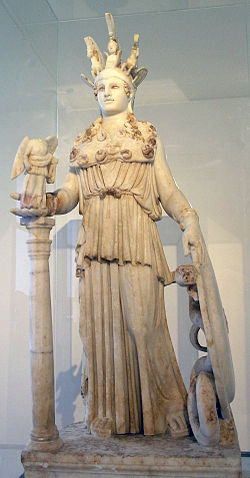
“Athena Parthenos” ( dr. Greek Ἀθηνᾶ Παρθένος - “Athena the Virgin ”) is an ancient Greek sculpture by Phidias . Creation time - 447 - 438 BC. e. Not preserved. Known for copies and descriptions.
| ||
| Fidium | ||
| Athena Parthenos . 447 - 438 years. BC e. | ||
| Ἀθηνᾶ Παρθένος | ||
| Marble | ||
| National Archaeological Museum , Athens | ||
Content
Description
Image of the goddess Athena , the patroness of the city of Athens . It was installed on top of the Acropolis, in the main temple, - the Parthenon .
Technique and Material
It was performed in chrysoelephantine (acrolite) technique (gold and ivory). Gold worth 40 (or 44) talents (about a ton ) and ivory covered the wooden frame of the statue 13 meters high. The gold used to make Athena was a significant part of the national gold reserve of the policy.
Iconography
The navigator Pausanias in his guide describes it as follows:
“Athena herself is made of ivory and gold ... The statue depicts her to her full height in a tunic to the very feet, she has the head of an ivory Medusa on her chest, in her hand she holds the image of Nika , about four cubits, and in the other hand - a spear. At her feet lies a shield, and near the spear is a serpent; this snake, probably Erichtonius . " (Description of Hellas, XXIV, 7).
The goddess's helmet had three ridges (middle with a sphinx , side with griffins ). According to Pliny the Elder , a battle with the Amazons was engraved on the outside of the shield, the struggle of the gods against the giants on the inside, and the image of a centauromachy was on the sandals of Athena. The base was adorned with the story of Pandora .
On marble copies, the hand of the goddess with Nika is supported by a pillar, whether it existed in the original is the subject of numerous discussions. Nick seems tiny, in fact, her height was 2 meters.
Hidden Trivia
- It is believed that on the shield of Athena, among other statues, Phidias placed himself and the images of his friend Pericles (presumably in the form of Daedalus and Theseus ). By the way, this turned out to be fatal for him - he was accused of insulting a deity, thrown into prison, where he committed suicide, or died of deprivation and grief (for more information about the process, see Phidias ).
“He was especially accused of portraying a battle with the Amazons on a shield, carving out his own image in the form of a bald old man who raised a stone with both hands, as well as a beautiful portrait of Pericles fighting an Amazon. He very skillfully placed his hand raising a spear in the face of Pericles, as if he wanted to hide the resemblance, but it is still visible from both sides ” ( Plutarch ,“ Pericles ”) .
- On the finger of this statue (either Zeus of Olympus or Aphrodite of Urania), Phidias immortalized the name of his beloved by writing “The Beautiful Pantark” .
Relationship with Architectural Space
The statue of Zeus at Olympia , sitting on a throne in the temple, almost touched the head of the cella ceiling, so that it seemed to the audience that if God stood up, he would destroy the temple. Athena stood to her full height, and free space remained between her helmet and ceiling. They say that in order to achieve the widest possible width of the interior, Phidius persuaded the builder of the Parthenon , Iktin , to deviate from the traditional norm of the Dorian temple and give eight columns along the facade. Another innovation was the location of the columns surrounding the statue not only on the sides, but also behind. Thus, the sculpture of Athena turned out to be inscribed in an architectural frame [1] .
Life Path of a Work
- OK. 447 BC e. Phidias receives an order and erects a statue.
- 438 B.C. e. The statue is installed in the temple.
- OK. 432-431 BC e. The enemies of Pericles accuse Phidias of having stolen part of the gold allotted for the creation of Athena. Phidias removes the gold plates (fortified in a special way), weighs them and clears the charge.
- 296 BC e. Tyrant Lachares removes gold from the statue to pay for his troops. Presumably, then this metal was replaced with bronze.
- OK. 165 BC e. Athena Parthenos suffers during a fire, but is undergoing restoration.
- is in the temple until the 5th century. n e., when allegedly dies during the next fire.
- there is also a mention of her in Constantinople approx. 10 c. n e.
The glory of a work of art
Athena Parthenos enjoyed incredible fame. In Plato’s dialogue “Hippias,” Socrates refers to Athena Parthenos to define the concept of beauty.
Copies
- The most complete and reliable copy is considered the so-called. Athena Varvakion (National Museum, Athens), marble.
- The second such copy is considered the unfinished statuette “Athena Lenormant” (Lenormant Athena) in the same museum.
- A copy of the head of the Gorgon Medusa, placed on the shield of Athena, is considered the so-called. "Medusa Rondanini" from the Munich Glyptothek .
- So-called. "Strangford Shield" at the British Museum.
- Another copy kept at the Louvre. [2]
- Another free copy at Museo Nazionale Romano, Rome. Attributed to Antioch (Antiochos).
- Athena of the Odescalchi type is considered to have developed from the Parthenos type.
- The image of the head of Athena on jewelry is a pendant from Kul-Oba.